

On Jan. 20, 2026, while discussing U.S. President Trump's stated desire to acquire Greenland, an autonomous territory of Denmark, Fox News host Jesse Watters drew online ridicule for a comment he made about the United States owning the moon (archived, archived).

Discussing Watters' remarks, one Facebook user posted a video with overlaid text reading (archived): "We don't own the moon. We can't claim celestial bodies by law. And imperialism by cable news analogy is not a foreign policy."

In a Fox News video (archived) on YouTube, Watters said on the network's "The Five" political talk show (emphasis ours):
We have to secure Greenland. It will happen. Dana is right. She's never been wrong in any of her predictions. The United States always secures our interests, economically, militarily, either by force or purchase. Louisiana Purchase. Alaska. The Philippines. We even got the Marshall Islands after World War II. You don't even know where they are, Greg. We got the moon. I think we own it. And — I know we own it.
According to the United Nations Treaty on Principles Governing the Activities of States in the Exploration and Use of Outer Space, including the Moon and Other Celestial Bodies, the answer is no to both. Celestial bodies, including the moon, are not subject to "national appropriation by claim of sovereignty, by means of use or occupation, or by any other means," according to Article II of the treaty. This essentially means that nations signing the treaty agree not to claim celestial bodies as their own.
The U.S. was one of the founding signatories of the treaty, along with the U.K. and the Soviet Union, in 1967.
As of this writing, no nation or group of nations, including the U.S., had defied the treaty and formally declared ownership of the moon. Therefore,
A broad agreement
The Outer Space Treaty (the shorter name for the 1967 agreement) started as a Cold War-era attempt to regulate nuclear weapons. Before the 1967 treaty, the U.N.'s General Assembly passed a resolution in 1963 stating that countries would refrain from introducing weapons of mass destruction into outer space.
In U.N. terms,
Alongside an agreement that the moon was not subject to "national appropriation," the Outer Space Treaty established other principles, including that space exploration "shall be carried out for the benefit and in the interests of all countries" and that the "moon and other celestial bodies shall be used by all States Parties to the Treaty exclusively for peaceful purposes."
At the time of this writing, all five nations that have so far landed on the moon —
'Moon mining' sharpens focus on lunar ownership
Questions about whether anyone can own the moon have become more urgent as spacefaring nations begin to consider the possibility of "moon mining" — the extraction of valuable resources, like water or rare earth metals, from our planet's only natural satellite.
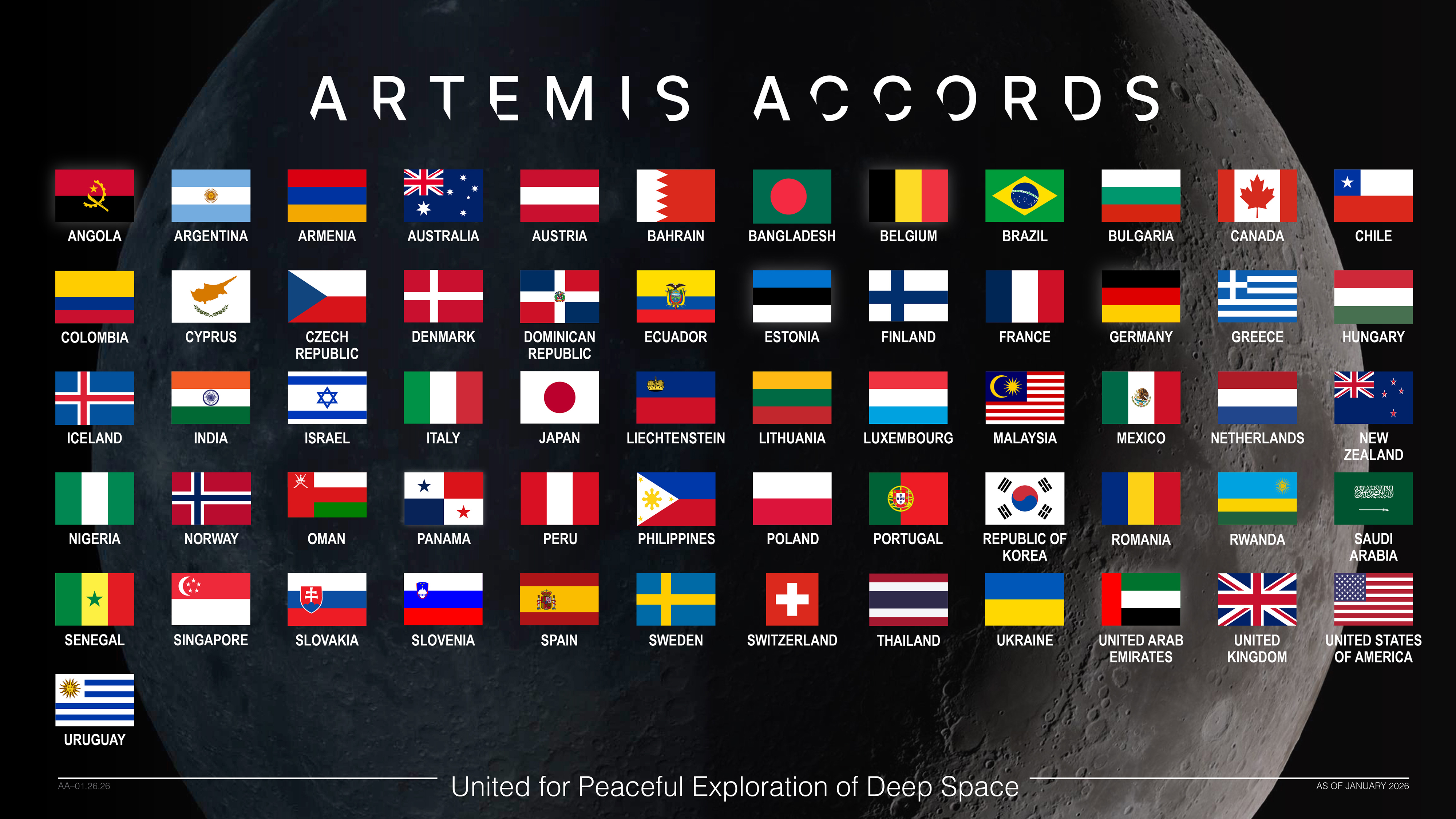
In 2020, NASA, the U.S. Department of State and seven initial signatory nations announced the Artemis Accords as part of the international Artemis program that would send humans back to the moon.
The accords built on the Outer Space Treaty but included a passage (Page 4, Section 10, Subsection 2) on "Space Resources" that reads (emphasis ours):
The Signatories emphasize that the extraction and utilization of space resources, including any recovery from the surface or subsurface of the Moon, Mars, comets, or asteroids, should be executed in a manner that complies with the Outer Space Treaty and in support of safe and sustainable space activities. The Signatories affirm that the extraction of space resources does not inherently constitute national appropriation under Article II of the Outer Space Treaty, and that contracts and other legal instruments relating to space resources should be consistent with that Treaty.
At the time of publication, the U.S., India and Japan, along with dozens of other countries, had signed the Artemis Accords, while China and Russia — the other two nations that had previously landed on the moon — had not.
Trump admin wrote space was not 'global commons'
Though the U.S. does not own the moon, the second Trump administration appeared keen to establish the nation's dominance in space.
In a Jan. 25, 2025, executive order titled "Ensuring American Space Superiority," Trump wrote that his administration aimed to establish "elements of a permanent lunar outpost by 2030." The executive order also said the administration would work to deploy nuclear reactors "on the Moon and in orbit, including a lunar surface reactor" that would be ready for launch by 2030.
During his first administration, Trump signed an executive order titled "Encouraging International Support for the Recovery and Use of Space Resources." That order read: "Outer space is a legally and physically unique domain of human activity, and the United States does not view it as a global commons." The term "global commons" refers to areas that lie outside of national jurisdiction, "such as the oceans, outer space and the Antarctic," according to a U.N. definition.
In that executive order, Trump also emphasized that the U.S. had not signed the 1979 Moon Agreement that proposed the establishment of an "international regime" to govern the "exploitation" of natural resources on the moon. As of this writing, none of the spacefaring nations who had previously landed on the moon had ratified — meaning consented to be bound by — the 1979 agreement, though India had signed it.
In conclusion, while the world's major spacefaring powers were, at the time of publication, committed to a treaty that said the moon was not subject to "national appropriation," it would ultimately be up to the signatories how long that principle would stand.