
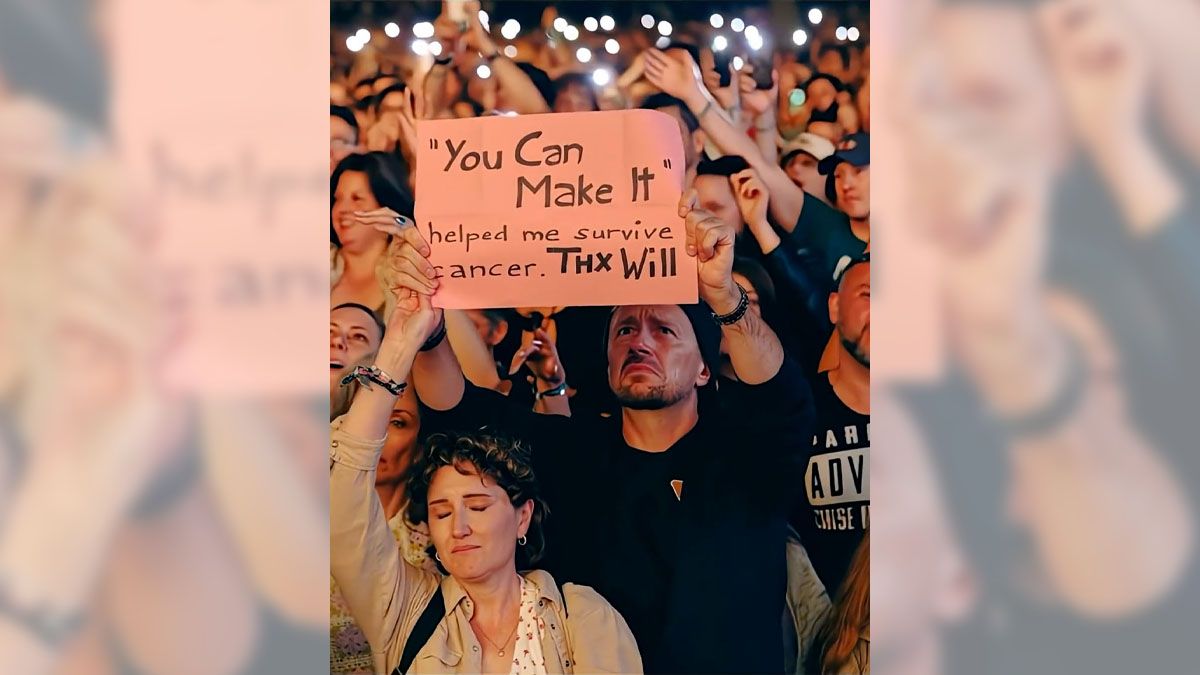
A rumor that circulated online in late August 2025 claimed Will Smith's official social media accounts shared a video showing genuine shots of the entertainer singing at one or more of his recent concerts, intercut with artificial intelligence-generated footage of completely fake, nonexistent crowds — including people with the sort of disfigured-appearing faces and bodies sometimes seen in AI-manipulated content.
At the time, Smith was busy wrapping up the remaining European dates on his "Based on a True Story" tour, several months after the March release of his new album of the same name. The rumor alleging AI-generated crowd scenes were inserted into video footage from the tour sowed skepticism about Smith's popularity.
For example, one X user's post (archived), receiving more than 9 million views, included the clip and read, "Will Smith is being accused of posting a video that features AI-generated shots of fans cheering in the crowd during his tour." Other users shared the video and claim on Bluesky (archived), Facebook (archived), Instagram (archived), Reddit (archived), Threads (archived), TikTok (archived) and X (archived), essentially alleging that Smith's concerts didn't feature large, enthusiastic crowds, and that some crowd shots depicted people who do not exist in real life.
Prominent news media outlets including CNET, Cosmopolitan, the Daily Mail, Futurism, The Independent, the International Business Times, Mashable and Rolling Stone all reported on this rumor. However, many of these sources failed to report that Smith's video depicted real people, and that the reality of the matter involved someone using AI to generate short video clips from professional-looking still images — with no visible label notifying viewers of the altered content.
Waxy.org blogger Andy Baio, who painstakingly examined the video, concluded that some of the crowd shots in Smith's video do feature AI-generated clips but also show people who truly attended Smith's concerts. Baio found genuine, professional-looking still photos matching several of the presumptive AI clips. That discovery led him to conclude someone used an AI tool to bring those still pictures to life, generating short video clips from still images.
The photo-to-AI-video manipulation, combined with YouTube's recently revealed efforts to allegedly enhance the visual quality of some YouTube Shorts with what a company spokesperson labeled as "traditional machine learning technology" — terminology some users believed to be a safe way for companies to refer to generative artificial intelligence without mentioning AI — led to users questioning the authenticity of Smith's video.
Online photos and videos showed at least some of Smith's concert dates featured packed houses with enthusiastic crowds. Those pieces of media served to dispel a narrative circulating in social media comments claiming the recording artist struggled to fill seats — a viewpoint stemming from his underperforming sales of his new album, as well as the continuing fallout from when he famously slapped stand-up comedian Chris Rock during the 2022 Academy Awards. As of this writing, Smith's final three concerts in England all displayed "sold out" messages.
Baio wrote in his investigation of Smith's video, "We can debate the ethics of using an image-to-video model to animate photos in this way, but I think it's meaningfully different than what most people were accusing Will Smith of doing here: using generative AI video to fake a sold-out crowd of passionate fans."
In an email to Snopes, Baio also added of the aforementioned news media outlets' reports, "It's frustrating that mainstream outlets were amplifying misinformation based solely on random social media posts, but to be fair, the use of AI tools here created a confusing and novel situation that I imagine was difficult for most people to parse, including professional writers."
TikTok user @showtoolsai — an account owned by a user who says in their bio they promote AI literacy — examined Smith's concert video and arrived at the same conclusion as Baio. That user added of Smith's video, "This went unnoticed for two weeks, but once it started the story blew up as part of the Will Smith spiral narrative. I think it's a better example of poor editing and oversight."
We contacted a representative for Smith to ask questions about this matter, including to find out whether Smith approved the decision to generate still images into short video clips, and will update this story if we receive further information.
On Aug. 12, someone managing Smith's social media accounts posted the in-question video on Facebook (archived), Instagram (archived) and YouTube (archived). The posts' caption read, "My favorite part of tour is seeing you all up close. Thank you for seeing me too."
As Baio noted in his story, the video begins with a genuine clip showing Smith singing his new song "You Can Make It" to a packed house, during either a July 31 or Aug. 1 concert at Théâtre Antique d'Orange in Orange, France. The video then cycles through a series of crowd shots, including at least some created by using an AI tool to turn still photos into short video clips.
One of the shots in Smith's video shows a sign essentially reading "I Will always love you," with a photo of a "Fresh Prince"-era Smith representing for "Will" and a red heart for "love."

A still frame from the inauthentic video clip displaying exaggerated, AI-generated facial expressions. (Will Smith/Instagram)
Smith's team posted the original, authentic still photo corresponding to that AI-generated clip in an Instagram slideshow on Aug. 6 — the day following his concert in Braine-le-Comte, Belgium.

An authentic photo posted to Smith's account. (Will Smith/Instagram)
The possibly AI-generated clip of a woman holding a sign reading "Take us back to Bel-Air" truly showed a real person and sign, as evidenced by a different slideshow's still picture of the same sign visible in the crowd at Smith's July 23 concert in Nyon, Switzerland.

A still image from the potentially AI-generated video clip. (Will Smith/Instagram)

This authentic photo shows the same person and sign, visible center-left, confirming they truly exist. (Will Smith/Instagram)
A later clip displaying a view of people holding up a sign mentioning "West Philly" and "West Swizzy" (for Switzerland) — including the most egregious examples of disfigured-appearing, AI-generated faces (a common characteristic of AI-manipulated crowd shots) — also originated from a still photo hosted with the same slideshow.

This specific video clip, shown here in a still frame, displayed one of the best examples of distorted faces often seen in AI-created crowd shots. (Will Smith/Instagram)

An authentic still image. (Will Smith/Instagram)
Skipping ahead a few shots, one AI-generated clip shows a man and woman holding up sign reading, "'You Can Make It' helped me survive cancer. Thx Will."

A still frame from a brief AI-generated clip during Smith's video. (Will Smith/Instagram)
Once again, the AI-manipulated video clip depicted real people. Smith's Instagram account hosted two authentic photos of the same man and woman holding the sign during his July 19 concert in Bern, Switzerland. As Baio noted in his report, the latter part of a genuine video also showed the same couple, further confirming them as people who exist in real life.

An authentic image showing two people holding a real sign about surviving cancer. (Will Smith/Instagram)

A second authentic photo of the same couple and sign. (Will Smith/Instagram)
Baio's full report features further details about the YouTube Shorts issue that helped to fan the flames of misinformation, including comparisons showing the difference in how Instagram and YouTube processed Smith's video. Essentially, YouTube processed Smith's video with a shiny-appearing, blurry finish, making the clip potentially look even more inauthentic. A YouTube spokesperson has since said the company is planning "an opt-out" for the alleged enhancement feature.
For further reading about social media rumors gone wrong, we previously examined the false and unfounded claims about the Meijer supermarket chain allegedly firing a 16-year-old autistic, food-insecure deli worker — purportedly following a company-led investigation lasting months — for supposedly taking and eating discarded food. We also reported about how the attorney for a murder suspect said unused footage for an episode of the former HBO TV series "Curb Your Enthusiasm" did not, in fact, serve as the primary factor in saving his client from prison.