
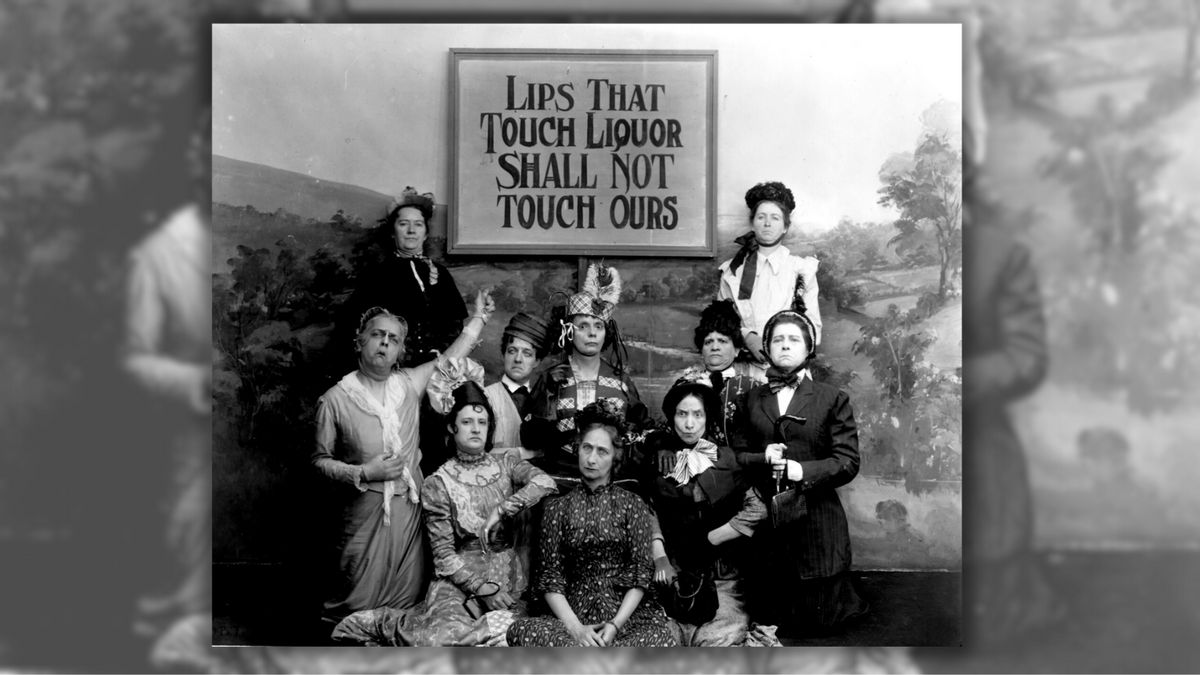
A vintage photograph some internet users purport is an authentic Prohibition-era image of women protesting alcohol consumption shows 10 women posing in front of a sign that reads "Lips that touch liquor shall not touch ours."
The image has circulated online since at least 2008, according to a reverse-image search on TinEye. Users shared the image on Reddit (archived) as far back as 2015, trying to determine its legitimacy. Users on Facebook (archived), Instagram (archived) and Pinterest (archived) have also shared it throughout the years, and copies of the photo are even available for purchase at online retailers such as eBay (archived) and Etsy (archived).
The image is also featured on several websites about Prohibition and the temperance movement, an anti-alcohol social movement of the late 19th and early 20th centuries that ultimately led to the 18th Amendment of the U.S. Constitution, which banned the sale of alcohol when it went into effect in January 1920.
However, the photograph is widely miscaptioned in its many appearances across the internet.
While the image in question does authentically depict a group of female-presenting people with a sign that reads "Lips that touch liquor shall not touch ours," it is not an authentic pro-Prohibition poster.
Rather, this image is a publicity photo promoting a 1901 silent film made by Thomas Edison's studio titled "Kansas Saloon Smashers," directed by Edwin S. Porter. The film is a satire of teetotaler women — those who abstained from alcohol — using a phrase that was coined during the temperance movement.
The photograph can be found in the archives of photo collection databases Everett and Wikimedia Commons, each citing it as a photo from "Kansas Saloon Smashers" and dated 1901.

Wikimedia Commons' caption also describes it as a "satirical photograph of teetotaler women." This description is mirrored in the photo's appearance in literary magazine Lapham's Quarterly, which describes the photo as a "film still mocking teetotallers."
The photo also appears in the photo archives of Alamy, but its webpage does not reflect an accurate date. Further, some appearances of the promotional photograph show a copyright date of 1895 in addition to the film date of 1901.
Alexandra Humphrey, director of the Edison Museum in Beaumont, Texas, told Snopes via email, "I think the copyright 1895 is actually referring to Edison's studio and not the film itself. As he showed the first film in his kinetoscope in 1894, I feel it would line up; he copyrighted his studio name around that time."
"Kansas Saloon Smashers" is available to view on the Internet Archive. However, the image in question does not appear in the film.
Charles Musser's 1991 book "Before the Nickelodeon: Edwin S. Porter and the Edison Manufacturing Company," explains: "Porter and [George S.] Fleming were turning out short films; one of the first, 'Kansas City Saloon Smashers,' was the occasion for a rare publicity still." The book features the photograph with the caption, "Publicity still for 'Kansas Saloon Smashers.'"

("Before the Nickelodeon: Edwin S. Porter and the Edison Manufacturing Company")
Further, it is probable that the women featured in the photograph are actually men in drag. According to Musser's 1994 book "The Emergence of Cinema: The American Screen to 1907":
Fleming and Porter soon established their worth with films like "Kansas Saloon Smashers (© 23 February 1901), which reenacted and burlesqued a recent news event — Carrie Nation's saloon-smashing spree in Wichita, Kansas. For the one-shot film, men in drag played many of the female roles, making the women sexually unappealing.
According to Musser, "Kansas Saloon Smashers" was originally advertised as "Mrs. Carrie Nation and Her Hatchet Brigade." Nation was a radical teetotaler who made headlines around the turn of the 20th century by attacking alcohol establishments with a hatchet. A news item in the April 16, 1901, edition of The New York Times with the headline "Mrs. Nation Barred from Kansas City" read:
Mrs. Carrie Nation, arrested yesterday charged with obstructing the street, was arraigned before Police Judge McAuley this morning, fined $500, and given until 6 o'clock this evening to leave the city. She agreed to leave town, and fifteen minutes later boarded a street car for Kansas City, Kan. The fine will be held over Mrs. Nation in case she should return, and, until she is released from the court's order, she is practically barred from visiting Kansas City.
Another piece in the Times' Aug. 19, 1901, edition followed Nation's arrival in Atlantic City, New Jersey, writing, "Mrs. Carrie Nation has come and gone, and there was not a smashing nor anything else sensational. The hopes of the crowds that she would use a hatchet upon some saloonkeeper's outfit were accordingly dashed."
The phrase "Lips that touch liquor shall not touch ours," seen in the photo, is a spin on a popular slogan connected to the temperance movement, "Lips that touch liquor shall never touch mine."
A variety of posters in the late 19th century featured versions of this phrasing, and songwriters Sam Booth and Geo T. Evans used it as the title of a musical composition they "dedicated to women's crusade against liquor throughout the world."
Though the image has been widely shared as an authentic photo of women supporting Prohibition, its origins are satirical in nature and the photo was in fact a publicity photograph for a silent film. Thus, we've rated the photo as miscaptioned.