
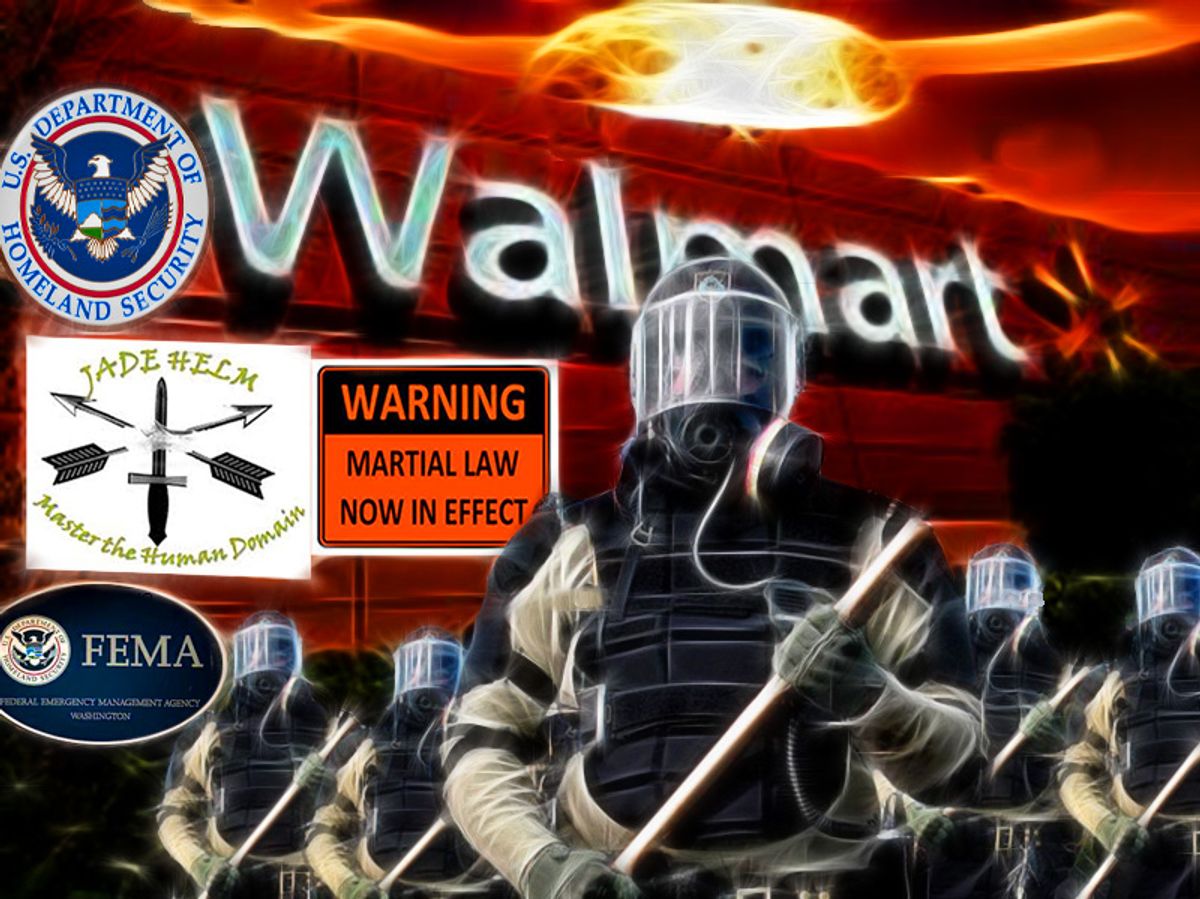
Our "Most Popular Legends of 2015" round-up catalogs the most widely read and shared items of urban legendry in 2015, but a handful of elements characterize the predominant themes of the year in rumors, misinformation, hoaxes, and other odd tales.
By many accounts 2015 was an eventful year, and frequently in an uncomfortable way. ABC's 2015 retrospective kicked off with a morose description, musing that:
From start to finish, many of this year's biggest news stories were centered around violence, terror threats or a general sense of fear.
The year began with a targeted terror strike in Paris and closed out with another planned attack in California, proving that threats around the globe remain an issue for all.
Humorist Dave Barry was slightly less measured in tone, summing up the events of the year thusly:
We apologize, but 2015 had so many negatives that we're having trouble seeing the positives. It's like we're on the Titanic, and it's tilting at an 85-degree angle with its propellers way up in the air, and we're dangling over the cold Atlantic trying to tell ourselves: "At least there's no waiting for the shuffleboard courts!"
Are we saying that 2015 was the worst year ever? Are we saying it was worse than, for example, 1347, the year when the Bubonic Plague killed a large part of humanity?
Yes, we are saying that. Because at least the remainder of humanity was not exposed to a solid week in which the news media focused intensively on the question of whether a leading candidate for president of the United States had, or had not, made an explicit reference to a prominent female TV journalist's biological lady cycle.
It's certainly true that anxiety, phobia, and a general sense of impending doom permeated 2015. January's Charlie Hebdo massacre rang in the year in an unpleasant fashion. Americans didn't need a reminder to be fearful, but the bloodshed in Paris (repeated on a larger scale that November) that bookended 2015 was a factor in what would become one of the year's most pervasive rumor topics.
ISIS
Islamic State militants (commonly called "ISIS" in the United States) were already lurking menacingly in the margins even before the January 2015 attacks in Paris. A few weeks after the Charlie Hebdo massacre, social media users spread tales that Jordan's King Abdullah II had taken it upon himself to personally secure revenge for the murder of a Jordanian pilot. People feared ISIS operatives were parked on the U.S. border with Mexico, that they planned to attack en masse on the 4th of July, that they were infiltrating car dealerships, planning shopping mall attacks, assembling a "kill list" of U.S. cities, and plotting to hit the New York City subway system.

Whatever ISIS was planning to do was rivaled by what they had supposedly done, including a widely-reported tale of ISIS operatives feeding the remains of a slain man to his mother, killing puppies, recruiting children, immolating caged children, euthanizing disabled babies and toddlers, and condemning the sight of pigeon genitalia.