
On July 9, 2024, a female X user (archived) claimed no women had ever initiated a war.
"Friendly reminder that every single war in history was started by a man," she wrote.
Her statement was a response to a post by controversial online influencer Andrew Tate — wanted in the U.K. over alleged sexual offenses, which he denies — who said on X: "Want to see cruelty? Put a female in charge."

(X account @AshleyDCan)
The X user's post had amassed more than 397,000 views at the time of this writing.
Similar posts appeared elsewhere on X, including one in November 2023. The claim also cropped up in a TikTok video and in the caption of another in 2024.
Responding to another X user who said her statement was "factually untrue," the female X user wrote: "Name one war."
Elsewhere, she said former U.S. Secretary of State Hillary Clinton was "the closest any woman has gotten" to starting a war.
Defining War
Although many of us understand what a war looks like, defining the word "war" is something academics have contemplated for centuries.
Prussian general Carl von Clausewitz tackled the definition in his war and military strategy book "Vom Kriege" ("On War"), which was published posthumously in 1832. On Page 75, he described war as "an act of force to compel our enemy to do our will."
Clausewitz compared war to "a duel on a larger scale" that could be envisioned by "imagining a pair of wrestlers" using physical force to "compel the other to do his will."
More recently, in his July 2013 book, "Modern War: A Very Short Introduction," historian Richard English expanded on this, while referencing Clausewitz, and settled on the following definition:
War could be summarized as involving heterogeneous, organized, mutual enmity, and violence between armed groups, on more than a small scale, carried out with political objectives in mind, possessing socio-political dynamics, and focused on exerting power to overcome an enemy.
Elsewhere, in Michael L. Gross and Tamar Meisels' June 2017 book "Soft War: The Ehtics of Unarmed Conflict," professor Jessica Wolfendale said three criteria must be met for war to exist:
1) There are two or more organized groups.
2) These groups are engaged in intense hostilities.
3) No party to the conflict and no other third party has the authority and ability to effectively adjudicate between the opposing sides, punish them, and otherwise maintain effective control in the arena of the conflict.
Whichever interpretation one uses, at least two sides are needed for a war to commence. Therefore, for the purpose of this article, Snopes accepted that it takes two opposing sides to "start" a war, rather than just a single, initial aggressor. Below, we included wars involving at least one female leader on either side, whether or not they initiated the first act of aggression.
Wars Started by or Involving Female Leaders
Numerous wars in history have been initiated by or involved female leaders at the outset.
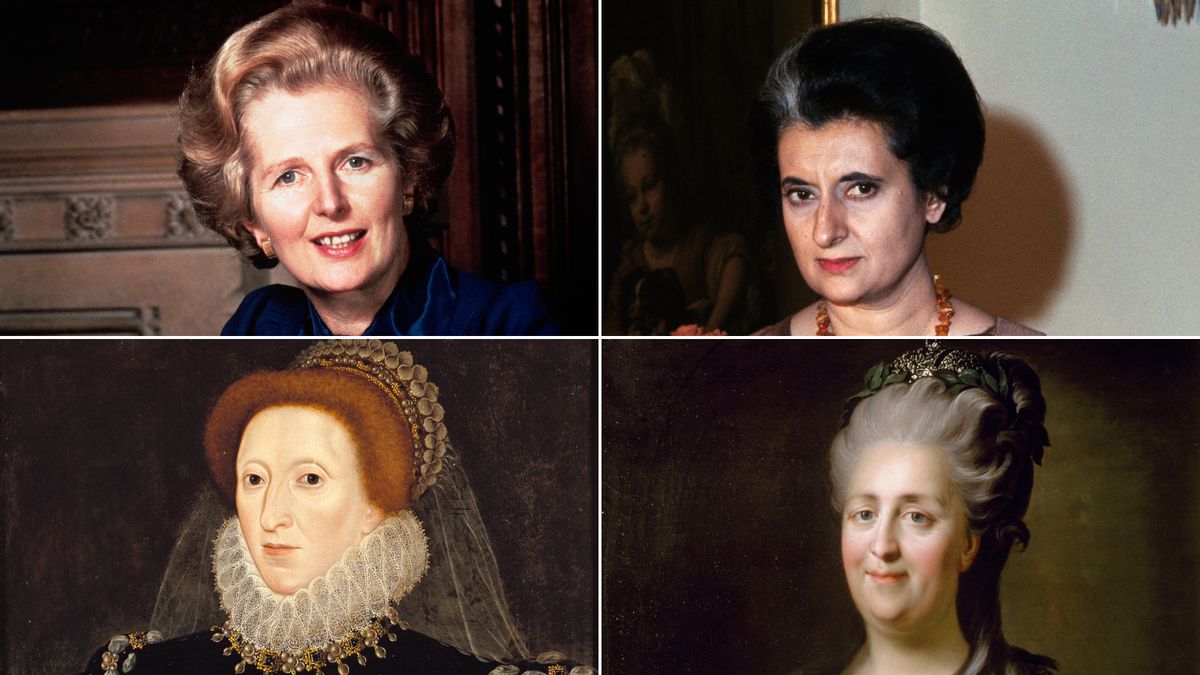
In recent history, then-U.K. Prime Minister Margaret Thatcher responded to Argentina's invasion of the Falkland Islands in 1982 by authorizing a military operation to secure the British overseas territory. The war lasted 74 days and kept the territory in British hands, although the dispute over the islands continues to this day.
In 1971, then-Prime Minister of India Indira Gandhi went to war with Pakistan for 13 days in the Indo-Pakistani War, which led to the secession of East Pakistan and the creation of the independent state of Bangladesh.
Further back, during Elizabeth I's reign as Queen of England and Ireland between 1558 and 1603, wars were estimated to have cost more than 5 million pounds at the prices of the time, according to the royal family's website. Numerous books have also been written about Elizabethan wars, such as The Anglo-Spanish War of 1585-1603 in which the Spanish Armada was defeated.
In Russia, Catherine the Great's military conquests during her 1762-96 reign have also been well-documented, such as the two Russo-Turkish wars she fought against the Ottoman Empire.
Other notable examples include:
- China's first and only female emperor Wu Zetian, who, according to The Smithsonian, oversaw "a few, victorious, wars" and "considerable expansion" during her 50-year rule.
- Palmyrene Queen Zenobia, who "seized Egypt" and "conquered much of Asia Minor" before declaring "her independence from Rome" in 269. However, she was defeated at the battles of Emesa and Immae in 272 by Roman Emperor Aurelian.
- Queen Nzinga of Ndongo and Matamba, in present-day northern Angola, who in 1627 "led an army against the Portuguese, initiating a thirty year war," according to The Open University. South African History Online, a website documenting South African and African history and culture, said Nzinga, also spelt Njinga, "personally led her armies in most of the battles they fought."
In fact, according to a National Bureau of Economic Research working paper issued in April 2017, queens in Europe between 1480 and 1913 were 27% more likely to wage war than the continent's kings, as reported in The Economist, The Cut and business news publication Quartz.