
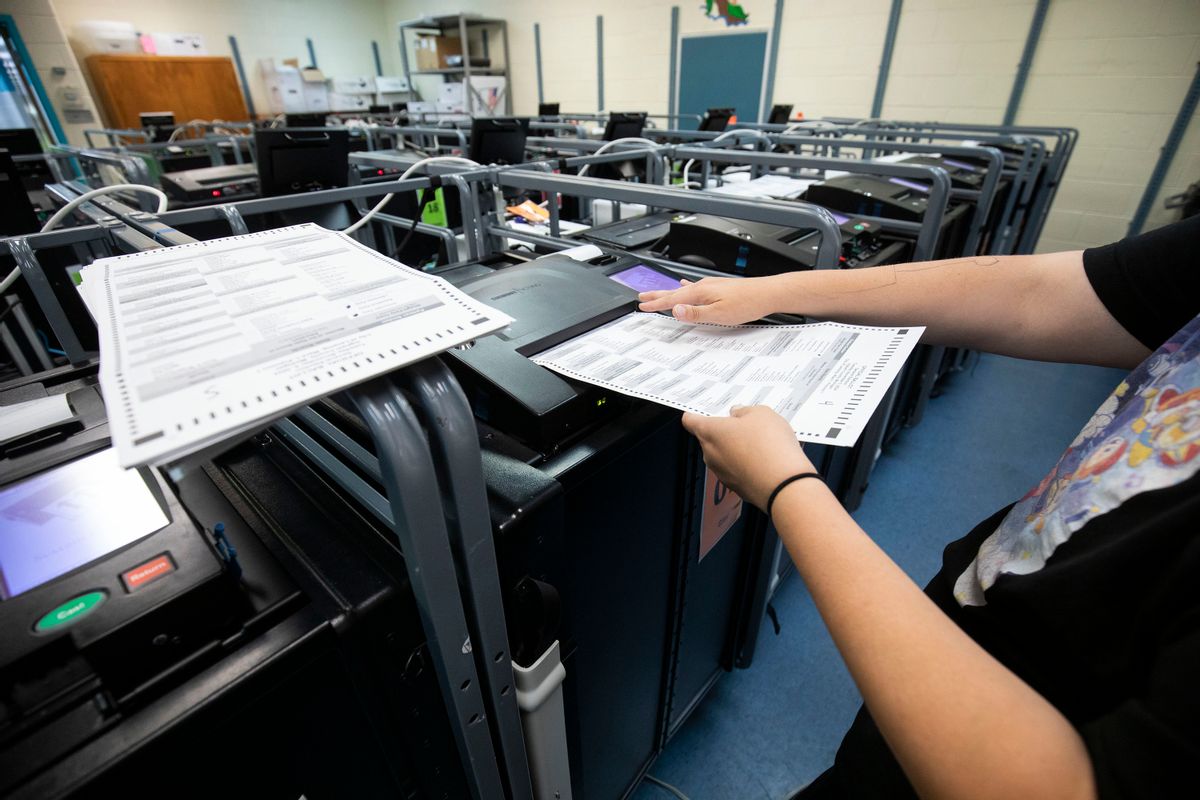
While voters in the U.S. cast their ballots for president and other candidates in November 2024, rumors spread online that final vote totals not being available yet on election night in some places means that someone was committing fraud.
One post on X (archived) by a supporter of Republican former President Donald Trump claimed that expected delays for vote totals in several swing states suggested that Democrats were "going to use those extra days to try to steal" the election for Vice President Kamala Harris:
This post, which had more than 4.7 million views and 131,000 likes as of this writing, was echoed by another, which asserted that the only reason for a delay would be "cheating" (archived):
A third post repeated that claim, using electoral counting systems from other countries, including India and France (archived):
But as we'll see, tallying votes can take time because different states follow different procedures to process and count mail-in and absentee votes. This means that delayed results are not necessarily an indicator of fraud.
Deadlines for Mail-In Ballots
While only three states (Alabama, Mississippi and New Hampshire) do not allow early voting, by 2024 all states allowed absentee and mail-in voting — at least for certain reasons. This means that 97% of voters in the U.S. had an option to vote before Election Day, either at the polls or by mail, according to the Center for Election Innovation and Research. The amount of mail-in ballots across the country has dramatically increased since 2000. However, while most states have agreed to expand access to voting, their procedures to handle mail-in or absentee ballots varied widely during the 2024 election cycle.
First, note that voters must respect deadlines to vote by mail, and those deadlines are different from state to state. For example, some accept ballots postmarked by Election Day. In other words, these ballots need not arrive by Election Day to be counted, but days after, delaying the counting. Other states, however, require mail-in ballots to arrive by Election Day. Research by the National Conference of State Legislatures showed what the rules were in different states in 2024:
- Eighteen states and the District of Columbia required that ballots be postmarked on or before Election Day (as well as Puerto Rico and the U.S. Virgin Islands, which do not have votes in the Electoral College). This group included Nevada, one of the seven so-called battleground states that will help determine the result of the election.
- The remaining 32 states required ballots to arrive by Election Day.
This means that in at least 18 states, counting would most likely not be done by the end of Election Day.
Processing and Counting Votes
After arriving, mail-in votes must be processed and then counted. Processing can include the verification of signatures, as well as the removal of ballots from envelopes and flattening, to prepare for scanning. The NCSL explains on its website that some states allow the ballots to be scanned, but poll workers do not request the tally from voting machines until Election Day, for example.
The vast majority of states (43 of them) allow processing to start before Election Day, but seven (Alabama, Mississippi, New Hampshire, Pennsylvania, South Dakota, West Virginia and Wisconsin) and the District of Columbia permit processing to start only on Election Day. Two of these states — Pennsylvania and Wisconsin — are battleground states.
As for counting, some states allow it to start before Election Day, but the vast majority do not, including most of the seven battleground states. On Oct. 22, 2024, the NCSL released an updated report showing which states can start counting before Election Day and which cannot. In this list, we have emphasized the seven battleground states:
- Twelve states allow counting to begin before Election Day: Arizona, Colorado, Delaware, Florida, Hawaii, Kansas, Montana, Nebraska, Nevada, New Jersey, Virginia and Utah.
- Twenty-three states allow counting to begin on Election Day, before polls close: Arkansas, California, Georgia, Indiana, Iowa, Kentucky, Louisiana, Maryland, Massachusetts, Michigan, Missouri, New York, North Carolina, Ohio, Oklahoma, Oregon, Pennsylvania, South Carolina, Tennessee, Texas, West Virginia, Wisconsin and Wyoming.
- Fourteen states and the District of Columbia allow counting to begin after polls close on Election Day: Alabama, Alaska, Idaho, Illinois, Maine, Minnesota, Mississippi, New Hampshire, New Mexico, North Dakota, Rhode Island, South Dakota, Vermont and Washington.
Connecticut leaves the timeline at the discretion of local registrars.
Because of these requirements and the nature of presidential elections in the U.S., it is entirely possible that the outcome of the 2024 election will not be determined by the end of Election Day. Therefore, if a delay occurs as the country tallies the votes, it will not mean that fraud has taken place.
As Snopes has reported on various occasions, rumors of systematic voting fraud in 2020 and rumors of noncitizens voting in U.S. elections have been repeatedly debunked.