
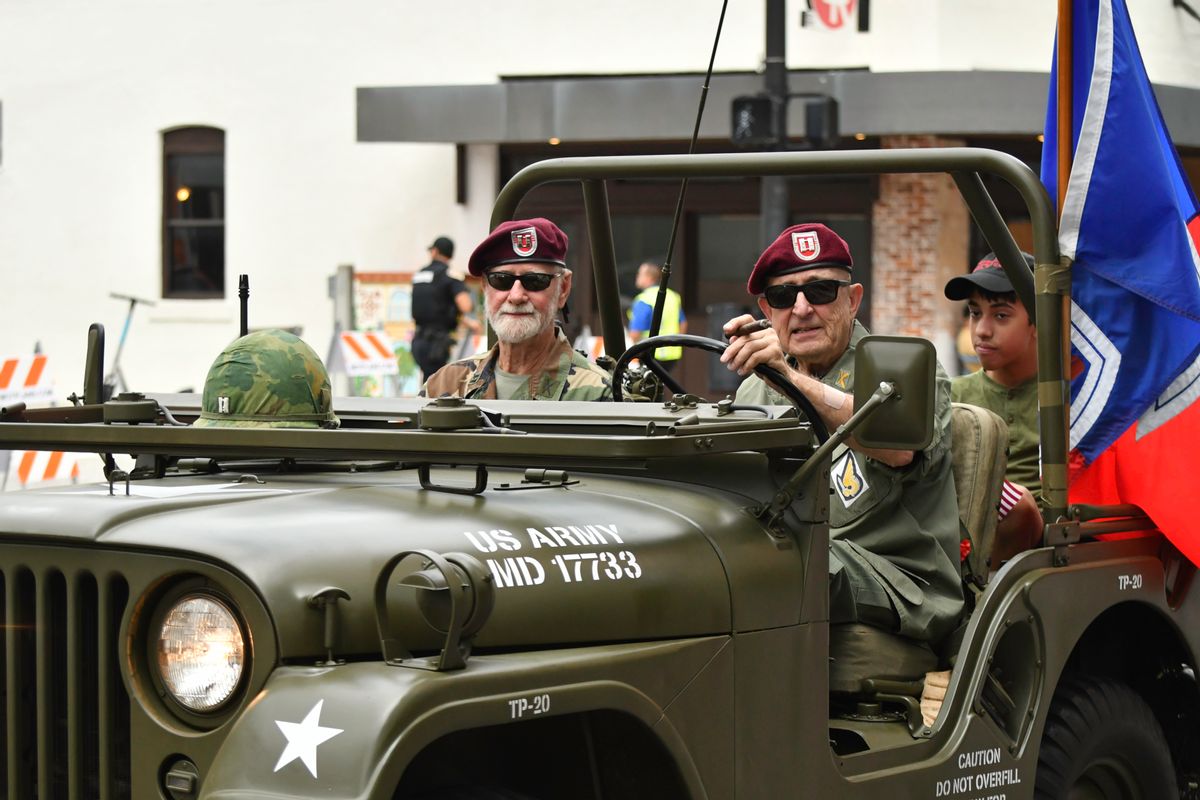
Each year on Nov. 11, the U.S. observes Veterans Day to remember and celebrate people who have served in the country's military throughout history. Then-President Dwight D. Eisenhower declared the first installment of the federal holiday in 1954, but, prior to that, Nov. 11 had been commemorated across the world for its connection to the conclusion of World War I.
The holiday was originally marked as Armistice Day in the U.S. and many other countries with memorials and celebrations marking the end of fighting in World War I. While the war officially ended when the Treaty of Versailles was signed on June 28, 1919, the cessation of most hostilities actually occurred at the 11th hour of the 11th day of the 11th month in 1918. At the time, Nov. 11, 1918, was regarded as the end of "the war to end all wars."
According to the U.S. Department of Veterans Affairs (VA), former President Woodrow Wilson proclaimed Nov. 11 Armistice Day for the first time in 1919 by saying:
To us in America, the reflections of Armistice Day will be filled with solemn pride in the heroism of those who died in the country's service and with gratitude for the victory, both because of the thing from which it has freed us and because of the opportunity it has given America to show her sympathy with peace and justice in the councils of the nations.
Then, in 1921, an unknown American soldier, who had fought in World War I, was buried in Arlington National Cemetery in Washington, D.C., which became a key site of reverence for the nation's veterans.
According to a VA document on the origins of Veterans Day:
Similar ceremonies occurred earlier in England and France, where an unknown soldier was buried in each nation's highest place of honor (in England, Westminster Abbey; in France, the Arc de Triomphe). These memorial gestures all took place on November 11, giving universal recognition to the celebrated ending of World War I fighting at 11 a.m., November 11, 1918 (the 11th hour of the 11th day of the 11th month). The day became known as "Armistice Day."
That same VA document said Armistice Day became the official name for the commemoration in 1926 following a Congressional resolution. It continued:
It became a national holiday 12 years later by similar Congressional action. If the idealistic hope had been realized that World War I was "the War to end all wars," November 11 might still be called Armistice Day. But only a few years after the holiday was proclaimed, war broke out in Europe. Sixteen and one-half million Americans took part. Four hundred seven thousand of them died in service, more than 292,000 in battle.
However, the term "Veterans Day" was first used to designate a celebration in Birmingham, Alabama, in 1947. The VA document further mapped out the term's timeline:
Raymond Weeks, a World War II veteran, organized "National Veterans Day," which included a parade and other festivities, to honor all veterans. The event was held on November 11, then designated Armistice Day. Later, U.S. Representative Edward Rees of Kansas proposed a bill that would change Armistice Day to Veterans Day. In 1954, Congress passed the bill that President Eisenhower signed proclaiming November 11 as Veterans Day. Raymond Weeks received the Presidential Citizens Medal from President Reagan in November 1982. Weeks' local parade and ceremonies are now an annual event celebrated nationwide.
A 1968 law briefly switched the date of the holiday to the fourth Monday in October, but by 1978, the country reverted back to observing it on Nov. 11 since that date continued to hold significance for veterans and Americans.