
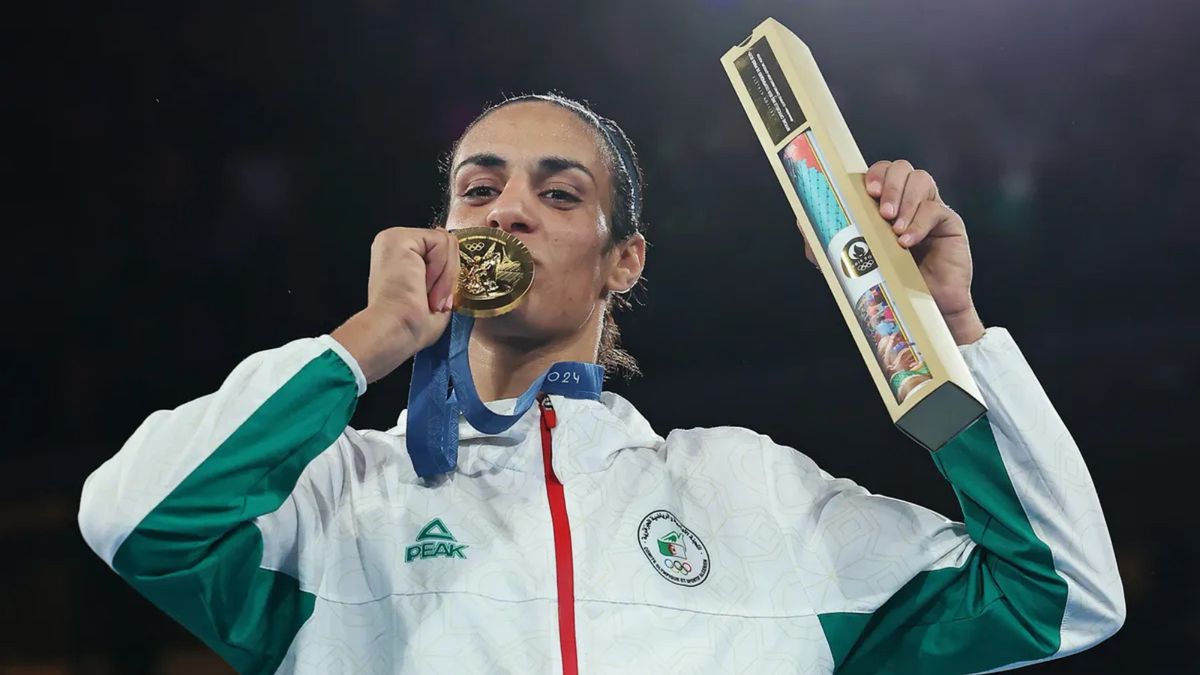
On Oct. 25, 2024, Djaffer Ait Aoudia, the independent French-Algerian journalist behind the website Le Correspondant, published what he represented to be excerpts of medical records provided to the International Olympic Committee (IOC). He claimed the records proved that the gender of women's Olympic boxing gold medalist Imane Khelif, who we've previously reported is not a trans athlete, is actually male (as translated from French by Google):
The Correspondent has poked his nose into the boxer's medical file -- the same file that the Algerian Boxing Federation and Imane Khelif are keeping safe. It comes from the tightly closed drawers of two renowned hospitals: the Kremlin Bicêtre hospital in Paris and the Mohamed Lamine Debaghine hospital in Algiers. [...]
In their report, submitted in June 2023, the two doctors, [Jacques] Young and [Soumaya] Fedala, point out, without beating around the bush, Imane Khelif's pathology: an "Alpha 5 reductase type 2" deficiency, a genetic anomaly which leads to metabolic dysfunction in testosterone and dihydrotestosterone".
This enzymatic abnormality mainly affects boys ("never girls", according to the specialists we interviewed), preventing the normal development of their sexual organs. At birth, male babies present a blind vaginal pouch and, in the absence of a good diagnosis, they are often assigned a female identity.
Conditions such as the one described above, broadly speaking, belong to a subset of congenital conditions known as disorders of sexual development, or DSDs.
As Snopes previously reported, Khelif's participation in the 2024 Paris Olympics generated controversy as it followed a 2023 disqualification by another boxing association. During the Olympic Games, one of her opponents ended a fight with Khelif early, telling reporters she had "never felt a punch like this."
Initially, IOC President Mark Adams said, in response to calls for her disqualification in Paris, that Khelif's case was "not a DSD issue." Later, Adams clarified that he meant to say that "this was not a trans issue," leaving room for the possibility of a DSD like the one alleged in Ait Aoudia's reporting.
The screenshots shown in Ait Aoudia's reporting are unverified. Snopes reached out to the doctors and hospitals associated with the alleged reports. They either did not respond or would not, as a matter of policy, confirm their authenticity or if Khelif was ever a patient of theirs. Ait Aoudia did not provide Snopes with any details of his source(s).
Even if the reports published by Ait Aoudia are authentic, however, the alleged findings have been misrepresented. If true, they would not conclusively prove that Khelif "is a man." Instead, as Snopes explains here, they would highlight the reality that, from a scientific standpoint, gender is not actually as binary as some suggest it to be.
Independent Confirmation of Medical Reports?
Nobody in a position to independently verify these documents or their findings has done so. As alleged confirmation of Ait Aoudia's reporting, other media outlets have pointed to an interview with a member of Imane's medical team, French physiologist Georges Cazorla, conducted by the French news outlet Le Point in August 2024.
In that interview, Cazorla — an academic adviser of one of Khelif's trainers — spoke of the trauma Khelif went through after her 2023 disqualification. He said that the testing Khelif's team conducted after her disqualification confirmed that Khelif was a woman, but that she had a problem with chromosomes and high testosterone (translated from French):
After the 2023 World Championships, where she was disqualified, I took the lead by contacting a renowned endocrinologist from the Parisian University Hospital, Kremlin-Bicêtre, who examined her. He confirmed that Imane is indeed a woman, despite her karyotype and her testosterone level. He said: "There is a problem with her hormones, with her chromosomes, but she is a woman."
That's all that mattered to us. We then worked with a doctor based in Algeria to monitor and regulate Imane's testosterone level, which is currently within the female norm. Tests clearly show that all her muscular and other qualities have been diminishing since then. Currently, she can be compared on a muscular and biological level to a woman.
Cazorla referenced the same Dr. Young whose signature appears to be affixed to one of the two screenshots published by Aoudia. Reached by Snopes, Cazorla did not confirm the authenticity of either of the screenshots. Asked if he felt as though Ait Aoudia's interpretation of the alleged reports was fair, he declined to comment.
Taking Cazorla's statements from August at face value, they make two crucial assertions: that Khelif has XY chromosomes and that she has high testosterone levels. This is consistent with, but not confirmation of, a deficiency in alpha 5 reductase type 2, as described in the unverified medical reports.
Androgen Insensitivity Syndrome and Gender
Ait Aoudia's reporting alleged that Khelif has a form of Androgen Insensitivity Syndrome (AIS). This DSD, which can range from partial to complete insensitivity, affects people with XY chromosomes but who, due to an inherited genetic mutation, are unable to process or react to the hormone androgen. Insensitivity to androgen affects the process responsible for determining sex during fetal development.
From a developmental standpoint, turning a fetus into a male is a two-step process initiated by the presence or absence of a gene, SRY, located on the Y chromosome. This gene instructs the fetal gonad tissue to form into testes. In the absence of this gene, the gonad tissue typically develops into ovaries.
The second step occurs as a result of the developing testes. As they develop, they produce a large amount of androgens in addition to a suite of chemicals that suppresses the development of some parts of the female reproductive system.
Those androgens, as described by Pulitzer Prize-winning science journalist Natalie Angier in her book "Women: An Intimate Geography," typically "sculpt the primordial genital buds into a penis and scrotum." Fetuses developing with AIS, however, are impervious or insensitive to the androgen their newly forming testes create.
In fetuses with AIS, the nascent genital tissue does not react to the androgens that "sculpt" a penis and scrotum, but it still reacts to the chemical that suppresses the development of some female anatomy.
As a result, individuals with AIS are usually determined to be female at birth based on the presence of a vagina and the lack of a penis. In her book, Angier described such a case — an individual pseudonymously named Jane Carden:
If Jane's mother had had amniocentesis while pregnant with Jane, and if she wanted to know the sex of the baby, she would have been told, It's a boy. [...] And then, when the baby was born, the mother would have been told, disregard the previous announcement, it's a girl.
Jane has the external genitals of a girl: outer labia, clitoris, and vagina. She has no inner labia, though, and her vagina is short, extending to only about a third the length of a normal vagina. It ends abruptly in a kind of membrane, rather than leading to a cervix that serves as the gatehouse to the womb.
She has no uterus or fallopian tubes. She used to have testes in her abdominal cavity, but they herniated noticeably downward into her pelvis and so were removed ten days after her birth. The excised testes were her "twisted ovaries."
There are numerous potential genetic causes of AIS that produce a range of differing outcomes from partial to complete androgen insensitivity. A defect in the ability to produce 5a reductase type 2, as Ait Aodia's reporting claims Khelif has been diagnosed with, is one such genetic cause. The chemical is responsible for transforming testosterone into dihydrotestosterone, a hormone that plays a role in male sexual development.
Most people do not become aware of such a disorder until later in life. DSDs involving AIS are, on average, diagnosed at age 17. To treat this condition later in life, patients with AIS can take drugs that break down testosterone and receive surgery to remove internal gonads — two procedures Khelif's doctors allegedly recommended for Khelif's treatment in the allegedly leaked medical file.
According to the alleged medical files produced by Ait Aoudia, Khelif had testosterone levels that well exceeded that of a typical female and, upon examination, lacked ovaries and had internal gonads.
Such a person might be considered chromosomally male, but that does not necessarily mean they are
Viral Headlines
Ait Aoudia's reporting in Le Correspondant went beyond a sober description of an alleged set of medical tests indicating a case of AIS. It included the addition of the terms "micropenis" and "testicles," and its conceit that chromosomal sex is the ultimate determinant of gender erases the reality of DSD individuals. His report followed two earlier (and since deleted) attempts to generate attention for his alleged scoop.
In the October iteration, Ait Aoudia described the contents of the alleged report from the Parisian hospital with headline-generating terms originating as editorial asides (highlighted by Snopes in bold) that painted his or his sources' own speculation as settled scientific interpretation:
Results? The pelvic MRI shows "an absence of a uterus," the presence of "gonads in the inguinal canals" (testicles in her abdomen, editor's note), "a blind vagina" and a micro-penis in the form of "clitoral hypertrophy ".
Despite not being included in the alleged report, the words testicles and micro-penis caught the attention of the far-right, anti-trans website Reduxx, whose reporting on Ait Aoudia's findings went viral on X this way:

"A shocking new development has emerged in the case of Algerian boxer Imane Khelif," Reduxx wrote on Nov. 4, 2024, "after a French journalist reportedly gained access to a damning medical report revealing Khelif has 'testicles.'"
Even though the words testicles and micropenis did not appear in the alleged medical report uncovered by Ait Aoudia, both words were included as direct quotes in Reduxx's reporting, either in its headline or in its social media promotion.
Describing undeveloped internal gonads as testes is a scientific conclusion inserted by Ait Aoudia. DSDs can sometimes cause ambiguous gonads with both ovarian and testicular tissues. Clitoral hypertrophy — an enlarged clitoris — is not necessarily the same thing as having a micropenis.
Most significantly, however, the reporting by Ait Aoudia and Reduxx forces a chromosomal definition of gender that ignores the reality of people with DSDs. There are several medical conditions, including cases of phenotypic males with XX chromosomes, in which a chromosomally determined gender does not match the biological or hormonal characteristics of that gender.
In other words, there are several ways to define gender. In most cases, any of these definitions would agree with each other. In a small population of individuals, however, these definitions can be in conflict. In these cases, it is not accurate to describe a single form of medical testing as "proof" of someone's gender.
Khelif has reportedly filed a legal complaint with French authorities over the online harassment she faced in response to these and other claims. The IOC stated in early November that it was aware she planned further legal action. As reported by The Guardian:
An IOC spokesperson said: "We understand that Imane Khelif has taken legal action against individuals who commented on her situation during the Olympic Games Paris 2024, and is also preparing a lawsuit in response to the latest reporting.
"The IOC will not comment while legal action is ongoing, or on media reports about unverified documents whose origin cannot be confirmed.
Reduxx reported that Ait Aoudia plans on suing Khelif and Khelif's attorney over their rejection of his reporting. Asked by Snopes if he had made any progress with the filings, he told us by email that he had not yet initiated any lawsuit but was still planning to.
The Bottom Line
The photographs and excerpts published by Ait Aoudia and alleged to be from Khelif's medical file are unverified. Even if accurately excerpted, however, the findings he describes have been distorted by editorializations that helped drive the story to virality.
This article contains additional reporting by Anna Rascouët-Paz.