
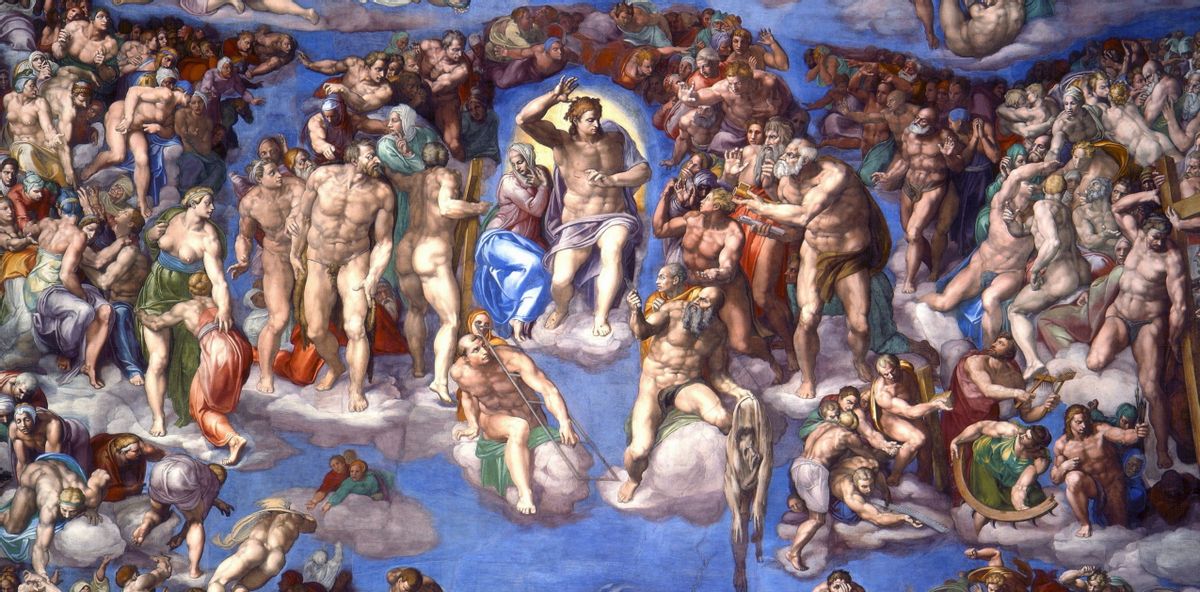
For years, a rumor circulated online that Michelangelo Buonarroti, one of the most renowned artists of the Renaissance, painted an image of Jesus based on his alleged lover, Tommaso de' Cavalieri (or Tommaso dei Cavalieri).
How exactly true is the claim about the Jesus most christians worship mostly being the one painted by Michelangelo, which is actually a picture of Tommaso de Cavalieri, his lover?
byu/ThatOneBlackGuy123 inChristianity
"How exactly true is the claim about the Jesus most christians worship mostly being the one painted by Michelangelo, which is actually a picture of Tommaso de Cavalieri, his lover?" one Reddit user asked. Similarly, a Quora user asked: "Is it true that the portrait image of Jesus that we see in museums is based on the one painted by the artist Michelangelo which was a portrait of his boyfriend?"
The rumor also spread on TikTok, where one user wrote: "Just sitting in a church Realizing ALL churches Are worshipping Micheal Angelos Gay Lover As the representative Of Jesus."
However, the claim that Michelangelo's depiction of Jesus was based on his alleged lover lacks historical substantiation.
Was Michelangelo Gay?
Michelangelo's relationship with de' Cavalieri, a young Roman nobleman, has long intrigued scholars and the public alike.
"Tommaso became the object of Michelangelo's affection, his muse, and the inspiration for letters, numerous poems, and various works of visual art. The two would remain devoted friends until the artist's death in 1564," A. Victor Coonin, a scholar specializing in Italian Renaissance art, wrote in a research paper titled "Beyond the Binary: Michelangelo, Tommaso de' Cavalieri, and a Drawing at Windsor Castle."
Additionally, Anna Swartwood House, an assistant professor of art history at the University of South Carolina, told us via email: "Michelangelo certainly expressed love and desire for Tommaso de' Cavalieri, for whom the artist made a famous series of drawings in the early 1530s. But these drawings all have mythological or secular (not Christian) subjects. Michelangelo also wrote sonnets declaring, for example, that he remained 'the prisoner of an armed cavalier,' alluding to Cavalieri's name."
Importantly, some argue that while Michelangelo exhibited signs of same-sex attraction through his poetry and relationships, applying more modern labels such as "gay" or "homosexual" to a 16th-century figure can be misleading because of different cultural understandings of sexuality at that time.
Jesus as Painted by Michelangelo
Posts spreading the in-question claim did not reference any specific depiction of Jesus, keeping the statement vague. One of the most recognized of Michelangelo's representations of Jesus Christ is "The Last Judgment," a monumental fresco painted between 1536 and 1541, located on the altar wall of the Sistine Chapel in Vatican City:

(Getty Images)
Michelangelo's other significant works featuring Jesus include the "Pietà," which portrays Jesus in Mary's arms after the crucifixion.
However, there is no documented historical evidence that Michelangelo based any depiction of Jesus specifically on de' Cavalieri. William E. Wallace, professor in the department of
"The claim that the source of this archetype is Michelangelo is incorrect," said Linda Wolk-Simon, a visiting professor at the Institute of Fine Arts at New York University who specializes in European art of the 15th to 19th centuries and specifically on the Italian Renaissance. "Jesus was portrayed in this general way by earlier artists like Botticelli and Leonardo among many others." Wolk-Simon also noted the assertion that spread online lacks clarity about which depiction of Christ it refers to. For example, it can't be the "Pietà," which was completed long before Michelangelo met de' Cavalieri, making such an inspiration impossible. But no credible evidence supports the claim for Michelangelo's later works, either.
"Given the absence of any contemporary sources making this claim about Michelangelo the (sacrilegious) idea that he would have used the male object of his desire (whether it was required or consummated love is debated) as an actual model for the Savior is anachronistic and dubious," Wolk-Simon said.
She also pointed out that Michelangelo's feelings for de' Cavalieri were a private matter, not something he would publicly display, especially in a religious context where homosexuality was condemned by the church.
Dan McClellan, an American biblical scholar, also debunked this claim in a YouTube video, stating that "there's absolutely no truth to this story." McClellan underscored that Michelangelo's art did not break from the tradition of how Jesus was depicted.
In fact, the image of Jesus as a white, European-looking figure emerged long before Michelangelo's time, evolving over centuries, and European Renaissance artists inherited and subtly reinterpreted established conventions.
Finally, no credible visual evidence links de' Cavalieri to any depiction of Jesus by Michelangelo. "It is impossible to prove, since there is no certain portrait of Tommaso as a young man," art critic and author of "Michelangelo: His Epic Life" Martin Gayford told us via email. "Therefore we do not know what he looked like. Nor would it fit Michelangelo's approach to art to give the features of a living person to a holy figure, especially Christ."