
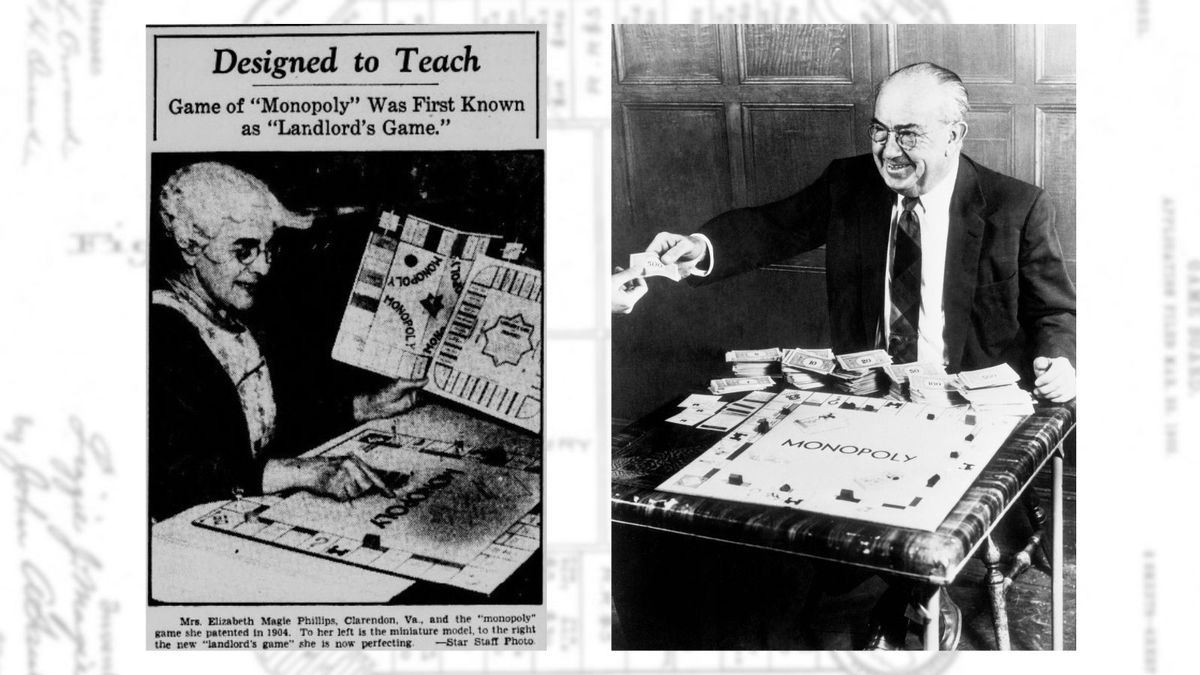
In a set of Monopoly rules published by Hasbro (archived), the company that distributes the popular board game, the story of the game's invention goes like this:
In 1934, Charles B. Darrow of Germantown, Pennsylvania, presented a game called MONOPOLY to the executives of Parker Brothers. Mr. Darrow, like many other Americans, was unemployed at the time and often played this game to amuse himself and pass the time. It was the game's exciting promise of fame and fortune that initially prompted Darrow to produce this game on his own. With help from a friend who was a printer, Darrow sold 5,000 sets of the MONOPOLY game to a Philadelphia department store. As the demand for the game grew, Darrow could not keep up with the orders and arranged for Parker Brothers to take over the game.
But the legend Hasbro tells about Monopoly overlooks a few important details — including the contributions of Elizabeth Magie, the woman who invented the first version of Monopoly, which she called The Landlord's Game.
Social media users sought to correct the record on X (archived) and Facebook (archived):
Much of the information shared in these posts is accurate. Patents issued in 1904 and 1924 credit a game-board design to "Lizzie J. Magie" and "Elizabeth Magie Phillips," years before the 1934 tale from Hasbro begins. The patents share many similarities to modern Monopoly, including rules about paying rent and earning wages each time a player moves around the board. While the "two sets of rules" referenced in social media posts have been reported by numerous reputable news outlets, including The Washington Post, Snopes was unable to independently verify their existence.

An image of "The Landlord's Game" from Magie's 1904 patent (left) and from her 1924 patent (right). (U.S. Patent Office )
Magie's 1904 and 1924 patents do not include two sets of rules. There are some references online to a version of Magie's game published in 1932 that allegedly included the "Prosperity" rules, but we weren't able to independently verify this. According to a website run by Thomas Forsyth, reportedly a private collector of Landlord's Game material, the 1932 game was published under Magie's 1924 patent by The Adgame Company with the two sets of rules.
Forsyth did not return a request for comment from Snopes, as of this writing, but we're including this because Forsyth's website was referenced by reputable experts such as journalist Mary Pilon, who wrote "The Monopolists: Obsession, Fury and the Scandal Behind the World's Favorite Board Game." Snopes will update this story if we hear back from Forsyth.
According to Pilon, much of Magie's story came to light through court documents and depositions from a case known as Anti-Monopoly, Inc. vs. General Mills Fun Group, Inc., which began after the Parker Brothers sued an economics professor, Ralph Anspach, over a game he made called "Anti-Monopoly."
Per "The Monopolists," that court case included a deposition from a friend of Darrow, Charles Todd. Snopes could not independently verify the deposition; Pilon told Snopes the book took five years of research and involved scouring "libraries, census records and other sources" to vet the information in it. (Pilon also provided Snopes with a free review copy of her book.)
Todd described teaching a modified version of Magie's game to Darrow, who later asked for a written set of rules and eventually sold the game to the Parker Brothers, which is where Hasbro's version of the story comes from.
In 1936, Magie spoke to The Washington Post and The Evening Star about creating the game before Darrow sold it to Parker Brothers. The Evening Star reported she sold her patent rights to Parker Brothers in November 1935 for $500 and no royalties.
Magie's 1904 patent also clearly stated the intention of her game long before Darrow came along:
The object of the game is to obtain as much wealth or money as possible, the player having the greatest amount of wealth at the end of the game after a certain predetermined number of circuits of the board have been made being the winner.
Was 'The Landlord's Game' a Critique of Capitalism?
Some social media posts note that Magie's game originally critiqued income inequality, like this one on X (archived):
Hasbro, who owns the rights to Monopoly, has gone to great lengths to conceal that it was invented in 1903 by a leftist Georgist named Elizabeth Magie, out of her frustration with the grotesque income inequality of her time.
Magie originally called it "The Landlord Game." https://t.co/QSF1xTW2Nb— Lee Hepner (@LeeHepner) April 11, 2024
Other online users called Magie's game "anti-capitalist" or a "critique of capitalism," such as this post on X (archived):
this man single-handedly inciting a class war through messaging like this is fascinating. monopoly is intended to be an anti-capitalist game demonstrating the negative impacts of economic privilege & private monopolies. https://t.co/t9vpHVuwbW
— kemi marie (@kemimarie) December 8, 2024
It's true Magie had progressive ideals. She was a Georgist, according to Pilon's book, which meant she believed in the economic theories of Henry George, a proponent of the "single tax" or "land value tax." George believed individuals should own everything they made or created, but land should belong to everyone — and as such, if people wanted to own land, that land should be taxed. All other goods were meant to remain untaxed.
Magie also explains her rationale for creating the game in her 1924 patent (emphasis is ours):
The object of the game is not only to afford amusement to the players, but to illustrate to them how under the present or prevailing system of land tenure, the landlord has an advantage over other enterprises and also how the single tax would discourage land speculation.
Her 1904 patent includes an illustration of her game board with "LABOR UPON MOTHER EARTH PRODUCES WAGES" written on it, a reference to George's views, according to "The Monopolists."
Whether Magie's board game can accurately be called "anti-capitalist" depends on your interpretation of George's views.
For example, in his book "Henry George and the Crisis of Inequality," history professor Edward T. O'Donnell called George's views a critique of "laissez-faire" capitalism, an economic theory opposing government intervention in the market. But a philosophy professor at Auburn University, Robert V. Andelson, said in a 2004 address that George's views incorporated tenets of both capitalism and socialism:
George considered himself a purifier of Capitalism, not its enemy. He built upon the foundations laid by the classical economists. The skeleton of his system was essentially Capitalist. In fact, Karl Marx referred to George's teaching as "Capitalism's last ditch."
Thus, it's true that Magie existed and the story Hasbro and the Parker Brothers tell about Monopoly's origins is missing her contributions — but some of the details described online about the popular board game's history are difficult to verify or are more nuanced than they appear.