

In January 2025, Snopes readers started searching our site for information about a rumored outbreak of human metapneumovirus, or HMPV, in China.
They weren't the only ones looking. Google Trends data showed an uptick in searches for HMPV starting in December 2024. On Jan. 7, 2025, related queries like "china hmpv" and "china virus hmpv" were also rising in the searches, according to Google Trends
News articles discussing the virus also circulated in the U.S., the U.K., Indonesia and India and in Chinese-owned media.
According to the U.S. Centers for Disease Control and Prevention, HMPV is a virus that spreads from person to person and can cause upper and lower respiratory diseases including bronchitis and pneumonia. The virus mostly affects young children and older adults, the CDC said.
Though reports of an increase in cases have caused concern online, Chinese officials said on Jan. 3 that the spread of seasonal viruses such as HMPV appears "to be less severe and spread on a smaller scale compared with the previous year." HPMV figures for the last week of 2024 released by the Chinese Center for Disease Control and Prevention and referenced by the World Health Organization show positivity rates in tests slightly higher than similar figures from the U.K. and U.S. The CDC in the U.S., experts from the U.K. and India and the WHO all said the reports from China were not currently a cause for concern and within the normal range for the season.
According to the CDC's National Respiratory and Enteric Virus Surveillance System, 1.94% of tests carried out in the U.S. for HMPV were positive in the week leading into Dec. 28, 2024. In the U.K., in that same week, 4.5% of tests were positive according to the U.K. Health Security Agency data dashboard. Neither of the datasets showed how many tests were carried out.
The Chinese CDC figures showed that among nonhospitalized patients tested for flulike illnesses in the week ending Dec. 29, 2024, 6.2% of tests for HMPV came back positive. For hospitalized patients, the positivity rate was 5.4%. Similarly to U.S. and U.K. data, the data released by the Chinese CDC did not contain information about how many tests were carried out. The increase in cases could be seen in a graph released by the Chinese CDC, with HMPV illustrated by the pink line. The graph shows that cases of HMPV started rising in about October (calendar week 42).
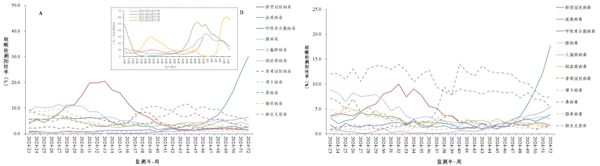
Chinese positivity rates for respiratory illnesses, with HMPV in pink. Nonhospitalized patients are on the left, and hospitalized patients on the right. (Chinese Center for Disease Control and Prevention)
Videos of Full Hospitals Fueled Pandemic Concerns
On Dec. 27, 2024, China Daily, a news outlet owned by the publicity department of the ruling Communist Party in China, published a report titled "Peak season for respiratory illnesses continues." The article quoted an official from the Chinese CDC as saying that the positivity rate of RSV and HMPV was rising, though "the spread of respiratory pathogens this winter has been less intense compared to the last peak season." International reports followed, some accompanied (archived) by unverified videos (archived) which outlets and social media users claimed showed hospitals in China overwhelmed by flu and HMPV cases.
The Chinese government commented on the situation during a Foreign Office news conference on Jan. 3. Spokeswoman Mao Ning said:
Respiratory infections tend to peak during the winter season in the Northern Hemisphere. Recently, the National Disease Control and Prevention Administration of China held a press conference to share information about the prevention and control of respiratory diseases in China during the winter time. The diseases appear to be less severe and spread on a smaller scale compared with the previous year. I can assure you that the Chinese government cares about the health of Chinese citizens and foreigners in China. It is safe to travel in China.
The statement that the spread of cases was not a cause for concern was also agreed upon by experts in countries including the U.S., India and the U.K.
India's director-general of health services, Dr. Atul Goel, told Indian media on Jan. 3 that numbers in India were not out of the ordinary.
I want to request the public to take general precautions, which means, those who have cough and cold should prevent coming in contact with other people to prevent the spread and take normal medicines prescribed for cold and fever. … Otherwise, nothing to be alarmed about the present situation.
The Science Media Centre in the U.K., a body that offers expert comment to journalists on a variety of scientific topics, published a collection of commentary on HMPV "following media reports about cases in China" on Jan. 6. Professor Peter Openshaw, known in the U.K. for his role on the government's Scientific Advisory Group for Emergencies during the COVID-19 pandemic, said a rise in infections had been seen in both China and Europe, and was likely not a cause for concern.
Openshaw and Dr. Claudia Efstathiou, both from Imperial College London, said:
More information is always helpful, but there is no evidence so far that what's being seen in China is much different from what's being seen in Europe. It seems that it's the summation of several common winter viral infections rather than a new or unknown virus.
Similarly, a CDC spokesperson in the U.S. said in a statement:
CDC is aware of reported increases of HMPV in China and is in regular contact with international partners and monitoring reports of increased disease. These reports are not currently a cause for concern in the U.S.
HMPV was discovered in 2001, according to the CDC, and is in the same family of viruses as respiratory syncytial virus (RSV) that is common in young children.
Symptoms of HMPV include cough, fever, nasal congestion and shortness of breath. Doctors can test for HMPV. However, there is no direct treatment, nor is there currently a vaccine. Prevention measures include hand washing, cleaning surfaces and staying home when sick, CDC guidelines said.