
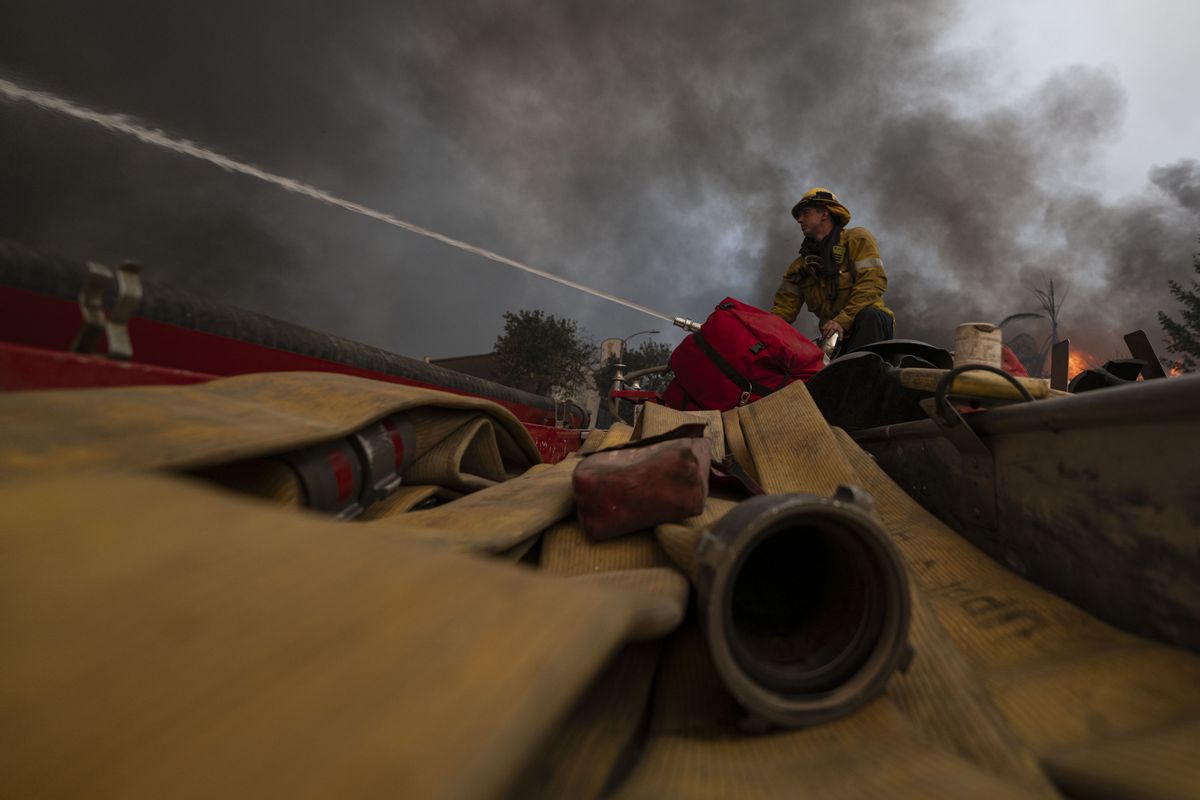
As wildfires raged across Los Angeles County in early January 2025, a persistent rumor claimed Los Angeles Mayor Karen Bass — whose city accounts for about 40% of the county's population — had cut the city's fire department budget. The Los Angeles Fire Department serves the city, while the LA County Fire Department attends to the needs of millions more residents in the county.
The rumor about Bass gained steam when fact checks from outlets including Newsweek and Verify, as well as reports from The New Republic, Fox News and the New York Post, highlighted a document appearing to show a reduction of around $17.6 million from the LAFD budget.
One popular post (archived) making the claim on X read, "The city of Los Angeles under Karen Bass slashed the firefighting budget by about $18 million and stopped filling fire hydrant reservoirs as a cost cutting measure." (We previously reported about the rumor about fire hydrants running out of water, adding the clarifying context that hydrants alone do not generally contain the capacity for large-scale firefighting, according to officials. Also, when firefighters lost water supply from some hydrants in Pacific Palisades, water still remained available in the area by other means.)

Our research indicated that, while city documentation did show a year-over-year fire budget reduction, one key factor influenced the decrease. At the time, a different budget held some funds for salaries, related to ongoing salary negotiations between the city and a firefighters' union. In November 2024, the Los Angeles City Council approved a plan adding approximately $76 million to the fiscal year's budget total. In other words, year-over-year figures showed a budget increase of well over $53 million — not a decrease of $17.6 million. Some of the aforementioned news media outlets mentioned this fact late in their stories but also featured headlines and other elements that did not help to inform readers.
At the same time, while one document showed Los Angeles Fire Chief Kristin Crowley explaining the budget decrease, months later in another document she informed the city's Fire Commission of her concerns about the "elimination of critical civilian positions" and a $7 million reduction in overtime hours. The latter memorandum mentioned fighting wildfires as one of several areas of possible negative impact related to her concerns. In other words, this rumor was complex and did not lead to a simple, straightforward answer.
We reached out to the Los Angeles mayor's office and the LAFD and will update this story if we get more information.
The Facts About This Rumor
The rumor of Bass cutting $17.6 million from the Los Angeles budget originated from a lengthy city document from July 2024, titled "Detail of Department Programs: Supplement to the 2024-25 Adopted Budget." The document described the adopted budget changes from the fiscal year 2023-24 to 2024-25 (the city's fiscal year spans from July 1 to June 30 of the following year). Page 291 of the document displayed a fire-budget reduction from $837,191,237 to $819,637,423, which amounted to a reduction of $17,553,814 — roughly $17.6 million. (We should note that Bass originally proposed a budget in April 2024 reducing expenses by $23 million for the year, though that budget was not the one adopted two months later.)
Jake Flynn, communications director for Los Angeles City Council member Bob Blumenfield, told Snopes these numbers did not provide a complete snapshot of the facts. By email, Flynn said that, at the time of the budget's adoption, salary negotiations continued between the city and the United Firefighters of Los Angeles City union. "The anticipated salary costs are not included in the departmental budget, but placed in the 'Unappropriated Balance' (UB)," Flynn said. He also asserted the standard nature of these practices for financial matters involving pending negotiations.
Indeed, the 2023-24 budget documentation showed a figure on Page 196 for "employee compensation adjustment" for sworn salaries, while the 2024-25 budget displayed nothing but a dash on Page 220 for the same line item — indicating at least one pending figure yet to be decided and approved.
On Nov. 5, 2024, the Los Angeles City Council approved a memorandum of understanding related to fire personnel. According to the City Council's agenda, the agreement allocated approximately an additional $76 million regarding salaries and other fire-related items for the 2024-25 fiscal year. Flynn told us these figures indicated not an overall year-over-year budget decrease of $17.6 million but rather an increase of well over $53 million. (The agreement further allocated approximately $39.4 million, $45.4 million and $42.2 million in each subsequent fiscal year, respectively.)
Crowley, the fire chief, also made note of sworn salaries in a July 22, 2024, memorandum, saying the 2024-25 fiscal year's budget showed the lower figure for "onetime adjustments to various sworn salary accounts," among other reasons including removing one-time expenses from the adopted budget.
The Fire Chief's Budget Concerns
Even though some of the aforementioned news media outlets misrepresented this budgetary matter, Crowley did express concerns about specific funding reductions.
In a December 2024 memo, Crowley painted a dire picture of the effect of budget cuts in other areas, saying she believed the elimination of civilian positions and funding for overtime hours created a range of operational challenges. She described how the loss of civilian positions increased responsibilities for firefighters who had to backfill a number of those roles.
In the memo, she said a $7 million reduction in overtime hours "severely limited the department's capacity to prepare for, train for, and respond to large-scale emergencies, including wildfires." Referring to "overtime variable staffing hours" as "V-hours", Crowley detailed how reduced funding would harm their wildfire response readiness impacting air operations, disaster response and other areas:
V-hour's support FAA-mandated annual pilot training and seasonal Helicopter Coordinator (HLCO) staffing for wildfire suppression. Without this funding, pilot compliance and readiness are jeopardized, and aerial firefighting capabilities are diminished. Changes to the Air Operations Section impact the Department's ability to adhere to current automatic and mutual aid agreements, provide air ambulance service, and quickly respond to woodland fires with water dropping helicopters.
[…]
V-hour's fund Heavy Equipment Operators (HEOs) who make fire control lines around wildland fires, manage firefighting robotics, wildland fire road maintenance, post-fire demolition services, and other allhazard emergency services. Ultimately, loss of funding impairs the Department's ability to mitigate wildland fires and other hazards effectively.
When reached for comment by NBC News, a spokesman for the LAFD downplayed the effect cuts would have on a major emergency and referred questions to Crowley. We will update this story if we receive a response from the LAFD regarding this specific matter, or if we hear back from the City Council regarding questions about Crowley's warning.
In a Jan. 9, 2025, news conference, Bass defended the city's fire budget and said ferocious winds were to blame. "We were in tough budgetary times, everybody knew that, but the impact of our budget really did not impact what we've been going through over the last few days," she said.
Freddy Escobar, president of the local firefighters' union, told The New York Times that Bass was correct about weather conditions but said staffing and budget cuts had an impact, as well. "If we had more apparatus and more staffing, it sure would have given us a better chance," he said.
He described eliminated positions as adversely affecting their operations. For example, he said fewer mechanics in the fire department meant they could not adequately maintain their fleet of vehicles and had a yard full of broken trucks just sitting unused. He also noted that, had officials predicted in advance the fierce winds propelling the fires, the availability of overtime pay would have allowed the fire department to reinforce fire crews on the ground.