
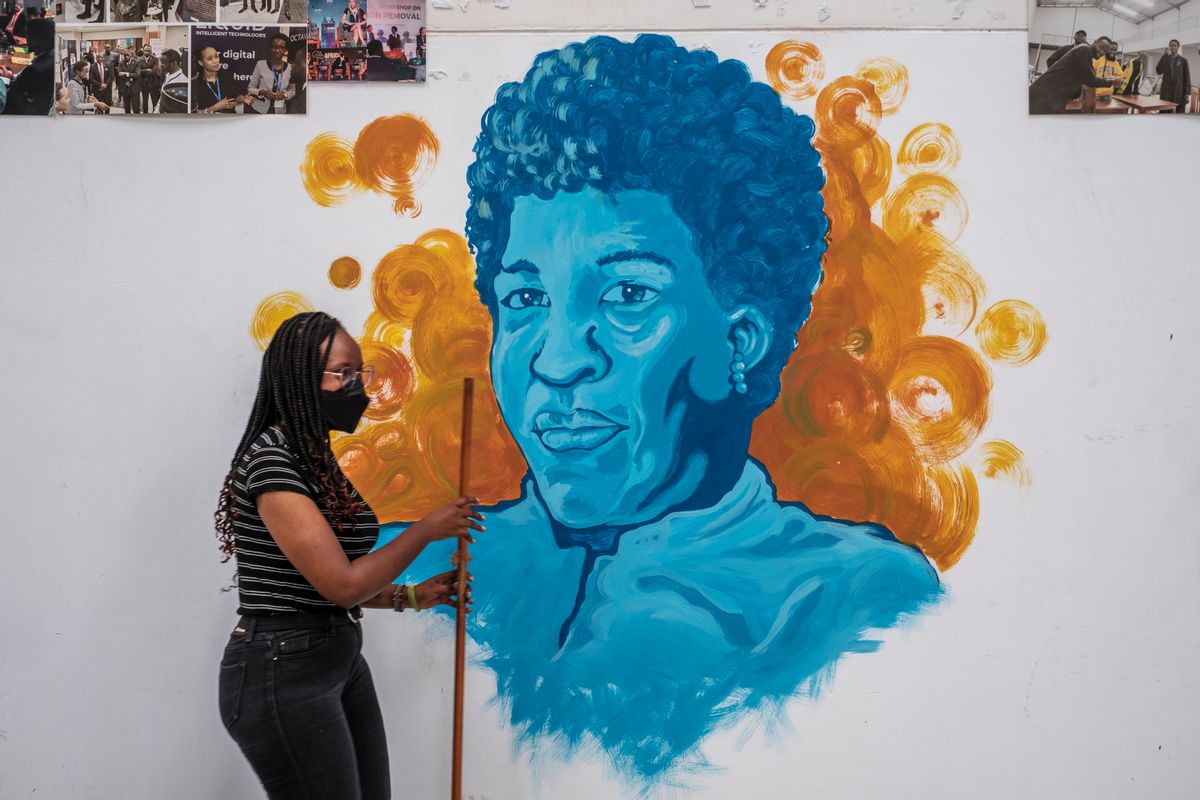
As wildfires scorched the Los Angeles area in January 2025, a number of Snopes readers and commentators (archived) pointed out similarities between current events and the plot of Octavia Butler's 1993 novel "Parable of the Sower" and its sequel "Parable of the Talents."
A reader shared the following Facebook post (archived) with the question: "Is this meme accurate about Octavia Butler's book 'Parable of the Sower' and predicting the recent LA fires with a new 'fascist' president who uses the slogan 'Make America Great Again'?"

(BlueSky user Leah Stokes)
Butler's 1993 novel did have startling similarities to the events in Los Angeles today. However, prescience does not indicate something supernatural is afoot. It simply shows Butler's attention to detail, historical research and ability to anticipate how societal problems would play out over decades based on the issues she saw when she was alive.
Butler was born in Pasadena, California, in 1947 and turned California into the setting for her "Earthseed" novels, the first of which was "Parable of the Sower." According to the synopsis on Bookshop.org:
When global climate change and economic crises lead to social chaos in the early 2020s, California becomes full of dangers, from pervasive water shortage to masses of vagabonds who will do anything to live to see another day. Fifteen-year-old Lauren Olamina lives inside a gated community with her preacher father, family, and neighbors, sheltered from the surrounding anarchy. In a society where any vulnerability is a risk, she suffers from hyperempathy, a debilitating sensitivity to others' emotions.
Precocious and clear-eyed, Lauren must make her voice heard in order to protect her loved ones from the imminent disasters her small community stubbornly ignores. But what begins as a fight for survival soon leads to something much more: the birth of a new faith … and a startling vision of human destiny.
We obtained copies of the two novels and pinpointed key sections that carry that prescience. In "Parable of the Sower," the main character, Lauren, writes diary entries in the years 2024 and 2025, which mention a number of natural disasters including "a big, early-season storm blowing itself out in the Gulf of Mexico. It's bounced around the Gulf, killing people from Florida to Texas and down into Mexico."
Then in an entry for July 30, 2024, Lauren writes:
Tonight the last big Window Wall television in the neighborhood went dark for good. We saw the dead astronaut with all of red, rocky Mars around her. We saw a dust-dry reservoir and three dead water peddlers with their dirty-blue armbands and their heads cut halfway off. And we saw whole blocks of boarded up buildings burning in Los Angeles. Of course, no one would waste water trying to put such fires out.
In an August 2027 entry, the narrator describes her travels en route to Northern California:
But it's the fire that holds our attention. Maybe it was started by accident. Maybe not. But still, people are losing what they may not be able to replace. Even if they survive, insurance isn't worth much these days.
People on the highway, shadowy in the darkness, had begun to reverse the flow, to drift northward to find a way to the fire. Best to be early for the scavenging.
In Butler's sequel, "Parable of the Talents," Lauren has managed to survive the destruction of her home and created a peaceful community which acts as a refuge. The second book also has a familiar sounding character in the form of a right-wing president. Per Bookshop.org:
In 2032, Lauren Olamina has survived the destruction of her home and family, and realized her vision of a peaceful community in northern California based on her newly founded faith, Earthseed. The fledgling community provides refuge for outcasts facing persecution after the election of an ultra-conservative president who vows to "make America great again." In an increasingly divided and dangerous nation, Lauren's subversive colony--a minority religious faction led by a young black woman--becomes a target for President Jarret's reign of terror and oppression.
A scene in the book, from the year 2032 describes the presidential candidate, Texas Sen. Andrew Steele Jarret, thusly (emphasis ours):
And "cultist" is a great catchall term for anyone who fits into no other large category, and yet doesn't quite match Jarret's version of Christianity. Jarret's people have been known to beat or drive out Unitarians, for goodness' sake. Jarret condemns the burnings, but does so in such mild language that his people are free to hear what they want to hear. As for the beatings, the tarring and feathering, and the destruction of "heathen houses of devil-worship," he has a simple answer: "Join us! Our doors are open to every nationality, every race! Leave your sinful past behind, and become one of us. Help us to make America great again." He's had notable success with this carrot-and-stick approach. Join us and thrive, or whatever happens to you as a result of your own sinful stubbornness is your problem. His opponent Vice President Edward Jay Smith calls him a demagogue, a rabble-rouser, and a hypocrite. Smith is right, of course, but Smith is such a tired, gray shadow of a man. Jarret, on the other hand, is a big, handsome, black-haired man with deep, clear blue eyes that seduce people and hold them. He has a voice that's a whole-body experience, the way my father's was.
Butler actually had enough examples of the term "Make America Great Again" in the 1980s and '90s as inspiration for the cultlike figure of Jarret. In 1980, the Republican Party's then-presidential candidate Ronald Reagan campaigned alongside George H.W. Bush to the slogan "Let's Make America Great Again." In 1992 the Democratic candidate Bill Clinton began his campaign with the pledge to "make America great again," according to the National Museum of American History.
In an interview with Democracy Now! in 2005, Butler described the inspiration for the two novels (emphasis ours):
I wrote the two "Parable" books, back in the '90s, they are books about, as I said, what happens because we don't trouble to correct some of the problems that we're brewing for ourselves right now. Global warming is one of those problems and I was aware of it back in the '80s. I was reading books about it and a lot of people were seeing it as politics, as something very iffy, as something they could ignore because nothing was going to come of it tomorrow. That and the fact that I think I was paying a lot of attention to education because a lot of my friends were teachers and the politics of education was getting scarier, it seemed to me. We were getting to that point where we were thinking more about the building of prisons than of schools and libraries. Not everybody was going in the wrong direction, but a lot of the country still was. And what I wanted to write was a novel of someone who was coming up with solutions of a sort.
In a 2000 interview at a Baltimore writing convention, Butler said: "Global warming is practically a character in 'Parable of the Sower.' … They are problems now, they become disasters because they are not attended to. I hope, of course, that we will be smarter than that."
According to The Associated Press, Butler also spoke of the past as "filled with repeating cycles of strength and weakness, wisdom and stupidity, empire and ashes. To study history is to study humanity."
Butler's prescience is not a sign of supernatural ability, but of a canny and well-researched writer. In her words, per the AP, "I didn't make up the problems. All I did was look around at the problems we're neglecting now and give them about 30 years to grow into full-fledged disasters."