
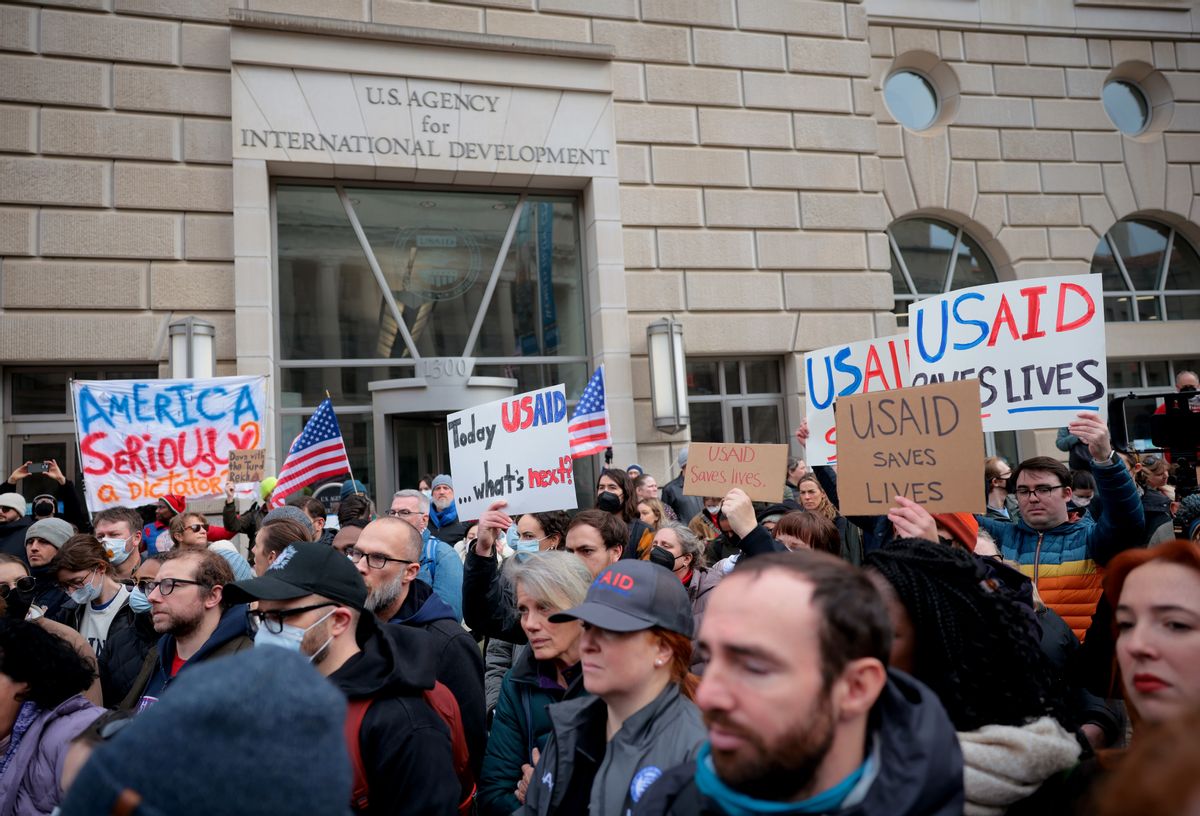
In early February 2025, U.S. Department of Government Efficiency head Elon Musk and President Donald Trump's administration began enacting radical changes to the U.S. Agency for International Development, which distributes humanitarian aid around the world.
Musk said on X on Feb. 3 that he "spent the weekend feeding USAID into the wood chipper." News outlets reported that Trump's administration put nearly all of USAID's staff on leave, laid off thousands of contractors and froze billions of dollars in humanitarian assistance to other countries.
After Democratic members of Congress were denied access to USAID headquarters, lawmakers blasted the administration's moves in news conferences and on social media, calling it illegal and unconstitutional to shut down USAID. Some of these posts had tens of thousands of views, including one from Rep. Sara Jacobs of California, who claimed only "an act from Congress" can eliminate USAID.
This is illegal. Neither Donald Trump nor Elon Musk has the authority to eliminate USAID; only an act of Congress can do that.
Lawsuits are underway and we are doing oversight to try to stop this. pic.twitter.com/7SKQOm1AZc— Congresswoman Sara Jacobs (@RepSaraJacobs) February 3, 2025
It wasn't clear whether the Trump administration was seeking to merge USAID into the State Department or abolish the independent agency entirely. Multiple legal experts told Snopes that the president does not have the legal authority to shut down USAID, although he is allowed to do some internal restructuring, given proper notification to Congress — which he has not appeared to have done.
Snopes reached out to a White House spokesperson for more information and we will update the story if we receive a response. Here's what we know as of this writing:
What does the Trump administration want to do with USAID?
During an hourlong audio-only conversation on X Spaces on Feb. 2, 2025, Musk said he was working to shut down USAID, and that Trump supported his efforts to do so. Multiple reputable news outlets reported that Trump told reporters USAID is run by a "bunch of radical lunatics, and we're getting them out." Other outlets reported that Trump said he "thinks" he will "wind down" USAID.
Some reputable news publications also reported that anonymous official sources said the Trump administration is considering merging USAID into the State Department. Part of the Trump administration's drastic changes to USAID included taking down its official webpage and launching a new page on the Department of State's website for USAID content.
The State Department announced on Feb. 3 that Secretary of State Marco Rubio was acting administrator of USAID, and Rubio wrote that a "review and potential reorganization" of USAID was underway.
Is it legal for Trump and Musk to shut down USAID?
In short, the president does not have the legal authority to shut down USAID without Congressional approval,
Musk's Department of Government Efficiency was created by executive order. It was not officially approved as a federal executive department by Congress,
Here is what the Congressional Research Service, the nonpartisan, independent policy research and analysis arm of the United States Congress, said about whether the president can shut down USAID:
Because Congress established USAID as an independent establishment (defined in 5 U.S.C. 104) within the executive branch, the President does not have the authority to abolish it; congressional authorization would be required to abolish, move, or consolidate USAID.
Multiple legal professors, including Alan Morrison, a professor at George Washington University who teaches constitutional law, and Jamal Greene, a constitutional law expert at Columbia University, told Snopes over email that the president does not have the legal authority to shut down USAID.
Wasn't USAID established by executive order, not an act of Congress?
Some social media users claimed that because USAID was established through an executive order, Trump is allowed to dismantle it by executive order.
While it is true that then-President John F. Kennedy established USAID via an executive order in 1961, Congress later passed the Foreign Affairs Reform and Restructuring Act of 1998, which entrenches USAID as an "independent establishment" outside of the State Department.
Here is what the act (codified into law as 22 USC 6563) says:
Unless abolished pursuant to the reorganization plan submitted under section 6601 of this title, and except as provided in section 6562 of this title, there is within the Executive branch of Government the United States Agency for International Development as an entity described in section 104 of title 5.
As noted, section 6601 gave the president temporary authority to reorganize the agency — but the authority to reorganize USAID expired in 1999. According to the Congressional Research Service, "Congress has not granted the President further authority to abolish, move, or consolidate USAID since."
Section 6562 is not concerned with the abolition of USAID, but the organizing structure. USAID was once overseen by a now-defunct agency called the International Development Cooperation Agency; Section 6562 moved USAID fund-allocation responsibilities from IDCA to the secretary of state.
"An entity described in section 104 of title 5" defines USAID as an "independent establishment," so the act essentially says USAID is an independent establishment in every way except for the fact that it reports to the secretary of state. The 1998 act says the USAID administrator "shall report to and be under the direct authority and foreign policy guidance of the Secretary of State."
In practice, this level of independence means USAID has previously been allowed to provide humanitarian aid to citizens of countries the United States does not have diplomatic relations with, such as North Korea.
Can Trump merge USAID into the State Department?
According to the Congressional Research Service, the president is allowed to "propose and execute structural changes related to USAID and State, including shifting certain functions from USAID to State."
However, in these cases, the administration must notify and consult with "appropriate congressional committees" using procedures outlined in annual appropriations bills. Here is the relevant section of the most recent version of that legislation:
Sec. 7063. (a) Prior consultation and notification.— Funds appropriated by this Act, prior Acts making appropriations for the Department of State, foreign operations, and related programs, or any other Act may not be used to implement a reorganization, redesign, or other plan described in subsection (b) by the Department of State, the United States Agency for International Development, or any other Federal department, agency, or organization funded by this Act without prior consultation by the head of such department, agency, or organization with the appropriate congressional committees: Provided, That such funds shall be subject to the regular notification procedures of the Committees on Appropriations: Provided further, That any such notification submitted to such Committees shall include a detailed justification for any proposed action: Provided further, That congressional notifications submitted in prior fiscal years pursuant to similar provisions of law in prior Acts making appropriations for the Department of State, foreign operations, and related programs may be deemed to meet the notification requirements of this section.
In other words, funds allocated to USAID by Congress cannot legally be used to reorganize USAID without the president undergoing detailed notification and consultation procedures with various congressional committees.
Greene, one of the legal experts, told us the president has no constitutional authority to "move USAID anywhere." Any authority he does have lies in the statutes — but having the authority to move some of USAID's functions into the State Department doesn't mean he has the authority to move USAID itself into the department. Greene's response is below:
He does not have statutory authority to subsume USAID within the State Department, because federal law (see 22 U.S.C. 6563 and 5 U.S.C. 104) establishes USAID as an "independent establishment" which cannot be part of another agency or government department. The President has no constitutional or statutory authority to override that.
David Super, a professor at Georgetown Law who studies constitutional law and legislation, told Snopes that the authority Trump has to move resources and responsibilities around between different U.S. government entities involved in foreign aid is "very limited" and "would not come close to allowing him to abolish USAID."
Per the Congressional Research Service, members of Congress may conduct "congressional hearings, letters, and informal communications" to determine whether the administration is complying with federal law on USAID.
Are Trump and Musk's actions unprecedented?
Yes, Trump and Musk's actions — which numerous legal experts say defy constitutional and statutory authority — are unprecedented. Super said Trump is acting in "open defiance" of the laws against shutting down USAID, and that he is at odds with not just the Foreign Affairs and Restructuring Act of 1998 (coded in law as section 6563), but multiple other laws:
Even if section 6563(a) did not require that USAID exist, the appropriations acts funding both the agency and its activities require that the agency continue, and the Impoundment Control Act prevents him from defunding those activities without getting Congress's permission through a procedure he has refused to follow.
Since this country's earliest days, Congress has decided by statute which agencies would exist in the federal government. Every prior president, including Mr. Trump himself from 2017-21, has followed these statutes even when they disagreed with them. This action is completely unprecedented.