
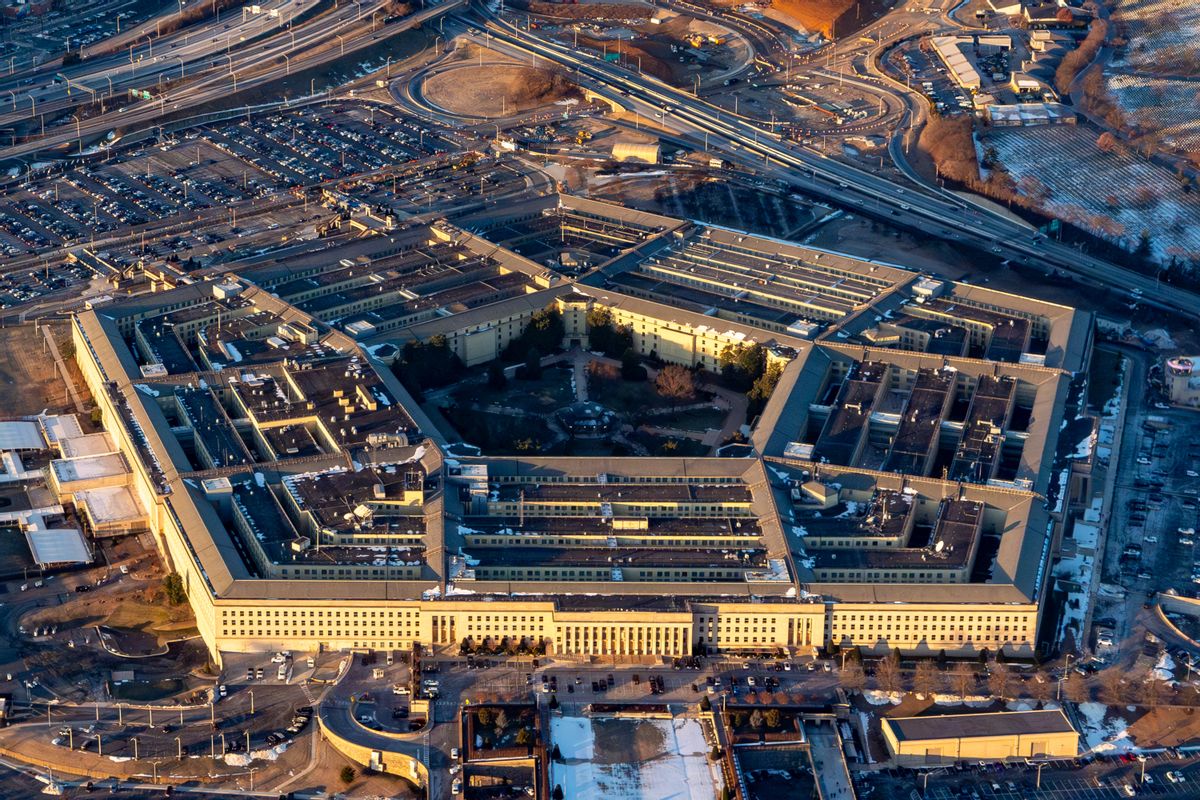
Since late 2024, social media users have claimed that the U.S. Department of Defense (DOD), headquartered at the Pentagon, had failed seven consecutive annual audits.
The rumor spread on Bluesky (archived), Facebook (archived) and X (archived), where one post had more than 80,000 likes.
News reports from 2024 also claimed the Pentagon had failed seven consecutive audits, and those reports came from The Hill, Fox News and Breaking Defense, among others. Some social media users, as well as news organizations including NPR, claimed the Pentagon had never passed an audit. U.S. Rep. Marjorie Taylor Greene, a Republican from Georgia, made the claim in multiple Facebook posts (archived, archived).
It is true that the Department of Defense has never received an agency-wide "clean audit" since audits began in 2018 — when an auditor finds no issues with an institution's financial records. The DOD began department-wide audits in 2018 and received a "disclaimer of opinion" every year since then, which means auditors could not obtain enough information to comprehensively assess the agency's financial records.
A disclaimer of opinion is not the same as an adverse opinion, which is when an auditor discovers mismanagement or fraud. However, it does mean that the Department of Defense isn't able to keep a detailed, transparent record of most of the money it spends, and auditors sometimes consider that not just a
Audits also have found major oversights at the Department of Defense. A 2023 audit, for example, found that the agency accidentally overvalued the military equipment it sent to Ukraine by $6.2 billion. The Government Accountability Office has placed the Department of Defense's financial management on its "high risk" list for fraud and mismanagement since 1995.
Auditing the Pentagon
According to a September 2024 GAO report, the Defense Department "remains the only major federal agency that has never been able to achieve a clean audit opinion," despite making progress toward that. The office told Snopes in an email that it prefers not to use the term "failed" because it is "subjective."
All seven full audit reports from 2018 to 2024 are available on the U.S. Under Secretary of Defense's official website. Partial audits from 1990 to 2017 also are available; while the DOD has conducted at least partial audits since 1990, the Pentagon did not comply with federal law — passed in 1990 — on conducting full, annual audits until 2018.
Auditing the entire Department of Defense actually involves 28 stand-alone audits of entities within the DOD — along with a consolidated, agency-wide audit — conducted by teams of independent public accountants and the Department of Defense Office of the Inspector General. Entities overseen by the Pentagon include the five branches of the U.S. armed forces and intelligence agencies such as the National Security Agency.
In fiscal year 2024, which ran from Oct. 1, 2023 to Sept. 30, 2024, the Pentagon's stand-alone entities could not comprehensively account for at least 44% of their total assets, or resources owned and controlled by the Defense Department, and at least 68% of their budgetary resources, the money allocated by Congress for the agency's use. As of a November 2024 report from nonpartisan Congressional staff, the DOD has $4.1 trillion in assets and $4.3 trillion in liabilities, or debt owed to other entities.
Of the stand-alone audits, nine received an "unmodified audit opinion," or a clean audit, and 15 received disclaimers of opinion. One received a qualified opinion, meaning the financial records were largely clean but had some areas of concern, and three opinions were pending as of this writing. The Pentagon must obtain a clean audit by 2028, per an act passed by Congress in 2023.
Auditors also performed 27 audits of
Auditors: Disclaimer of opinion is essentially a failure
Kimberly J. Tribou, a certified public accountant and accounting professor at The College of Charleston who once worked for the Department of Energy Office of the Inspector General, wrote to Snopes in an email that "auditors would consider both an Adverse Opinion and a disclaimer of opinion to be 'audit failures.'"
Here's her explanation of why that is:
A "disclaimer of opinion" means there were material and pervasive issues that prevented the audit from being performed. Basically, the condition of the accounting information system was so poor that the auditor was unable to perform the required audit testing. This is true of the DOD, which has spent literal decades trying to get its subcomponents operating on an integrated accounting information system that complies with the federal laws. The DOD has no evidence to suggest that financial statement fraud has occurred, but it would be impossible to make this determination without performing this testing.
Here's what Mollie Halpern, a spokesperson at the DOD OIG, told us in a phone call about whether the office considers the agency's audit performances a failure:
For seven consecutive years, yes ... the DOD has been given a disclaimer of opinion. So auditors were not able to obtain sufficient appropriate evidence to support financial statements. So we wouldn't want to say it in any other way, just because we're in the audit world, and that's what we do, right? But we also understand the reasoning behind the press and politicians saying that they've — that the DOD has failed the audit, because [the audit] can't even happen. But accurately, in our world, it's a disclaimer.
Tribou also provided Snopes with a copy of a peer-reviewed paper about the DOD's first audit she published in the Accounting Historians Journal with her co-author Frank Badua. They came to the conclusion that the "DOD 'failed' its audit but the audit process wasn't a failure because it has helped improve the DOD's financial management systems."
That is because auditors typically terminate an audit once they have reached a disclaimer of opinion — but at the Pentagon, auditors continued to perform testing to gain a fuller understanding of the issues with the agency's accounting information system. The auditors issued hundreds of recommendations and findings, allowing the Defense Department to improve its financial-reporting process — evidenced by the fact that more of the organizations receiving stand-alone audits began receiving clean audits over the years.
For example, in 2024, the DOD's Defense Threat Reduction Agency received a clean audit for the first time. Mike McCord, the department's chief financial officer and its undersecretary of defense, said he believed the department has "turned a corner in its understanding of its challenges" to receive a clean audit. In a November 2024 news conference, McCord said it would be "very unfair" to claim the Pentagon failed its seventh consecutive audit. Here's the full exchange with Bloomberg reporter Anthony Capaccio, per the DOD's transcript:
Capaccio: Is it fair to say that you failed — the Pentagon failed — for the seventh consecutive year to score an overall clean audit, but progress is being made, is that — still fair?
McCord: I would think that's very unfair if you say that. I — do not say we failed. As I said, we have about half clean opinions. We have half that are not clean opinions, so. If someone had a report card that is half good and half not good, I don't know that you call the student or the report card a failure. We have a lot of work to do and but — I think we're making progress as I said.
Capaccio: What's the more accurate verb then if it's not failed?
McCord: We had — I — first of all, I guess, I don't know if I would reduce it to one word or not. We — have made progress and we need to get better and faster.
In 2018, news outlets reported that then-Deputy Secretary of Defense Patrick Shanahan told journalists that the agency "failed its audit" but "never expected to pass it," meaning that at the time, top Pentagon officials also considered the 2018 disclaimer of opinion rating a failure.