
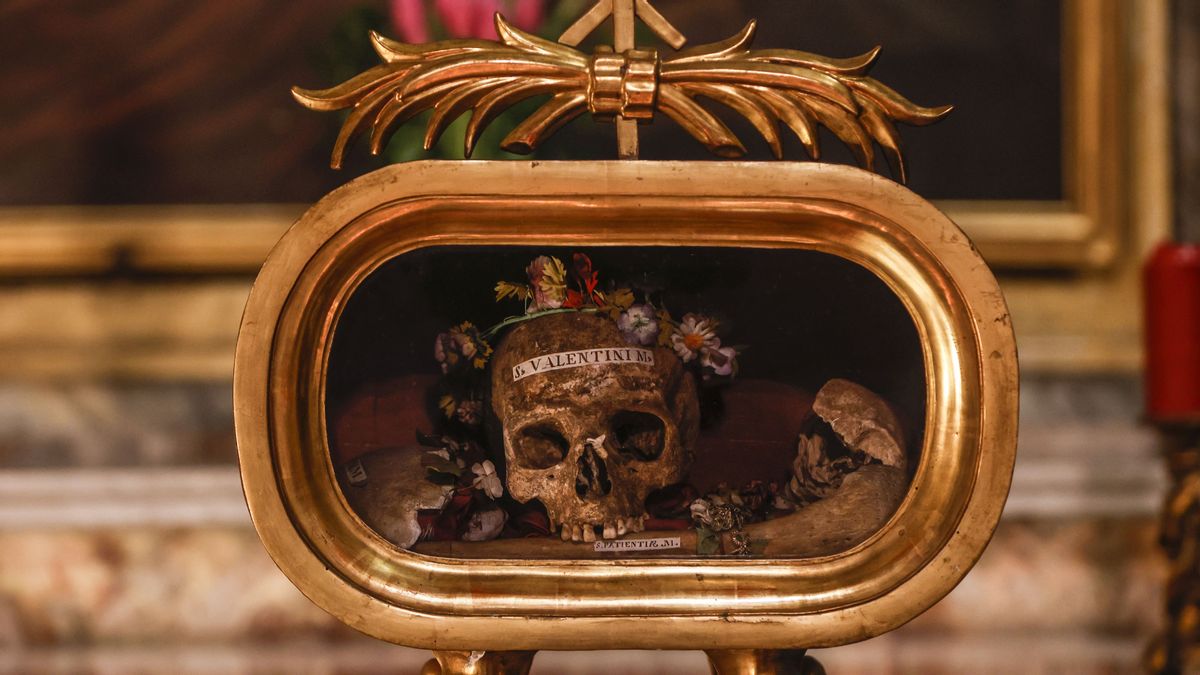
As couples across the world prepared for Valentine's Day in February 2025, a rumor cropped up on social media that St. Valentine is not only the patron saint of lovers, but also of beekeepers, fainting, epilepsy and the plague.
The claim has circulated online for years, appearing on X (archived, archived), in multiple Reddit posts and on YouTube.
Neighborhood Gazette, a monthly newspaper serving communities in Denver, Colorado, also wrote about the rumor in February 2023, while travel and exploration company Atlas Obscura said in a 2014 article:
Saint Valentine's holy name may now be inextricably linked to pastel hearts and Hallmark cards, but he's the patron saint of much more than love. Bee keepers, plague victims, and epilepsy sufferers also fall under his posthumous jurisdiction.
However, it was not possible to find an official list of Catholic saints and their respective patronages. Before Pope John XV formalized the process for the identification of saints by canonizing St. Ulrich of Augsburg in 993, saints were established by public demand. Therefore, it is difficult to determine any official patronages. Some estimates put the number of saints at more than 10,000.
Additionally, the identity of St. Valentine is complex and likely to be a composite of several men. Therefore, it is difficult to determine what he is the patron saint of. Outlined below are the theories as to how this claim emerged:
History of St. Valentine
The fullest accounts of the martyrdom of St. Valentine can be found in early medieval hagiographies — biographies of saints or venerated people — which reveal that there may have been two Christian martyrs with that name. Some accounts even suggest the two men below were the same person.
The first is St. Valentine of Rome. In The Golden Legend, sometimes described as the most-read book of the Middle Ages and the main database of saints' lives, his story was not related to love or marriage. Instead, he refused to sacrifice to pagan idols and was imprisoned. He then healed the sight of an official's daughter, converting many in the aftermath. However, this incurred the wrath of the emperor, leading to his beheading allegedly on Feb. 14.
The passio — a story about a martyr who died a violent death due to their faith or for another reason deemed to be arranged by God — of another man, St. Valentine of Terni, says he was a bishop. According to the Acta Sanctorum, an encyclopedic text that examines the lives of Christian saints, he came to the attention of a scholar named Crato, who asked Valentine to heal his son. The bishop agreed — on the condition that Crato converted to Christianity. Valentine cured the boy and converted the scholar and his whole household. Roman senators heard of the healing and demanded Valentine worship their gods. However, he refused and was beheaded.
Following these two stories, numerous people throughout the centuries have crafted the cult of St. Valentine. While St. Valentine of Terni was imprisoned for secretly marrying couples in contradiction to the edict of the Roman Emperor Claudius II, it is widely accepted that 14th-century poet Geoffrey Chaucer was the first to make the link between St. Valentine and romantic love. In his poem "Parliament of Fowls," Chaucer wrote that St. Valentine's Day was chosen for the date on which birds gathered together to select their mates. The line reads: "For this was on seynt Valentynes day/ Whan every foul [fowl] cometh ther to chese [chase] his make [mate]."
St. Valentine's patronages
The inconclusive nature of St. Valentine's identity also lays the groundwork for further uncertainty regarding his patronages. The website Catholic.org, a project of Your Catholic Voice Foundation, a nonprofit group that seeks to provide Catholic education for the public, says he is the patron saint of "affianced couples, bee keepers, engaged couples, epilepsy, fainting, greetings, happy marriages, love, lovers, plague, travellers, and young people." Below are some theories behind why he has been credited with such patronages.
Epilepsy was once considered a supernatural event, such as a curse or a possession by an evil spirit. As such, divine intervention was used as a healing method and saints were called upon to cure it. St. Valentine is one of almost 40 saints associated with the disorder, but it was his name that became linked with it. A history of medicine article titled "Saint Valentine: Patron of lovers and epilepsy," published in the Spanish medical journal Repertorio de Medicina y Cirugía explains the link between epilepsy and St. Valentine:
In France it was denominated maladie de Saint Valentin, in Germany the "plague of Saint Valentine["] and in Dutch the word sintvelten was a synonym of epilepsy. In German, Valentine is pronounced "fallentin" and is connected with one of the denominations of epilepsy, the falling sickness or the falling-down disease.
The article also said a chapel was built in Rouffach, a commune in Alsace, France, with relics of St. Valentine. It became a place of pilgrimage, and a hospital was built in the 15th century to house pilgrims looking for a way to control the disease.
A 2009 study by Gerhard Kluger and Verena Kudernatsch also found that, from the 15th century onward, 143 pieces of Christian art have portrayed people who suffer from epilepsy in illustrations of St. Valentine.
As for why he is considered the patron saint of the plague and beekeepers, St. Valentine had a reputation for healing the sick and was pictured in what were known as "plague sheets," which were printed materials distributing information about the disease or invoking a saint, Christ or God for protection. One example, which is from the late 3rd century and portrayed St. Valentine, can be seen in full here.
Meanwhile, a project by King's College University in London also found that bees were potent religious symbols closely associated with Christ and Mary. However, it was not possible to find any primary sources tracing how St. Valentine became known as the patron saint of beekeepers.
Snopes has researched other rumors related to Valentine's Day, including whether the holiday was created by greeting card companies.