
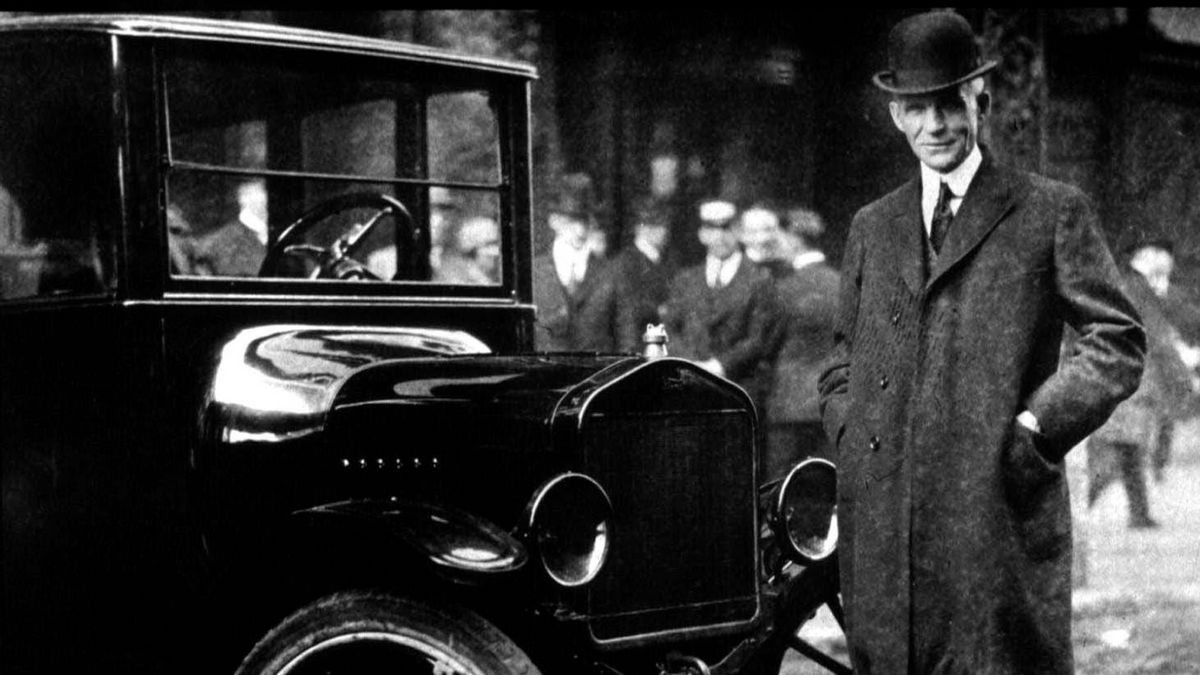
For years, social media users have claimed the founder of the Ford Motor Company, Henry Ford, once said, "If I had asked people what they wanted, they would have said faster horses," presumably in reference to his early days establishing the manufacturing company at the start of the 20th century.
Social media users have shared the attribution on platforms including X, Reddit, Goodreads and Facebook (archived, archived).
There is no firsthand evidence to confirm or disprove whether Ford, who is widely credited for transforming the automotive industry by developing a moving assembly line and mass production techniques, ever
Rather, no source in Google's newspaper archives or book archives supports the claim. Furthermore, the quote doesn't appear in Ford's autobiography and isn't included in a database of around 200 authenticated Ford quotations published by the Henry Ford Museum of American Innovation.
We reached out to the museum, asking whether the alleged quote was on its radar. A representative responded via email, saying the center no longer verifies quotes widely credited to the industrialist, writing:
In the past, research on this topic has not yielded satisfactory results either for the researcher or the research staff. Ford was quoted in numerous articles for a variety of periodicals and newspapers and the quotes attributed to him were varied and often cannot be substantiated.
We also reached out to Ford Motor Company to ask whether it had any information about the alleged quote. We have not received a response, and we will update this report if that changes.
The alleged quote's history
Only secondhand sources have repeated the quote with Ford's attribution. Namely, they include authors and a relative of Ford who say the phrase originates with him without providing evidence to substantiate that claim. The
There is a problem trying to figure out what people want by canvassing them. I mean, if Henry Ford canvassed people on whether or not he should build a motor car, they'd probably tell him what they really wanted was a faster horse.
Being market-led implies being led by the consumer – and consumers are bad at coming up with innovations (Henry Ford's quote: "If I had asked my customers what they wanted they would have said a faster horse" springs to mind…)
The 2002 book "Beyond Disruption: Changing the Rules in the Marketplace" by
In 2003, a slightly different version of the alleged quote with Ford's attribution surfaced in Mark Sherrinton's book "Added Value: The Alchemy of Brand-led Growth."

(Mark Sherrington)

(Mark Sherrington)
According to a 2006 article by Canadian newspaper The Globe and Mail, Ford's great-grandson William Clay Ford Jr. attributed the quote to his great-grandfather. During a news conference in Detroit, the newspaper
My great-grandfather once said of the first car he ever built: "If I'd asked my customers what they wanted, they'd have said a faster horse."
In our request to Ford Motor Company, we asked to connect with Ford Jr., specifically, to learn why he believed his great-grandfather said the quote. We will update this story if we hear back.
As stated in an article by the Harvard Business Review, the quote also appeared in 2018's

(John Krumm)
The Google Books version of "Ubiquitous Computing Fundamentals" credited author
An article by the MarketingWeek website also attributed the quote in 2019, tying it to Helen Normoyle, who was the marketing director of the British pharmacy chain Boots at the time:
"If I'd listened to my customers, I'd have given them a faster horse." These are the words of Henry Ford, the founder of Ford Motors, and it's a motto Boots marketing director Helen Normoyle stands by.
As reported by
Historian and architecture critic Lewis Mumford wrote in 1946 in "The Journal of Land & Public Utility Economics":
By the same token people who sought to improve transporation should have devoted themselves to breeding faster horses, rather than inventing railroads, motor cars, or airplanes.
If somebody had been asked to do research about the year 1800 into how transportation could be improved, what would he have done? He might have looked for some improved diet that would give horses greater stamina. He might have sought some way of breeding faster horses.