
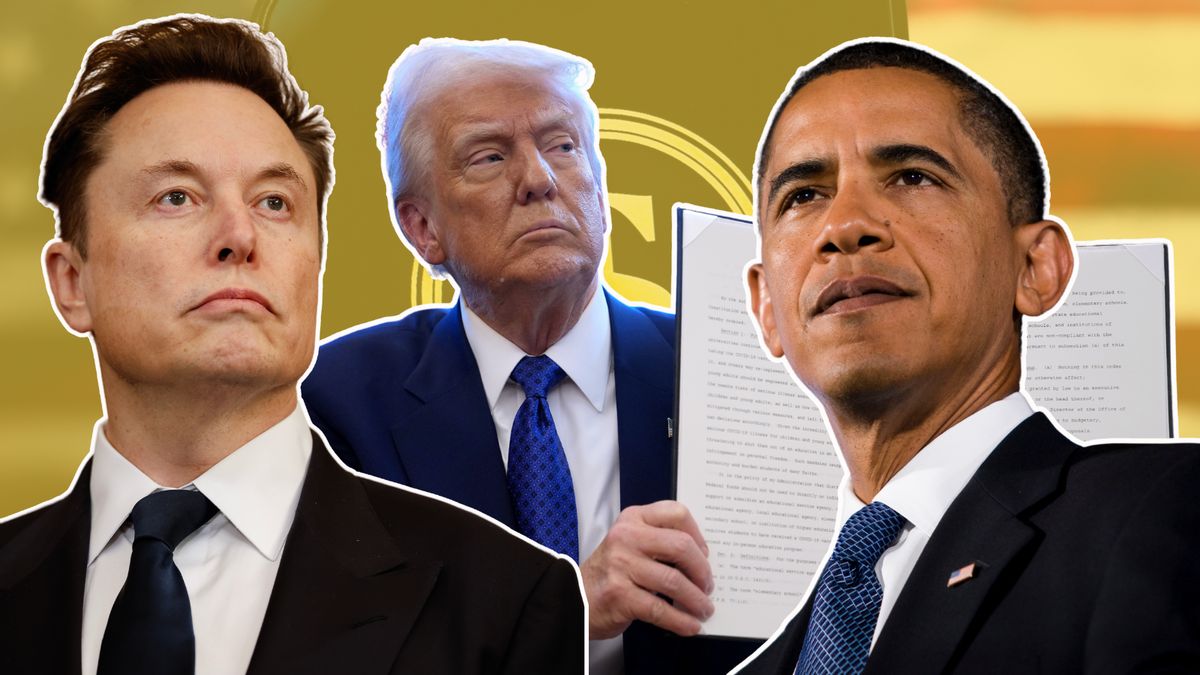
In February 2025, a rumor regarding the Department of Government Efficiency spread on social media — that U.S. President Donald Trump merely renamed an office created by former President Barack Obama rather than establishing the new DOGE initiative himself.
Social media users credited Obama with founding the U.S. Digital Service in 2014, which Trump later rebranded as the U.S. DOGE Service. Posts on the topic appeared on X, Facebook, Instagram and Reddit, often via a copy-pasted text that in some posts stated:
Obama created United States Digital Service (USDS) in 2014. It was meant as a bureaucratic patch job to fix the Obamacare website meltdown.
Fast forward to 2025. Trump rebrands it DOGE (United States DOGE Service). Keeps the acronym, keeps the funding, but gives it a whole new mission: Find the Receipts
[…]
Obama created DOGE. Trump is just capitalizing on it to Make America Great Again!!
The claims originated from a Feb. 6, 2025, Substack article by Tom Renz titled "DOGE - A Lawyer's Perspective." Renz is an attorney who first gained media attention by spreading false claims and filing lawsuits challenging COVID-19 vaccines. In the article, Renz wrote: "Trump did NOT actually create a new agency. Instead what he did was repurpose an existing agency - the USDS - into something more useful."
Renz also shared a thread on X stating that the "USDS was an Obamacare office created to make government software better." Tech billionaire Elon Musk — the public face of DOGE — reposted Renz's thread, writing: "We just renamed US Digital Services, created by Obama, to US DOGE Services, with a mandate to modernize all computer systems in the US government."
In short, Obama did establish the USDS in 2014 and Trump renamed it the United States DOGE Service in January 2025. However, the entity under Trump's administration has a broader mission than Obama's USDS, focusing not only on modernizing federal technology but also on reducing waste, reforming bureaucracy and cutting government spending.
Obama's U.S. Digital Service
In August 2014, Obama founded the USDS to address
The official USDS website stated that its initial priorities were modernizing immigration, veterans' benefits and HealthCare.gov. It also explained that its mission was to "deliver better government services to the American people through technology and design." According to a news release, its objectives included transforming public-facing services and expanding the use of common platforms, services and tools as well as rethinking "how the Government buys digital services."
An Aug. 13, 2024, news release marking the 10th anniversary of the USDS highlighted its origins as a crisis response team addressing service delivery challenges. Over time, the USDS evolved into "a trusted partner for over 30 federal agencies – working directly with them to deliver superior services to the public and to build digital capabilities for the future."
Therefore, the office was a technology-focused initiative within the Office of Management and Budget, not a regulatory or investigative agency. More details can be seen in the latest USDS impact report.
On Jan. 20, 2025, Trump signed an executive order titled "Establishing and Implementing the President's 'Department of Government Efficiency.'" It stated that the USDS was being renamed as the United States DOGE Service.
Both entities use the same acronym; however, the United States DOGE Service is more commonly known as DOGE. As the BBC reported, despite its full name, the Department of Government Efficiency is not an official government department and was not created by an act of Congress.
The executive order also moved the USDS from the OMB to the Executive Office of the President. It broadly stated that DOGE's purpose was "to implement the President's DOGE Agenda, by modernizing Federal technology and software to maximize governmental efficiency and productivity."
Trump's executive order also momentarily established the U.S. DOGE Service Temporary Organization until July 4, 2026 — a provision that applies only to this entity, not DOGE as a whole. Its stated purpose is to advance "the President's 18-month DOGE agenda."
Finally, the executive order mandated the creation of "DOGE teams" within federal agencies. Each agency must establish a team of at least four members, typically including a "DOGE team lead," an engineer, a human resources specialist and an attorney. It read: "Agency Heads shall ensure that DOGE Team Leads coordinate their work with USDS and advise their respective Agency Heads on implementing the President's DOGE Agenda."
What is DOGE's mission and who is in charge?
The executive order establishing DOGE mandated the appointment of a "USDS administrator" to lead the "Software Modernization Initiative." While Musk has often been portrayed as DOGE's leader, the White House confirmed in late February 2025 that Amy Gleason was the acting administrator. Office of Administration Director Joshua Fisher stated under oath that Musk is a White House employee but does not hold an official position within DOGE.
Other executive orders referencing DOGE highlight its role in ensuring efficiency, enforcing merit-based hiring and overseeing regulatory compliance. For instance, a Jan. 20 executive order tasks the DOGE administrator with shaping a federal hiring plan focused on bringing in "only highly skilled Americans dedicated to the furtherance of American ideals, values, and interests." A Feb. 11 executive order expands on this, requiring agency heads to work with DOGE team leads to prioritize hiring in high-need areas.
Other executive orders give DOGE a role in financial oversight. A Feb. 19 executive order on border policy directs the DOGE administrator to help "identify all other sources of Federal funding for illegal aliens," while a Feb. 26 executive order, focused on cost efficiency, requires agencies to implement tracking systems for payments and contracts under DOGE guidance.
Additionally, "DOGE" (or the term "Department of Government Efficiency") appeared on multiple White House webpages, often described as an initiative to streamline government, cut inefficiencies and shrink the workforce. Trump's Jan. 20 inaugural address and various fact sheets framed it as a way to optimize hiring and limit new positions to essential roles. Other references emphasized DOGE's role in uncovering alleged waste, fraud and abuse. Trump's remarks and fact sheets from mid-February also credited it with identifying billions in wasted taxpayer funds. A Feb. 20 post summarizing its first month reiterated DOGE's goal of maximizing government productivity.
As of now, the Trump-era USDS is undergoing restructuring, with unclear details on merging the so-called legacy USDS and the new DOGE. On Feb. 15, business news outlet Bloomberg UK reported that the DOGE team had sent termination notices to legacy USDS staff. Four days later, technology news outlet Wired noted that on Feb. 18, around 50 employees were fired while others met with DOGE representatives to discuss the future. On Feb. 25, multiple news media outlets reported that 21 USDS employees had resigned.
Snopes has investigated numerous DOGE-related claims in the past. For instance, on Feb. 20, we fact-checked a claim that Musk said he would ask Trump about a proposal to use savings made by the initiative to issue a $5,000 refund to every U.S. taxpaying household.