
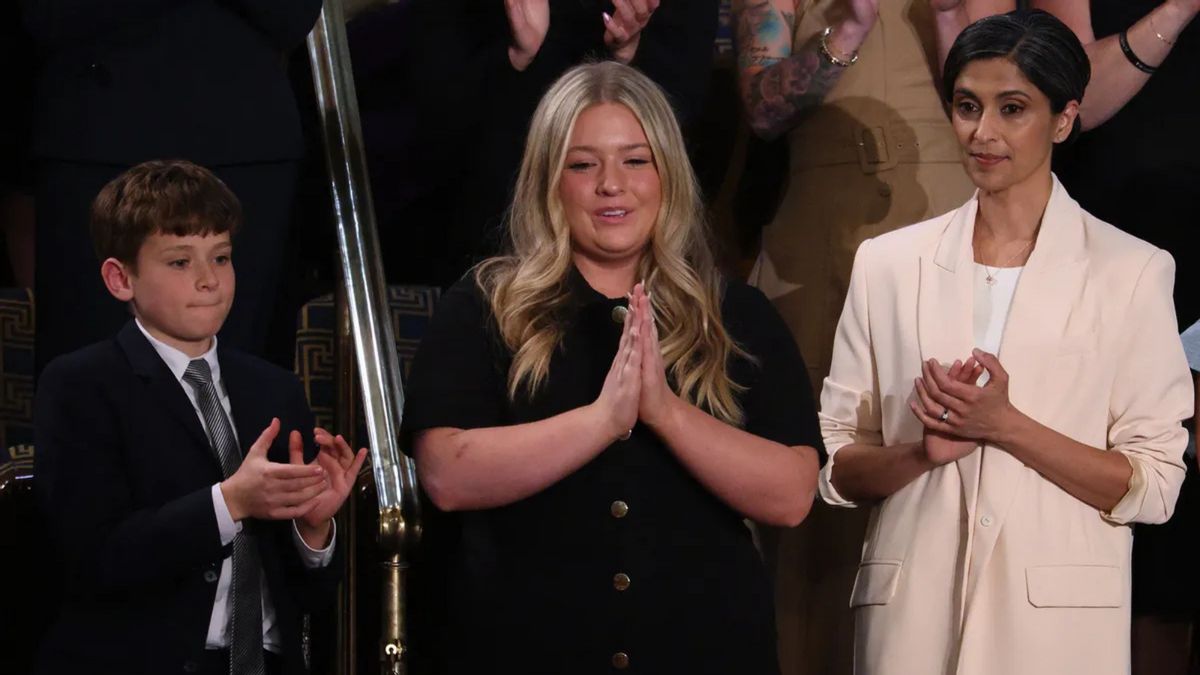
Payton McNabb, a former high school volleyball athlete who alleged a transgender athlete "permanently injured" her in 2022 by spiking a ball into her head, gained national attention after attending U.S. President Donald Trump's March 4, 2025, speech to a joint session of Congress.
Trump claimed during his speech that McNabb,
Following her attendance, social media users spread various rumors about her and the purported truthfulness of her story. A video on TikTok (archived) with nearly 500,000 views as of this writing — and another 500,000 on X — claimed she competed in two other high school sports shortly after her supposed injuries from the 2022 volleyball incident, calling it an example of the "endless lies" coming from anti-trans conservatives.
One popular post on X called her a "dirty grifter"; posts and comments on platforms like Bluesky questioned whether the athlete who spiked the ball at McNabb was even transgender. Other posts spread McNabb's story as truth, including an X post from U.S. Rep. Nancy Mace, an anti-transgender Republican lawmaker from South Carolina.
While video exists showing McNabb was, in fact, hit in the face with a volleyball spiked by an opposing team's athlete, there is insufficient evidence to verify that the athlete who spiked the ball in question was trans. McNabb played in North Carolina — and according to data from the North Carolina High School Athletic Association, two trans girls were approved through the state's waiver process to play high school sports from 2019 to 2023; it is unclear whether either of these girls played volleyball.
As claimed on social media, there is evidence McNabb played competitive high school basketball and softball shortly after she said the volleyball incident occurred; however, this does not definitively prove McNabb's story is false. The extent of McNabb's injuries is still unclear; she did not immediately return a request for comment through the Independent Women's Forum.
Verifying McNabb's version of events
Video of the incident, which happened Sept. 1, 2022, when McNabb was 17, is available on McNabb's X account:
Two years ago today, my life was changed forever because my rights and safety were deemed less important than a man's feelings and false reality.
I will always continue to fight the good fight for all the girls and women who deserve better? pic.twitter.com/TLpzCKryU6— Payton McNabb (@paytonmcnabb_) September 2, 2024
While the video McNabb released is not time-stamped, her high school's district, Cherokee County Schools in North Carolina, held a Sept. 21, 2022, board meeting and appeared to discuss this incident, matching up with the timeline McNabb gives when telling her story.
Cherokee County Schools' board bulletin notes from the meeting describe an athlete from an opposing high school who injured a volleyball player — presumably McNabb — as a transgender athlete, but do not provide evidence proving this; the board decided (see Page 3) not to participate in future games with
Several volleyball coaches in the district — none of whom identified themselves as McNabb's coach — spoke in favor of continuing to play games with the opposing school; one coach said, according to the notes summary, that they have "played against this team and the player in question for 4-years" and "none of her players wish to forfeit the game."
The alleged opposing athlete on the team against McNabb has not come forward, making it impossible to verify whether the athlete was a trans girl.
However, before North Carolina passed the 2023 Fairness in Women's Sports Act banning trans athletes from women and girls' sports — which McNabb testified in support of — the state's high school athletic association required trans athletes to request a waiver allowing them to participate on teams matching their gender identity. According to data from the North Carolina High School Athletic Association, from 2019 — when the waiver was first implemented — to 2023,
Brandon Moree, spokesperson for the association, said that in theory the two girls could continue to play in future years before the 2023 law passed without needing to fill out additional waivers. Thus, it is possible one of the two girls was on the opposing volleyball team.
Moree also noted that these numbers represent only requests and do "not indicate whether or not they actually made a team or participated." He said he did not have information regarding which sports these athletes requested waivers for.
McNabb has also claimed that the volleyball traveled at 70 mph before hitting her. That is equivalent to the fastest spike speed recorded in Olympic-level women's volleyball and roughly
McNabb did not cite any sources when making claims about the athlete's gender identity or the speed of the volleyball.
McNabb continued to play sports
In the popular TikTok claiming to debunk McNabb's story, the content creator said McNabb's page on Hudl — a website for reviewing sports videos — shows she joined her school's varsity basketball team shortly after the incident.
This is true; McNabb confirmed on X that the Hudl account is hers in response to an X user who claimed McNabb's Hudl account showed she continued to play volleyball after September 2022. "Clearly, you don't understand how HUDL works," McNabb wrote on X. "Yes, you're right that I was still on the roster because I was still on the team, even though I couldn't play. That was my last volleyball game, ever."
McNabb did not respond to the X user's reply: "How is it that your last game was in 2022 when you had 2 steals in Robbinsville Feb 7, 2023, 2 steals vs Nantahala on Feb 28, 2023, et al?" The games this X user was referring to were basketball games, not volleyball games, which means McNabb's Hudl account does not disprove McNabb's claim that the September 2022 volleyball game was her last.
However, the dates listed by that X user are accurate, per McNabb's Hudl account, and McNabb played varsity-level basketball after the volleyball incident as soon as Nov. 18, 2022. She also appeared to be active on her high school's varsity softball team as early as March 2023, according to statistics available on MaxPreps, a website covering high school sports; while McNabb has not confirmed that the MaxPreps page is hers, the basketball jersey number on the MaxPreps page matches her basketball jersey number on Hudl. Furthermore, McNabb said in an Independent Women's Forum video that "from the beginning," she played "basketball, volleyball and softball" (see 7:46).
McNabb claimed in a White House video that she has "lifelong" injuries from the volleyball hit, including "partial paralysis, vision impairment, cognitive issues, the list goes on." In the IWF video (see the 2:41 mark), she said that after the September 2022 game, she "ended up going to the doctor a couple days later" and found out she had "a traumatic brain injury, a brain bleed and partial paralysis and it would take months, years to recover and they don't know if I'll ever be 100% back."
While volleyball is considered a noncontact sport, head injuries are the second-most-common injury among high school and college female volleyball athletes. Partial paralysis and traumatic brain injuries — which can be lifelong — also occur in women's volleyball. (It is also worth noting available evidence — which is limited — found trans women who undergo testosterone suppression show no clear biological advantages to cisgender female athletes.)
Athletes should return to sports after a concussion under the supervision of their health care provider once they are symptom-free, which typically takes a minimum of six days. Athletes should not continue playing sports if symptoms return; however, traumatic brain injury symptoms can manifest years later. Furthermore, McNabb has not detailed what, specifically, on her right side allegedly experiences partial paralysis, which makes it difficult to tell if her supposed partial paralysis may hamper her ability to play elite sports.
Thus, while it is true McNabb returned to sports, complicating the narrative she often espouses of the September 2022 game being "career-ending" (see 7:46) as an athlete, this does not definitively prove her story is false. However, it is not possible to verify whether the athlete who spiked the ball into McNabb's head was transgender, and a volleyball player can sustain injuries such as the ones McNabb said she has regardless of the gender identity of the opposing players.