
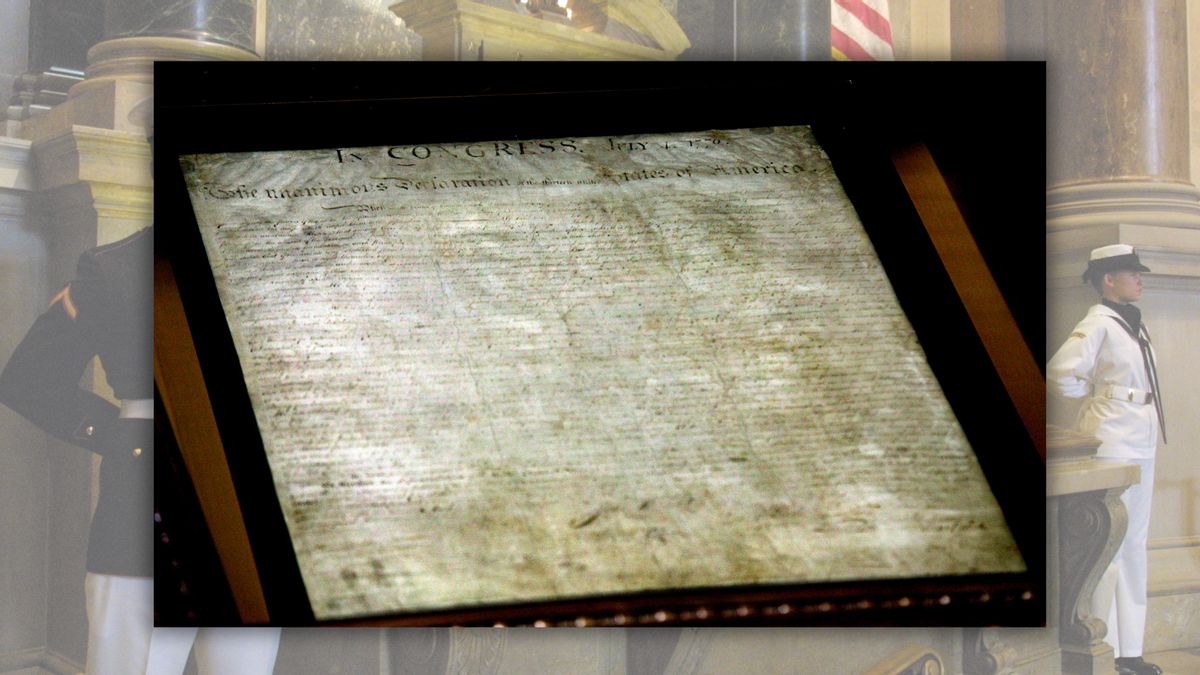
In early March 2025, claims emerged that U.S. President Donald Trump asked advisers about moving the original copy of the Declaration of Independence from its permanent exhibit in the National Archives to the White House's Oval Office.
The Declaration of Independence is the founding document of the United States, in which the original thirteen colonies declared themselves a sovereign nation separate from the rule of Great Britain's King George III.
Internet users discussed the claim in various Reddit threads and on social media platforms like TikTok (archived), Instagram (archived), Facebook (archived) and Threads (archived).
Trump Tried to Seize Original Declaration of Independence for Oval Office
byu/Majano57 inuspolitics
Some users jokingly compared Trump's request to the 2004 film "National Treasure," in which Nicolas Cage's character enacted a plan to steal the Declaration of Independence from the National Archives.
The claim that Trump sought to move the original Declaration of Independence to the Oval Office originated from an article in The Atlantic,
Snopes has not yet been able to independently verify these claims.
The Rotunda of the National Archives Building in Washington, D.C., has displayed the original documents of America's "Charters of Freedom" — the Declaration of Independence in addition to the original copies of the Constitution and the Bill of Rights — since 1952. Due to deterioration of the helium-filled encasements, starting in 2001 the exhibit
According to a National Archives factsheet
The design for the new encasements will allow conservators to open and reseal the cases — if it's ever necessary — to examine the documents or modify the interior components. The documents will be mounted so that glass never touches parchment. Ultra-smooth surfaces, new space age gaskets and the use of argon gas, rather than helium, will prevent leakage. The new design allows for flexibility to incorporate future conservation techniques as they are developed.
As The Atlantic pointed out, moving the original documents would be impractical both logistically and financially, especially for an administration whose primary platform has been the elimination of excessive spending in government. White House aides recognized this impracticality, according to The Atlantic article, which read in part:
Trump's request alarmed some of his aides, who immediately recognized both the implausibility and the expense of moving the original document. Displayed in the rotunda at the National Archives Building, in Washington, D.C., it is perhaps the most treasured historical document in the U.S. government's possession. The original is behind heavy glass in an oxygen-free, argon-filled case that can retract into the wall at night for security. Because of light damage to the faded animal-skin parchment, the room is kept dimly lit; restrictions have been placed on how often the doors can even be opened.
We previously looked into the claim that the U.S. National Archives Records Association introduced a "Harmful Language Alert" to accompany some historical documents on its website, including the Declaration of Independence, Bill of Rights and the Constitution.