
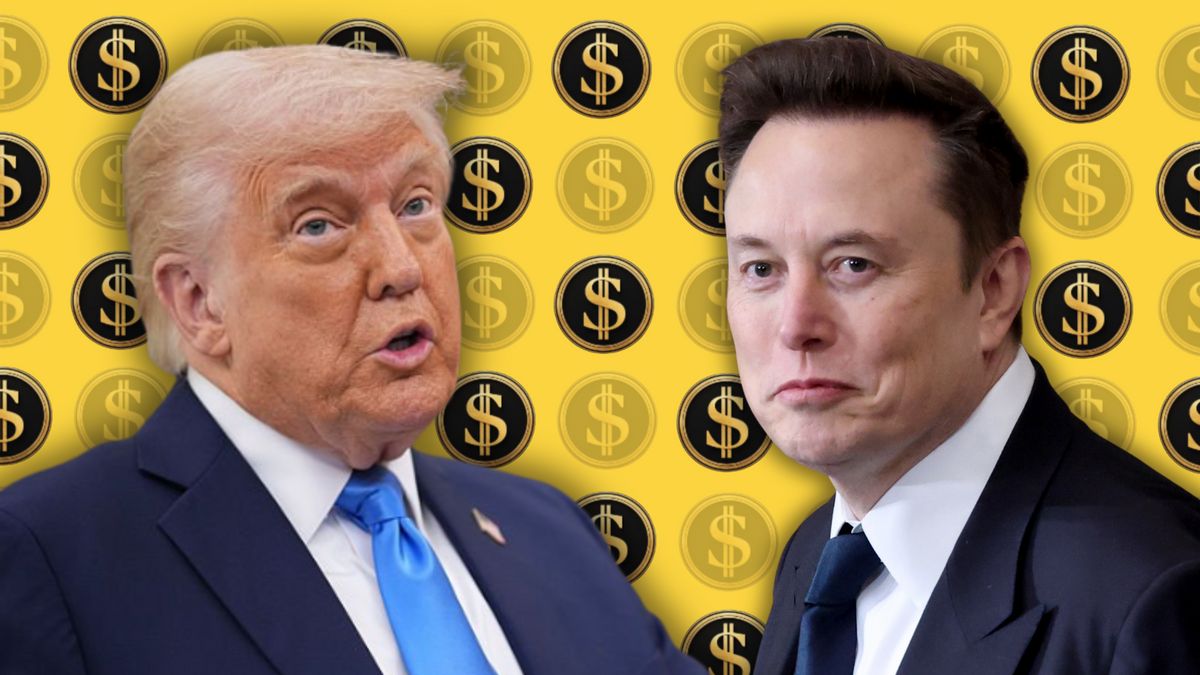
The Department of Government Efficiency has shaken up U.S. politics since its announcement in November 2024, prompting readers to ask us whether DOGE is a "real agency." U.S. President Donald Trump officially established it on Jan. 20, 2025, with tech billionaire Elon Musk prominently positioned as its public face.
Numerous political figures and social media users have disputed whether DOGE is a legitimate government entity. For instance, in early February 2025, Democratic Sen. Chuck Schumer of New York wrote on X that DOGE is "not a real government agency" and that it has "no authority to make spending decisions" or "to shut programs down or to ignore federal law."
Another X post with more than 2.4 million views as of this writing reads:
DOGE is not a legal government agency. It doesn't exist. The people who are working for Musk are not government employees nor are they contracted employees. They have no legal basis I can find that would allow them access to protected government data. There is zero oversight.
Conversely, some social media users have said Trump's executive order establishing DOGE makes it "100% legal" and immune to legal challenges (based on a claim that Trump renamed an existing entity created by former U.S. President Barack Obama). While Obama did establish a United States Digital Service in 2014 and Trump did rename it the United States DOGE Service (also abbreviated as USDS) in January 2025, this does not mean DOGE is immune to legal challenges or lawsuits.
In short, much about DOGE remains ambiguous. Its nature, function and legality are all unclear because of inconsistent and sometimes contradictory information about it, as we outline below. For example, there has been ongoing confusion over whether it should be referred to as a department, agency or advisory initiative. Furthermore, the Trump administration has been limited in its transparency regarding DOGE's structure, scope and operational mechanisms. This has contributed to the ongoing uncertainty about its purpose and implementation.
We have reached out to DOGE and the Trump administration with questions and will update this report if we receive a response.
Below we explore what DOGE is, how it was created, its legal status and much more:
How was DOGE established?
On Jan. 20, 2025, Trump signed an executive order titled "Establishing and Implementing the President's 'Department Of Government Efficiency.'" Section 3 stated that the Obama-era United States Digital Service was being renamed the United States DOGE Service and that it would be part of the Executive Office of the President. This order moved the USDS away from the Office of Management and Budget.
Though Obama's USDS and Trump's USDS use the same acronym, Trump's United States DOGE Service is more commonly known as the Department of Government Efficiency — or, simply, DOGE. As reported by the BBC, Reuters and other reputable news media outlets, DOGE is not an official government department, despite its name, and was not created by an act of Congress.
Section 1 of the executive order broadly stated that DOGE's purpose was "to implement the President's DOGE Agenda, by modernizing Federal technology and software to maximize governmental efficiency and productivity."
It also provisionally established the U.S. DOGE Service Temporary Organization until July 4, 2026, to "[advance] the President's 18-month DOGE agenda." The order says this time constraint applies only to the Temporary Organization, not DOGE as a whole. However, we contacted DOGE and the Trump administration to ask whether this condition could be extended to the entirety of DOGE.
In early December 2024, Musk shared a post by former DOGE figurehead Vivek Ramaswamy that read: "Most government projects should come with a clear expiry date. That's why we set one for @DOGE: July 4, 2026." Musk echoed this statement, adding: "The final step of @DOGE is to delete itself." However, according to the Trump's executive order, only the Temporary Organization is set to end, not all of the U.S. DOGE Service. We will update this article if we hear otherwise from DOGE or Trump's team.
The final step of @DOGE is to delete itself https://t.co/ZCj2NvHm1U
— Elon Musk (@elonmusk) December 2, 2024
Finally, the executive order mandated the creation of "DOGE Teams" within federal agencies. Each agency must establish a team of at least four members, typically including a "DOGE Team Lead," an engineer, a human resources specialist and an attorney. Section 3(c) of the order read: "Agency Heads shall ensure that DOGE Team Leads coordinate their work with USDS and advise their respective Agency Heads on implementing the President's DOGE Agenda."
Who is in charge of DOGE?
The executive order launching DOGE said a "USDS Administrator" would be established in the Executive Office of the President and that they "shall report to the White House Chief of Staff."
While Musk has been widely portrayed as DOGE's leader, on Feb. 17, 2025, Office of Administration Director Joshua Fisher stated under oath that the billionaire is an employee of the White House Office and is not employed by DOGE or the U.S. DOGE Service Temporary Organization. As such, Musk is not the DOGE administrator but rather serves as a special government employee.
In late February 2025, reputable news media outlets, including The Associated Press, Reuters and Business Insider, reported that the White House had revealed Amy Gleason was the DOGE administrator. Gleason's LinkedIn profile has since been updated to list her as the acting administrator of the USDS.

(LinkedIn)
Snopes has contacted Gleason for comment on this article and we will update it if she responds.
What do executive orders say about DOGE?
As of this writing, DOGE's official website offered no further details on its scope. Until February 2025, however, it featured an "About" link redirecting users to its founding executive order.
But both the term DOGE and its full name, the Department of Government Efficiency, have appeared in several executive orders and White House news releases. Below is a chronological list of Trump's orders referencing DOGE as of this writing:
- Jan. 20: Establishing and Implementing the President's "Department of Government Efficiency" — this is the aforementioned executive order renaming the Obama-era United States Digital Service as the United States DOGE Service.
- Jan. 20: Reforming the Federal Hiring Process and Restoring Merit to Government Service — this says the DOGE administrator will help develop a "Federal Hiring Plan … that brings to the Federal workforce only highly skilled Americans dedicated to the furtherance of American ideals, values, and interests."
- Feb. 11: Implementing the President's "Department of Government Efficiency" Workforce Optimization Initiative — this says each "Agency Head shall develop a data-driven plan, in consultation with its DOGE team lead, to ensure new career appointment hires are in highest-need areas."
- Feb. 19: Ending Taxpayer Subsidization of Open Borders — this says DOGE's administrator would, among other things, help "identify all other sources of Federal funding for illegal aliens."
- Feb. 19: Ensuring Lawful Governance and Implementing the President's "Department of Government Efficiency" Deregulatory Initiative — this mentions the DOGE team leads' role in reviewing "all regulations subject to [agencies'] sole or joint jurisdiction for consistency with law and Administration policy."
- Feb. 26: Implementing the President's "Department of Government Efficiency" Cost Efficiency Initiative — among other things, this requires all federal agencies, under the guidance of a DOGE team lead, to implement systems for tracking payments, justifying expenses and reviewing contracts and grants to eliminate waste and inefficiency.
- March 25: Preserving and Protecting the Integrity of American Elections — mentions the DOGE administrator coordinating with DHS to review state voter rolls and related records for compliance with federal law.
Additionally, "DOGE" or "Department of Government Efficiency" has appeared on multiple White House webpages, including a transcript of Trump's Jan. 20 inaugural address, where he announced DOGE would "restore competence and effectiveness" to the federal government.
Over the following weeks, the White House published multiple fact sheets and articles referencing the entity, one of which described it as a "workforce optimization initiative" tasked with shrinking the federal workforce. Others claimed it will improve efficiency, accountability, transparency and attrition, eliminate unnecessary programs, streamline bureaucracy and reduce waste, fraud and abuse. Several articles claimed the initiative already had identified billions in savings.
Musk has repeatedly echoed these themes on X, the platform he owns, calling DOGE a "wood chipper for bureaucracy" and claiming it would prevent people's tax dollars from being used on wasteful and fraudulent spending. He also said DOGE "will greatly improve government efficiency, saving your tax dollars and ending rampant inflation."
What DOGE says vs. what it does
DOGE actively promotes its role in cutting government waste on its website and X account, a message echoed by officials like Secretary of State Marco Rubio. After announcing the cancellation of 83% of USAID programs, Rubio wrote on X: "Thank you to DOGE and our hardworking staff who worked very long hours to achieve this overdue and historic reform."
As of this writing, the "Savings" page on DOGE's website (archived) claims that the estimated $130 billion in savings comes from a "combination of asset sales, contract/lease cancellations and renegotiations, fraud and improper payment deletion, grant cancellations, interest savings, programmatic changes, regulatory savings, and workforce reductions." An archived version of the website additionally included "fraud detection."
However, DOGE's exact role in delivering the reported savings remains unclear. While it has positioned itself as a key player in cutting costs, its function appears to be largely advisory. Though its recommendations have contributed to program shutdowns, grant terminations and contract cancellations, individual agencies have reportedly carried out the actual implementation of those recommendations.
For example, in February 2025, White House Press Secretary Karoline Leavitt said the responsibility for layoffs rested with agency heads. She noted that "DOGE does not have statutory authority" and serves only in an advisory capacity. "It's ultimately up to the discretion of these secretaries to make these hirings and these firings," she said, adding that "the agencies are directing the cuts of the wasteful spending." A month later, Trump reportedly reinforced that position, telling agency leaders that they, not Musk or DOGE, were ultimately in charge of making cuts.
Despite claiming transparency, DOGE has quietly revised its public "wall of receipts," a list of canceled contracts meant to demonstrate the entity's impact, according to The New York Times. Other Snopes investigations have also raised questions about the accuracy of several claims regarding DOGE's actions.
How is DOGE funded?
Speculation around DOGE's funding and staff compensation has circulated since its launch. In November 2024, Musk claimed he would not be paid for his work, calling it "tedious" with "zero" compensation. In March 2025, rumors spread that DOGE staff were earning six-figure taxpayer-funded salaries. We investigated that claim in a separate fact check and looked into another rumor about Musk's financial gains from federal contracts.
As of this writing, DOGE's financial structure remains unclear. Avi Asher-Shapiro, an investigative reporter at the nonprofit investigative outlet ProPublica, told NPR on March 1 that it appeared federal agencies were funding DOGE "out of their own pocket." However, he was not able to specify which agencies these were.
A ProPublica investigation that reviewed OMB records found that more than $39 million had been earmarked to DOGE during Trump's first month in office "in the form of payments from other federal agencies made possible by a nearly century-old law called the Economy Act." Similarly, an article in the Yale Journal on Regulation and an issue brief by the Governing for Impact think tank both concluded that Economy Act agreements with agencies were a primary mechanism through which the Trump administration was funding USDS operations.
DOGE's legal status and challenges
Being placed within the Executive Office of the President means that, legally, DOGE functions as an advisory or supportive body directly assisting the president. Unlike executive departments, DOGE was not established by an act of Congress and therefore lacks statutory authority (archived). However, its status does not shield it from legal challenges. In fact, DOGE is currently facing multiple lawsuits challenging its legitimacy and actions.
In early February, a federal judge temporarily blocked DOGE from accessing the Treasury Department's payment systems after serious concerns were raised about overreach and unauthorized access. Snopes also covered this topic.
Similarly, on March 18, U.S. District Judge Theodore Chuang issued a preliminary injunction against DOGE's efforts to dismantle the U.S. Agency for International Development, finding these actions likely unconstitutional and ordering the restoration of access for USAID employees who had been placed on administrative leave.
Meanwhile, because DOGE was established within the Executive Office of the President, its records are protected under the Presidential Records Act, which means that documentation of information including employee salaries isn't subject to a Freedom of Information Act request until 2034.
However, on March 10, U.S. District Judge Christopher Cooper issued a memorandum opinion ordering DOGE to release records concerning its operations, citing the agency's "unusual secrecy" and significant authority. He found "that USDS is likely covered by FOIA" and wrote: "The authority exercised by USDS across the federal government and the dramatic cuts it has apparently made with no congressional input appear to be unprecedented."
The Yale Journal on Regulation article above concluded: "If USDS solely advises and assists the President and thereby does not qualify as an 'agency' under myriad federal laws like FOIA, then it is not an 'agency' under the Economy Act and cannot enter into such agreements."
It also noted that in a case brought against the Department of Labor by the AFL-CIO, the court preliminarily concluded that USDS likely qualifies as an agency under the Economy Act based on definitions from numerous pieces of legislation. The court reasoned that DOGE goes beyond solely advising the president by actively coordinating interagency teams to restructure data, technology and spending.
Finally, as The New York Times noted, lawyers challenging Musk have struggled to pinpoint who was truly behind some of DOGE's most consequential actions, such as mass firings and spending freezes, because agency officials often claimed in sworn statements that they implemented the DOGE team's goals independently.
For further reading, check out our collection of DOGE-related claims that we have investigated.