Snopes is tracking tariffs U.S. President Donald Trump's administration has imposed on countries and products since his inauguration in January 2025 here.
Hours after sweeping tariffs developed by U.S. President Donald Trump took effect on April 9, 2025, he unexpectedly announced on Truth Social a 90-day pause on most of the new rates, while increasing China's levy to 125% (archived). He posted:
Based on the lack of respect that China has shown to the World's Markets, I am hereby raising the Tariff charged to China by the United States of America to 125%, effective immediately.. [...] Conversely, and based on the fact that more than 75 Countries have called Representatives of the United States [...] to negotiate a solution to the subjects being discussed [...] and that these Countries have not, at my strong suggestion, retaliated in any way, shape, or form against the United States, I have authorized a 90 day PAUSE, and a substantially lowered Reciprocal Tariff during this period, of 10%, also effective immediately.

(Truth Social/@realDonaldTrump)
In reaction, stocks soared. The S&P 500 stock index jumped 9.5% after Trump's announcement, The Associated Press reported. Those gains followed days of a market rout around the world that worsened with an ongoing escalation of a trade war between the U.S. and China.
Below, we explain how the tariffs — and Trump's subsequent pause on most of them — came to be.
How Trump has used tariffs
During his 2024 reelection campaign, Trump announced that his economic program would include heavy tariffs on China and the rest of the world. At the time, he threatened 60% tariffs on Chinese goods and tariffs of 10% to 20% on goods from the rest of the world.
However, now that he is in office, his implementation of tariffs is following a different playbook.
Indeed, since his inauguration on Jan. 20, 2025, Trump has used tariffs in various ways. Sometimes he uses them as a negotiating chip to obtain concessions from other countries, as was the case with the Jan. 26 showdown with Colombia on immigration. Other times, he uses them as a cudgel to retaliate against countries whose actions he deems unacceptable, for example when the government Canada's Ontario province threatened to raise the cost of the energy it exports to the U.S. He also uses them as an economic tool to restore the trade balance in favor of the U.S., as he did with Japan.
Trump's policy has been described as a form of neomercantilism. Mercantilism, an approach to trade developed between the 16th and 18th centuries, measured a nation's economic power by its trade surplus. In other words, a country was deemed rich when its exports exceeded its imports. Building wealth on exports rather than spending it on imports was the key idea.
Critics of mercantilism say it failed to understand the principle of comparative advantage, later theorized by British economist David Ricardo. Ricardo said in 1817 that countries should focus on the products or services they make best and for which they can obtain a higher profit. The countries should then trade these products among themselves. Ricardo believed free trade based on comparative advantage would provide the inhabitants of a nation with cheaper products of better quality. Instead, mercantilism required protectionist policies and, often, high tariffs, which increased the cost of living of those who lived in the country practicing it.
As Snopes reported in September 2024, research on the tariffs Trump imposed during his first presidential term showed they were inflationary, and experts also expected new tariffs to add to the cost of living in the U.S.
But one key feature of the way Trump has deployed tariffs has been unpredictability. The president has repeatedly threatened to impose tariffs on countries only to cancel them shortly thereafter. As much as the effects of tariffs themselves, this uncertainty has caused jitters among U.S. and global stock markets, and led economists and the Federal Reserve to slash their forecast for U.S. economic growth in 2025.
Trump's April 2, 2025, announcement
On April 2, 2025, Trump announced tariffs on imports from dozens of countries that export to the U.S. more than they import from it (the speech begins 55 minutes into the video):
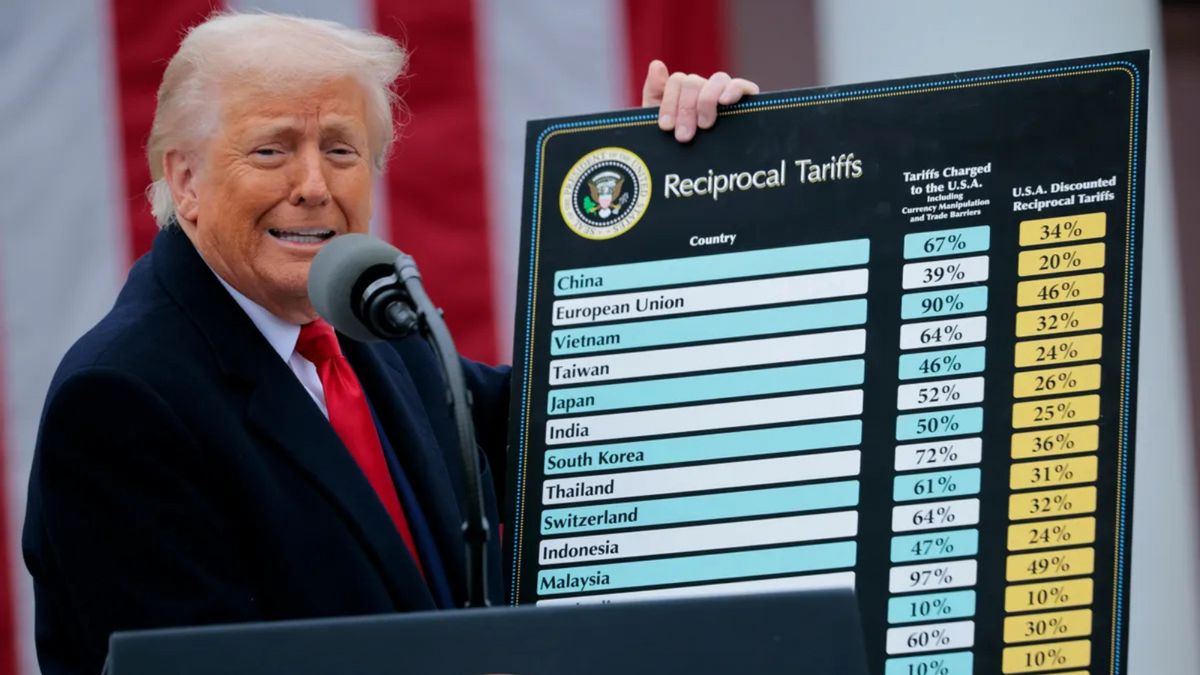
Trump held up a list of countries with the reciprocal tariffs he planned to impose on them, ranging from 10% to 49%. He said the tariffs would represent half of the tariffs these nations impose on U.S. goods, a calculation that supposedly includes "currency manipulation and trade barriers." These individual reciprocal tariffs were set to take effect on April 9. The same list was later shared in a series of four posts on X (archived). Further, he announced that all countries would have tariffs imposed at a minimum 10%, effective April 5.
The markets' reaction was swift. Stocks plummeted around the world while investors sought safety in bonds:
Stocks fell further on April 4, 2025, after China retaliated with 34% tariffs on U.S. imports.
Meanwhile, investors expected the dollar to rise, as a currency normally does when people are expected to spend less of their money on foreign goods.
But the projected magnitude of the tariffs' impact on the U.S. economy was such that the reserve currency dropped instead. "The dollar is being sold against the big, liquid defensive currencies of the Japanese yen and Swiss franc and, to a lesser degree, the euro," Chris Turner, the global head of head of markets and regional head of research for the U.K. and Central and Eastern Europe at ING wrote in a note. "Here, the blowback of U.S. tariffs onto the U.S. domestic economy leaves the dollar naked."
Asked what may have driven the dollar's depreciation, Kimberly Clausing, an economist at UCLA who has written extensively about tariffs, said in an email that it "reflects some loss of confidence in the U.S. market, as ordinarily both the tariffs and the fiscal expansion (that Congress is presently preparing) would appreciate the dollar." Referring to the country's future ability to borrow money, she added: "This basically signals a higher risk premium on U.S. borrowing."
"The [April 2] announcement was worse than I expected," Clausing said in the email. "Tariffs were both higher and less principled than anticipated." She warned against consequences on the Peterson Institute for International Economics website:
These tariffs lack any principled rationale, and they risk economic catastrophe. The largest tax increase in more than fifty years will burden U.S. consumers, generating thousands of dollars in tax increases for the median household. Retaliation and the tariffs on intermediate goods (a majority of U.S. imports) will harm U.S. investment, production, and growth. Trump may wager that tariffs will return us to a better economic time but, in reality, they will leave behind only broken partnerships and economic devastation.
On X, Olivier Blanchard, a professor emeritus of economics at MIT, called the sweeping reciprocal tariffs "simply stupid" (archived):
Running bilateral trade surplus/deficits with different countries is the way it should be. Trying to eliminate each one is simply stupid.
I have a trade deficit with my grocer, a trade surplus with my employer. I am not sure it would be a great idea for me to work for my grocer.…— Olivier Blanchard (@ojblanchard1) April 3, 2025
As Snopes reported in September 2024, sweeping tariffs are inflationary. On March 28, 2025, a consumer sentiment survey from the University of Michigan reported that inflation expectations were as high as they were in 2022, when the U.S. reached the highest inflation in more than 40 years. But after the announcement, the Yale Budget Lab estimated that the tariffs would represent an annual loss of $3,800 for the average household in the U.S. in additional expenses.
The choice of territories targeted as well as the calculations Trump's team used to reach these numbers also baffled many, as Snopes reported previously.
Here, Snopes is tracking the current state of U.S. tariffs, including their impact on the country's relationships with other countries.