
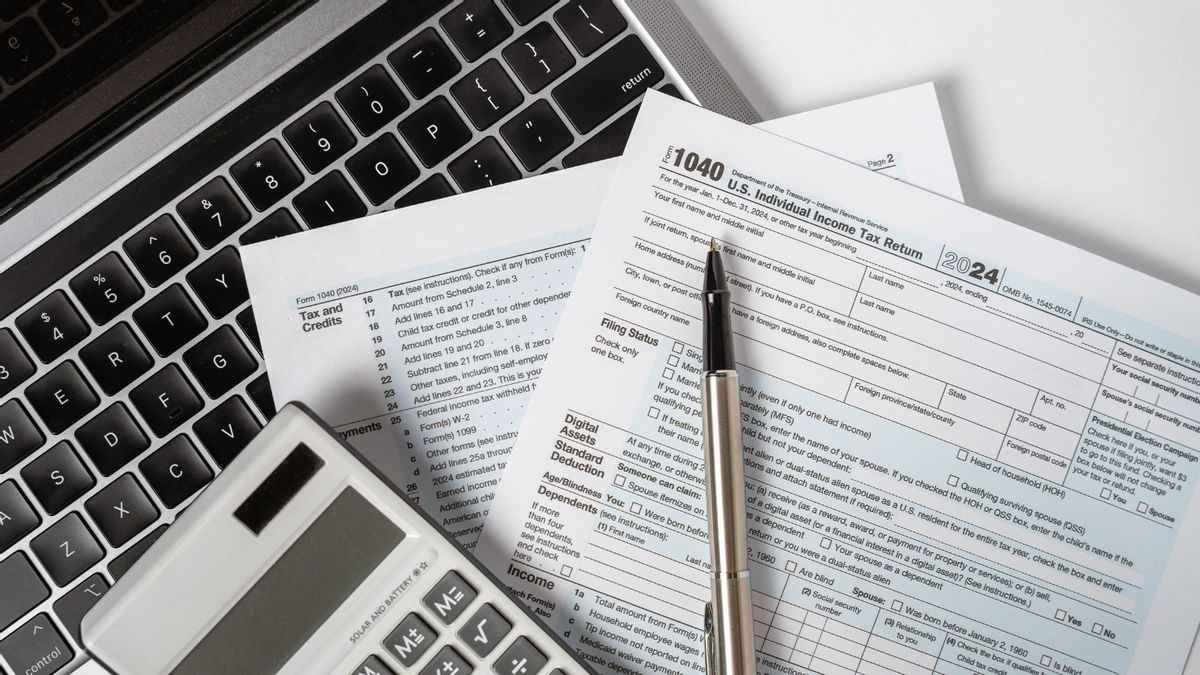
The deadline for filing federal tax returns for tax year 2024 is April 15, 2025. If you haven't filed yet, you might be able to do so for free online through the IRS Free File portal, which offers pathways for U.S. taxpayers to submit their federal tax documents online and at no cost using guided tax preparation — either at an IRS partner site or by filling out forms online for themselves. (Both options are only for federal taxes, though some partners may also offer free or paid state filing options.)
IRS Free File is a nonprofit, public-private partnership between the IRS and the Free File Alliance, a coalition of tax preparation and filing companies, to provide free federal tax preparation in two ways. The service may be used to prepare taxes only for the current year, as only registered tax preparers can file for the previous two tax years.
Guided tax preparation for incomes of $84,000 and less
Individuals who qualify for the guided tax preparation must have an adjusted gross income of $84,000 or less for tax year 2024. (AGI is defined as gross income minus adjustments to income, according to the IRS.) This option connects taxpayers with companies belonging to the Free File Alliance to prepare and file federal taxes online at no cost to qualifying taxpayers.
Using the free fillable form for incomes above $84,000
Taxpayers whose adjusted gross income was over $84,000 in 2024 can use the fillable forms online through the IRS website. These include federal tax forms like 1040, used for individual income tax returns. Qualified taxpayers may file these forms themselves using the form instructions and IRS self-help guides available on the website.
How to get started
After determining the correct income bracket, taxpayers can choose either the IRS Free File or Free Fillable Forms option.
Taxpayers with an AGI of $84,000 or less can begin the filing process at the IRS.gov website — users won't be able to get the free file option directly from affiliated companies' websites. Filers should only use companies verified by the IRS that are linked directly to the website. A redirection link will take the filer to a partner website for account creation. The IRS Free File offer can be viewed in greater detail on the IRS website.
Incomes above $84,000 are still eligible for the Free File Fillable Forms option, which requires that taxpayers fill out and file the forms themselves. There is no tax preparation guidance, and only limited calculations are provided. It is recommended that users familiarize themselves with IRS forms, instructions and publications.
Documents needed to prepare and file taxes
The following documents are required to file annual federal taxes using the free programs, according to the IRS.gov's Free File webpage.
Personal information
- A copy of last year's tax return in order to access AGI.
- Valid Social Security numbers for oneself, one's spouse and any dependents, if applicable.
- Income and receipts for:
- Social Security benefits.
- Unemployment compensation.
- All receipts pertaining to a small business, if applicable.
- Income receipts from rental, real estate, royalties, partnerships, S corporations and trusts.
Other income documentation
- W-2s showing annual wages from all employers.
- Form 1099-INT showing interest paid throughout the year.
- Form 1099-G showing any refund, credit or offset of state and local taxes.
- Forms 1099-DIV and 1099-R showing dividends and distributions from retirement and other plans paid during the year.
Filers with health insurance purchased through the Health Insurance Marketplace will also need:
- Form 1095-A Health Insurance Marketplace Statement. (For more information see Affordable Care Act tax provisions.)
- Form 8962, Premium Tax Credit.
Instructions for filing electronically
- When self-preparing taxes and filing electronically, filers must sign and validate their electronic tax return.
- Verify identity using last year's AGI or last year's self-select signature personal identification number.
- Have a valid email address so that the IRS may verify it has received the filing.
Securing personal data online
The IRS notes that individual information is protected when it is sent to the IRS or its partner companies, who are not allowed to disclose or use tax return information for reasons other than filing taxes. All entities are also subject to Federal Trade Commission Privacy and Safeguards Rules, as well as the IRS e-file regulations.
Users are encouraged to peruse the IRS Free File information page. If more time is needed, qualified filers may also ask for an extension to file, pushing back the deadline to Oct. 15, 2025.