
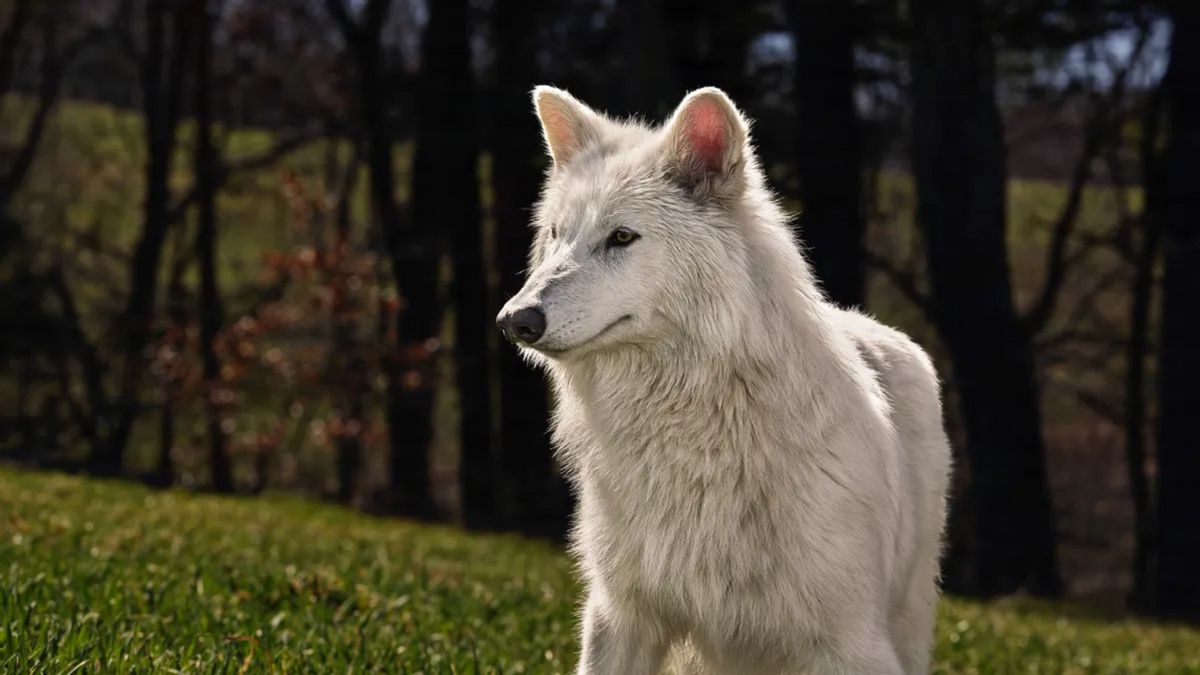
On April 7, 2025, the American biotechnology company Colossal Biosciences announced something huge: Using genetic editing technology, it had brought an extinct species, the dire wolf, back from the dead. The purported feat made the cover of Time magazine and was widely reported in the news.
A significant portion of the scientific community quickly pushed back, however, claiming the pups weren't dire wolves at all.
"This is not a dire wolf. They cannot do de-extinction. They can just tweak living animals to have primitive features," one paleontologist wrote on X. A geneticist called the animals "optimistically 1/100,000th dire wolf" on Bluesky.
Snopes readers asked whether the story was true — whether the company had successfully "de-extincted" the dire wolf.
The answer depends on whom you ask. Either way
Snopes reached out to Colossal Biosciences and several researchers unaffiliated with the work for comment. We received statements and pre-print scientific research from the company but have not heard back from the unaffiliated researchers.
What is Colossal Biosciences?
Over the course of the Earth's 4-billion-year history, scientists have identified at least five mass extinction events — short periods of time where large proportions of living things went extinct. For more than 20 years, many scientists have argued that human activity, through mechanisms including climate change and invasive species, is creating a sixth mass extinction.
Colossal Biosciences is an American biotechnology company founded to resurrect the woolly mammoth, according to The New York Times. However, its goal has expanded to include using cloning and gene editing to help solve the mass extinction problem by propping up populations of endangered species
Alongside the dire wolf, Colossal's website highlights efforts to bring back the woolly mammoth (extinct about 4,000 years ago), the dodo (extinct in 1681), and the thylacine, or Tasmianian tiger (extinct in 1936).
What is a dire wolf?
Today, the dire wolf is probably most associated with George R.R. Martin's "A Song of Ice and Fire" fantasy books, adapted into the TV show "Game of Thrones." However, there was an actual animal called a dire wolf that lived across much of North America until about
The real dire wolf was a large wolf that existed alongside many doglike animals that still exist today, including the gray wolf and coyote. The apex predator went extinct around the end of the last Ice Age alongside many other giant mammals, including the saber-toothed cat and mastodon.
Scientists aren't sure why the dire wolf went extinct. The leading hypothesis is that it preyed on the giant plant-eating mammals found across North America and was not able to adapt fast enough as its prey went extinct.
The dire wolf, scientific name Aenocyon dirus, is placed alongside other wolves (and the dog), coyotes and jackals in the canine family. However, there is still debate about exactly where it fits into the family tree.
The dire wolf's closest living relative
A 2021 study in the journal Nature that included several co-authors associated with Colossal compared DNA from dire wolf fossils with DNA from seven living canine species, including the gray wolf and the coyote. The paper found dire wolves had a "distant evolutionary relationship" with the other canines, and that the last common ancestor between the two lived about 5.7 million years ago.
Colossal claims the dire wolf's closest living relative is the gray wolf. However, one argument against calling the animals dire wolves relies on the claim that the dire wolf's closest relative is instead the jackal.
Snopes asked why Colossal used the gray wolf genome as part of the process to create its dire wolf pups. In response, the company shared a pre-print scientific research paper (meaning it had not yet gone through the rigors of peer review) aiming to clarify the dire wolf's place in the canine family tree. This paper was not yet available online.
As a part of the dire wolf project, Colossal needed to understand what the dire wolf's genome, or complete genetic code, looked like. Because the dire wolf is an extinct animal, this was not an easy task.
Scientists compared dire wolf DNA they had extracted from two fossils with the gray wolf genome.
The pre-print study found the dire wolf was part of a lineage that split from other canine species around the
"The lineage that eventually evolved into dire wolves interbred extensively with the lineage that ultimately evolved into gray wolves deep in evolutionary time," Beth Shapiro, Colossal's chief science officer, said in a statement provided to Snopes. "As a consequence, if we sum across all of the ancestry in dire wolves that lived during the last ice age, we see that they are more closely related to gray wolves overall than they are to jackals."
In simpler terms, because the findings suggested dire wolves contributed some DNA to the modern gray wolf down the line, Colossal claims the gray wolf is the closest living relative to the dire wolf.
What did Colossal claim to do?
On April 7, several news outlets, including Time, published stories outlining a recent breakthrough at Colossal — the birth of three dire wolf pups named Romulus, Remus and Khaleesi.
Colossal's website featured the following description of the project:
On October 1, 2024, for the first time in human history, Colossal successfully restored a once-eradicated species through the science of de-extinction. After a 10,000+ year absence, our team is proud to return the dire wolf to its rightful place in the ecosystem. Colossal's innovations in science, technology and conservation made it possible to accomplish something that's never been done before: the revival of a species from its longstanding population of zero.
The science involved in their birth, regardless of whether the pups are dire wolves or not, was remarkable.
After extracting the DNA from the dire wolf fossils (one of which was more than 72,000 years old) and analyzing it, the company took a sample of blood vessel cells from gray wolves and used gene editing technology to recreate 14 dire wolf genes. (This means that none of the original DNA extracted from the dire wolf fossils made it into the pups.)
The altered DNA was placed into fertilized egg cells, which were incubated to create embryos. The embryos were inserted into the wombs of surrogate mother dogs, who gave birth to the genetically modified pups.
What does 'de-extinction' mean?
Colossal's website includes a significant amount of information about the term "de-extinction" — specifically, how it hopes to redefine it.
The website begins by citing the "simplistic definition" of de-extinction found on Wikipedia, likely in line with the general public's understanding: "the process of generating an organism that either resembles or is an extinct species."
Colossal says this definition is not "accurate nor comprehensive enough" to describe its goal. The company provides an alternate definition:
noun.
The process of generating an organism that both resembles and is genetically similar to an extinct species by resurrecting its lost lineage of core genes; engineering natural resistances; and enhancing adaptability that will allow it to thrive in today's environment of climate change, dwindling resources, disease and human interference.
In other words, according to Colossal, a de-extinct animal:
1. Needs to look like the extinct animal.
2. Needs to have DNA similar, but not necessarily identical, to that of the extinct animal.
This definition is similar to one found in a 2016 report by the International Union for the Conservation of Nature (IUCN), best known for maintaining the
Colossal claims its pups are dire wolves because they meet both qualifications of its definition: They look like dire wolves and have similar DNA.
Or, according to a statement from Shapiro, "Our dire wolves are functional replacements designed to express the key traits that made dire wolves unique —Fiucn their size, musculature, coat characteristics, and potentially their ecological role."
(It's unclear what "ecological role" the pups would fill — the ecosystem has adapted to life without the dire wolf since it went extinct around 10,000 years ago. Colossal has said it does not plan to release its pups into nature, according to USA Today.)
So, are these new wolf pups dire wolves?
Philip Seddon, a professor of zoology at New Zealand's University of Otago who chaired the IUCN task force that published the report defining de-extinction, told the Science Media Centre of New Zealand he did not consider the pups dire wolves.
"They are claiming this as the world's first de-extinction, but while no doubt it has required some amazing technological breakthroughs, the cute pups … are not dire wolfs – they are genetically modified grey wolves."
Julie Meachen, a Des Moines University paleontologist who is not affiliated with Colossal but co-authored both the 2021 paper and 2025 pre-print, told ABC News she was impressed but did not consider the pups dire wolves. "What we had is something new — we have a mostly gray wolf that looks like a dire wolf."
Colossal disagrees with this argument. In a statement, the company said:
So many experts out there are demanding that species are defined solely by their DNA. That's some version of "insane". Even evolutionary biologists can't agree on species definitions. Mammoth species? Defined by teeth ridges. Ancient bison? Horn shapes. […] Brown bears and polar bears, humans and Neanderthals, wolves and coyotes are all different species unless you apply the most commonly taught species concept, which would classify them as the same species because they can interbreed and produce healthy, fertile offspring.
[…]
Why did we stop at 14 genes and 20 edits? Because we didn't need more and because we prioritize animal welfare. Every modification carries risk, and our primary goal was creating healthy animals with extinct traits. We meticulously evaluated each edit for safety and successfully birthed healthy animals that both resemble dire wolves and manifest the traits we targeted. Now critics are having meltdowns because we didn't make hundreds or thousands of unnecessary, risky edits just to satisfy one particular interpretation of what constitutes a species? No thank you.
"Species" is indeed a weighted term — a 2024 The New York Times story noted that a 2021 survey found biologists used 16 different definitions for the word. One biologist simply said, "Everyone uses the term, but no one knows what it is."
Colossal's statement concluded by saying detractors were missing the point:
We totally understand that some scientists are not comfortable calling these dire wolves because they feel like the wolves are not sufficiently genetically similar to a particular extinct individual to merit that name. That's ok with us. This is not a fight that we care about. We're calling them dire wolves, and if you prefer something else (how about "Colossal's dire wolves"?) that works too. And maybe also take a breath and think about what the birth of these technologies means to the future of our planet instead of nitpicking terminology.
Internet science educator Hank Green released a video in which he concluded the pups were gray wolves edited to look more like dire wolves. But he also thought ahead to the future.
"I don't think that you would make the case that this is a new species, but if you did, it's not going to be a dire wolf, it would be a synthetic species," he said. "If you can do multiplex gene editing, we have to wrestle with the reality that we can now probably create synthetic species," he said.
Green acknowledged Colossal was financially incentivized to market the pups as revolutionary but said the science was still quite astonishing.
"What was done is in some ways more remarkable, but also almost certainly more scary, than de-extinction," he said.