
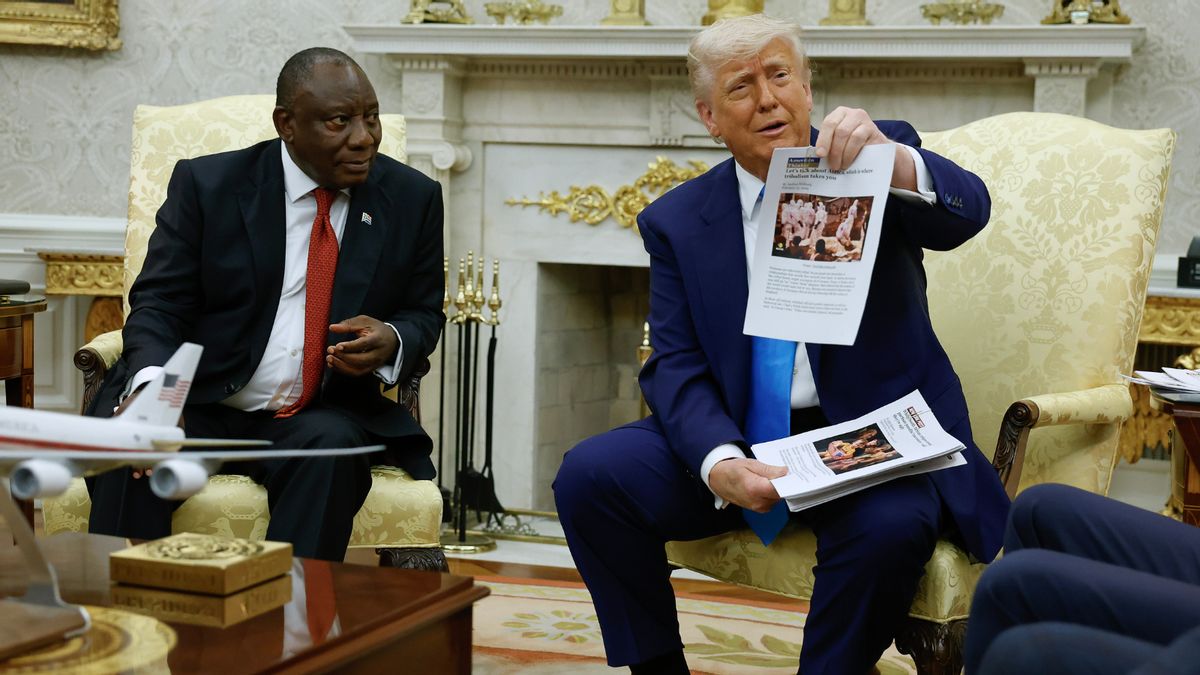
In late May 2025, during a tense meeting with South African President Cyril Ramaphosa, U.S. President Donald Trump presented a series of visuals as alleged evidence of a "white genocide in South Africa."
The meeting occurred after Trump admitted 59 white South Africans from the Afrikaner minority group into the United States, saying they would be granted refugee status on account of facing "racial discrimination" in South Africa. The South African government in turn said these Afrikaners were not facing discrimination that would warrant their being granted refugee status.
Trump has promoted the "white genocide" conspiracy theory since 2018, referring to alleged systematic, large-scale killings of white farmers in South Africa. We covered the claim here, and found the assertion to be false.
Below, we debunk the so-called visual evidence Trump provided during the Oval Office meeting with Ramaphosa. We also reached out to the White House for comments on Trump's debunked claims. It did not respond to our questions about why Trump misrepresented the footage and photograph below, instead directing us to news stories about murders of white farmers, criticisms of Ramaphosa's land seizure law, and discrimination complaints from white South Africans.
Were white crosses placed above burial sites of murdered white farmers?
In short, no. Trump showed Ramaphosa a video clip of a long line of cars on a highway lined with white crosses. Trump claimed these were "burial sites," to which Ramaphosa asked for the location. Their exchange went as follows:
TRUMP: These are burial sites right here [...] over a thousand—of white farmers. And those cars are lined up to pay love on a Sunday morning. Each one of those white things you see is a cross. There's approximately a thousand of them. They're all white farmers, the family of white farmers. Those cars aren't driving. They stop there to pay respect to the family members' who are killed. And it's a terrible sight, I've never seen anything like it. Both sides of the road you have crosses. Those people are all killed.
RAMAPHOSA: Have they told you where that is, Mr. President? I'd like to know where that is, because this, I've never seen. [...]
TRUMP: I mean, it's in South Africa [...]
The footage was also shared by the White House's official YouTube account alongside a caption saying, "Each cross represents a white farmer who was murdered in South Africa."
However, Trump misrepresented the video. We found an early example of the same footage on YouTube dated September 2020. News reports from the time showed the white crosses were erected along the highway in protest against the recent killing of a white couple on their farm — and a spate of farmer murders over several years — and were not grave markers above actual burial sites. Satellite images on Google Earth show those crosses have been taken down since then. As such, this part of Trump's claim was false.
Based on South African news sources, the protest with white crosses took place after the murder on a farm of Glenn and Vida Rafferty in September 2020 outside the hamlet of Normandien. The protest took place near the town of Newcastle in northern KwaZulu-Natal province. News reports from 2020 indicate that locals erected hundreds — not thousands as Trump claimed — of these crosses along the highway. After a memorial service, locals drove their cars in what they called the "Move One Million" drive from Newcastle to the Rafferty farm to honor the memory of the couple.
Darrell Brown, a local who helped organize the protest, told SABC News at the time: "The message we are trying to convey is farm murders must stop. I don't mean just murders of white commercial farmers. Farm murders must stop. More needs to be done [...] Each and every one of these crosses represents almost 10 commercial farmers that have been murdered over the last few years. And as you see there's over 500 crosses."
Per a report from the Institute of Race Relations, an anti-apartheid think tank in South Africa, the protest saw both Black and white participants mourning the deaths. One protester told the IRR: "We are supporting each other. There should be no killing anymore. White or black, we are all one."
In November 2022, two men were convicted in the Rafferty killing, each receiving life sentences for the murder and additional sentences for robbery and housebreaking.
Al Jazeera English highlighted statistics from South Africa's Transvaal Agricultural Union (TAU) — a group that was critical of Ramaphosa for passing laws they say discriminate against white people — which found total numbers of farm murders
We should note that white people own the vast majority of farmland in South Africa — roughly 80% per the 2017 census — but per the above calculations (1,363 white farmer deaths since 1990), whites still account for less than 1% of total murders in the country. In our past coverage, we found that South Africa's farm murders hit a low point in 2017-2018. CNN found police statistics detailing 62 farm murders in that year, only 0.3% of the 20,336 murders in the country in that time frame. The Raffertys were murdered during an attempted robbery, and not specifically due to their race. Afrikaner agriculture union TLU-SA said farmers are susceptible to attacks due to their isolation. Experts told PBS the vast majority of victims of everyday murders in South Africa are Black.
Gareth Newham of the Institute of Security Studies, an African policy think-tank, told CNN, "There is no evidence that a group of people are killing farmers for political purposes. There is no evidence that they are doing it because they are listening to political leaders. It is happening
Ramaphosa and his delegation made the same comment to Trump during their Oval Office meeting, arguing that they were facing a crime problem in South Africa and they need the United States' technological support to address the issue.
We found footage from early September 2020, soon after the Rafferty murders occurred, showing sections of the highway where the crosses were erected and a sign criticizing Ramaphosa.
Comparing the above footage to satellite images from Google Earth, we were able to estimate the location on the P39-1 highway where the protests occurred. The most recent satellite images we observed were captured in 2023 and showed the crosses are no longer in that location.

(Screenshots via YouTube/André Boies/Google Earth/Snopes reporter Laerke Christensen)
In May 2025, Roland Collyer, nephew of the murdered couple, showed the BBC the same stretch of land where the crosses were put up and pointed out they had been removed since then. Rob Hoatson, the Raffertys' neighbor, told the BBC, "It's not a burial site [...] It was a memorial. It was not a permanent memorial that was erected. It was a temporary memorial."
Where was the photograph of body bags from?
The photograph that Trump claimed showed burials of white farmers was not from South Africa. Trump held up this article from the American Thinker blog, a right-leaning publication, and claimed: "Look, here's burial sites all over the place. These are all white farmers that are being buried."
The article, written in February 2025 by Andrea Widburg, carried the headline, "Let's talk about Africa, which is where tribalism takes you," and criticized the left's focus on identity: "... leftists have steadily been balkanizing us. Now, our loyalties lie not with nation and values, but with people who share our skin color, our nation of origin, being a conservative or a leftist, or being hetero- or homosexual."
The image Trump pointed to is a YouTube screengrab. The article directs to the following video from WION, an Indian news site.

(Screenshot via WION/YouTube)
The video was uploaded on Feb. 7, 2025, and the caption states:
Over 100 women raped, burnt alive during mass jailbreak in Congo amid rebel conflict. Horrific atrocity follows the escape of thousands of male inmates amid chaos. Chaos unfolded as a Rwandan-backed rebel group entered the Congo's Goma last week. Senior UN official says female inmates were attacked inside Goma's Munzenze prison. Watch to know more!
Reuters published this footage on Feb. 3 and confirmed it showed humanitarian workers lifting body bags in the Congolese city of Goma after it was attacked by M23 rebels. Djaffar Al Katanty, the Reuters video journalist covering the incident, said, "That day, it was extremely difficult for journalists to get in [...] I had to negotiate directly with M23 and coordinate with the ICRC to be allowed to film [...] Only Reuters has video."
In sum …
Trump misrepresented both the photograph from the Democratic Republic of Congo and a protest video from South Africa, and made false statements about each item presented. Neither image shows evidence of systematic mass murders of white farmers in South Africa that could reasonably be said to constitute a "white genocide."
Farmer murders have indeed taken place in South Africa and have been acknowledged as a crime issue by the South African government. The 2020 protests saw both Black and white South Africans condemn the killings.