
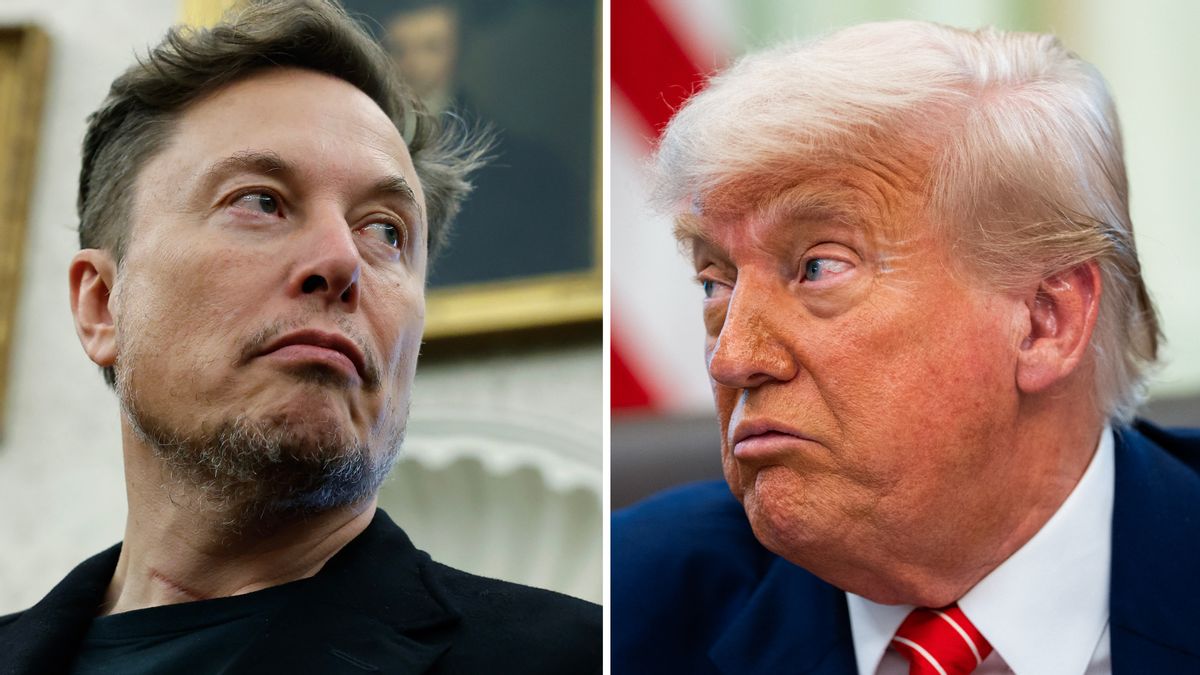
U.S. President Donald Trump and tech billionaire Elon Musk, a former special government employee and Trump adviser, once presented themselves as the ultimate bromance in U.S. politics — but as their relationship crashed and burned in mid-2025, speculation and questions about what caused their very public breakup circulated online.
"Who else still doesn't understand why Elon Musk and Donald Trump are fighting?" wrote one confused X user.
The fight between Musk and Trump appeared to center around Musk's criticism of Trump's One Big Beautiful Bill of tax breaks and spending cuts, which Musk called a "disgusting abomination." Trump, on the other hand, lamented that he once "had" a great relationship with Musk and claimed Musk's anger was over cuts to electric-vehicle tax credits in the bill — credits that would have benefited Musk's car company, Tesla.
"I'll tell you, he's not the first," Trump said (at 1:13). "People leave my administration and they love us, and then at some point they miss it so badly. And some of them embrace it and some of them actually become hostile. I don't know what it is, it's sort of 'Trump derangement syndrome' I guess they call it."
Still, news outlets and late-night hosts speculated about the "real reasons" Musk was feuding with Trump. Some X users alleged Musk had simply pretended to support Trump to receive the EV subsidies. Meanwhile, conspiracy theorists argued that the fight was planned as a distraction or so Musk could sell cars to liberals and Trump could stop appearing beholden to the world's richest man.
Much of what we know about Trump and Musk's relationship comes from reporting based on anonymous sources inside the White House who fear losing their jobs, making it impossible to definitively determine based on public information if there was a "real" reason for the spat. In response to an inquiry, the White House ignored detailed questions asking for evidence of various claims and allegations made by Trump and Musk, instead providing a boilerplate statement that had been sent to Snopes previously.
"This is an unfortunate episode from Elon, who is unhappy with the One Big Beautiful Bill because it does not include the policies he wanted. The President is focused on passing this historic piece of legislation and making our country great again," read the statement from Karoline Leavitt, the White House press secretary.
On June 11, 2025, Musk posted on X that he regretted some of his posts about Trump. "They went too far," he said.
Below, we break down what has been reported, what Trump and Musk have said and what they appeared to be fighting about:
Musk and Trump's close relationship publicly began when the SpaceX founder endorsed Trump for president on July 13, 2024, in an X post following an assassination attempt on the president in Pennsylvania. Musk poured nearly $300 million into Trump's campaign, and shortly after Trump won, he appointed Musk to head the Department of Government Efficiency, a new initiative dedicated to cutting government spending.
As Musk used a literal chain saw to promote his cuts to government agencies, outwardly, the two could not have been more agreeable to each other. However, reputable news outlets — citing anonymous sources in the White House — painted a more complicated story. In March, The New York Times reported cabinet officials were growing increasingly frustrated with the billionaire's "unchecked power," culminating in an explosive meeting over Musk's efforts to slash spending via mass layoffs of federal workers.
The meeting, the Times reported, "yielded the first significant indication that Mr. Trump is willing to put some limits on Mr. Musk," as Trump reportedly said that from that point on, "the secretaries would be in charge; the Musk team would only
In
But the WSJ reported in May that the president and his staffers had expressed various frustrations over Musk's erratic messaging and his deep investment in a Wisconsin Supreme Court race. The candidate Musk backed, Brad Schimel, was a conservative backed by the Republican Party, but White House aides believed he would not win the race and it would become a referendum on Musk and Trump. (They were right.)
Axios reported in June that Musk wanted the Federal Aviation Administration to use his Starlink satellite system for national air traffic control — but "the administration balked at it because of the appearance of a conflict of interest and for technological reasons."
Snopes has not independently verified the reports from Axios, The Wall Street Journal and The New York Times.
Fighting spills into public view
On April 5, news outlets reported that Musk posted, then deleted, an X post disparaging Trump's top trade adviser, Peter Navarro. "A PhD in Econ from Harvard is a bad thing, not a good thing," Musk said in reference to Navarro's degree, adding that Navarro "hadn't built s***." On April 8, Musk called Navarro a slur for developmentally disabled people, "truly a moron" and "dumber than a sack of bricks" in several X posts.
Musk's frustrations with Navarro appeared to be over Trump's tariff policy, which Navarro was largely in charge of. (Musk said in an X post on June 5 that he believed Trump's tariffs would cause a recession in "the second half this year.")
Musk then began publicly criticizing the One Big Beautiful Bill Act in a May 27 interview with CBS News, saying he was "disappointed" to see that the "massive spending bill" would increase the budget deficit, adding that it "undermines the work DOGE has been doing" (see 6:00).
The next day, Musk announced that his "scheduled time" as a special government employee was coming to an end. Trump presented Musk with a key to the White House on May 30 and called him an "incredible patriot" (see 11:40). Musk said he'd "expect to remain a friend and an adviser" and that he was "at the president's service" (see 20:13). Axios reported, however, that Musk had discussed trying to stay in that role beyond the 130-day time limit for special government employees but White House officials denied the request.
On June 1, Trump announced on Truth Social that he would withdraw a nomination of a Musk ally, Jared Isaacman, to head NASA after a "thorough review of prior associations." Based on other comments, Trump was likely referring to Isaacman's past donations to Democrats — but Axios reported that for Musk, the withdrawal was the "final straw."
"I'm not going to play dumb on this — I don't think timing was much of a coincidence. … There were other changes going on the same day," Isaacman said at the 50:04 mark in an "All-In Podcast" episode published June 4, presumably referencing Musk's departure.
The big blowout
On June 3, Musk posted that he "just can't stand it anymore."
"This massive, outrageous, pork-filled Congressional spending bill is a disgusting abomination," he wrote.
Over the next few days, Musk's X feed largely consisted of criticizing the budget bill. He repeatedly raised concerns over "debt slavery" — enslavement for unpaid debts — and the bill's potential effect on the national deficit. He began outright lobbying against the bill, calling on his followers to "kill the bill."
In a June 5 Oval Office meeting with German Chancellor Friedrich Merz, Trump said he was "very disappointed" to see Musk's tirade (see 4:09).
"I've always liked Elon, and so I was very surprised," Trump said. "He hasn't said anything about me that's bad. I'd rather have him criticize me than the bill, because the bill is incredible. It's the biggest cut in the history of this country."
Trump claimed Musk "knew the inner workings" of the bill better than many in the administration and "had no problem with it" until they cut the EV
"He said the most beautiful things about me. And he hasn't said bad about me personally, but I'm sure that'll be next," Trump said (see 21:55). "But I'm very disappointed in Elon. I helped Elon a lot."
As Trump predicted, Musk turned to personal attacks: Musk claimed Trump wouldn't have won the election without him, amplified a call for Trump's impeachment and alleged the Trump administration hasn't released files related to deceased sex offender Jeffrey Epstein because the president is in them.
Minutes before Musk posted about the Epstein files, Trump posted on his Truth Social account, "Elon was 'wearing thin,' I asked him to leave, I took away his EV Mandate that forced everyone to buy Electric Cars that nobody else wanted (that he knew for months I was going to do!), and he just went CRAZY!"
Minutes after Musk posted his allegations that Trump was in unreleased Epstein-related files, Trump appeared to respond, without directly referencing Musk's claim. Trump's post read, "I don't mind Elon turning against me, but he should have done so months ago. This is one of the Greatest Bills ever presented to Congress. It's a Record Cut in Expenses, $1.6 Trillion Dollars, and the Biggest Tax Cut ever given. If this Bill doesn't pass, there will be a 68% Tax Increase, and things far worse than that. I didn't create this mess, I'm just here to FIX IT. This puts our Country on a Path of Greatness. MAKE AMERICA GREAT AGAIN!"
Trump also threatened to take away Musk's government contracts in a Truth Social post the same day: "The easiest way to save money in our Budget, Billions and Billions of Dollars, is to terminate Elon's Governmental Subsidies and Contracts. I was always surprised that Biden didn't do it!"
Musk, in a now-deleted response, threatened to decommission the SpaceX capsule used to take astronauts and supplies to the International Space Station — before backing off from the threat after an X user pleaded with him to cool off.
What exactly are they fighting about?
Let's discuss the actual policy the two men appear to be fighting about: the One Big Beautiful Bill Act.
First, a quick recap: Musk's criticisms of the bill, at least publicly, center on his belief it will increase the federal deficit. Trump says Musk is mad over the administration's decision to remove electric-vehicle tax credits — what the president called an "EV
While Musk initially supported eliminating the EV tax credit in 2023, he appears to have reversed his stance. The budget bill includes the elimination of a tax credit worth roughly as much as $7,500 for some Tesla models and other electric vehicles by Dec. 31, 2025, seven years ahead of schedule — see Section 112002 of the bill, "TERMINATION OF CLEAN VEHICLE CREDIT." JP Morgan estimated Tesla would lose $1.2 billion over the elimination, according to Bloomberg.
Thus, it is accurate to say Musk stands to lose money over the removal of the tax credit. But Musk, in response to Trump's comments in the Oval Office, claimed on X that he cared more about what he believed was wasteful spending in the bill.
"Whatever," he said. "Keep the EV/solar incentive cuts in the bill, even though no oil & gas subsidies are touched (very unfair!!), but ditch the MOUNTAIN of DISGUSTING PORK in the bill."
Musk's attacks centered on what he believed was Trump's about-face on raising the debt ceiling — a limit Congress sets as to how much money the government can borrow — as well as the fact the budget bill would increase the deficit. Part of Musk's tirade against Trump involved him pulling out old Trump posts about the deficit to paint the president as a hypocrite.
It is true that Trump was against raising the federal deficit before he became president — but he raised the ceiling multiple times during his first term. In a June 4 Truth Social post, he said he wanted to abolish the debt limit entirely "to prevent an Economic catastrophe."
The nonpartisan Congressional Budget Office estimated the bill would increase the federal deficit by $2.4 trillion through 2034; that would grow to $3 trillion with interest, according to an analysis by the nonpartisan Committee for a Responsible Federal Budget — and $5 trillion with interest if temporary tax cuts were made permanent. As Trump had touted, the package also cuts spending by about $1.3 trillion, with most of that coming from cuts to Medicaid and food assistance, according to the CBO.
The bill would thus necessitate raising the debt ceiling, as the ceiling as of 2025 is $36.1 trillion, which the United States has already breached — the national debt, as of this writing, was $36.2 trillion, forcing the United States to take what's called "extraordinary measures" to temporarily prevent a default on the debt. Defaulting, the Department of the Treasury said, would result in "catastrophic repercussions."
In sum …
Private arguments and issues the Trump team had with Musk may have led to this very public fight, according to reputable news outlets. While the center of the fight appeared to be the One Big Beautiful Bill Act, the two were already at odds over Trump pulling the nomination of a Musk ally to lead NASA and Musk's opposition to Trump's tariff policy and the architect behind it, to name a few incidents.
In early June, Musk began attacking the budget bill, leading Trump to say he was "very disappointed" in the tech billionaire before posting a few of his own responses on Truth Social. Aside from Musk attacking the bill as being bloated and financially irresponsible, Musk also attacked Trump's character. Trump alleged Musk was actually upset with the bill's electric-vehicle tax-credit cuts and said the easiest way to reduce spending would be to take Musk's government contracts away.
In terms of the policy discussion, it is true the bill increases spending and the national debt, as Musk claimed, and it is true ending the EV tax credit would likely harm Tesla. At the end of the day, we can't say exactly what is going on in either man's head, making it impossible to know whether there's more to the fight — but the evidence suggests the budget bill is at least one major sticking point for the relationship.