
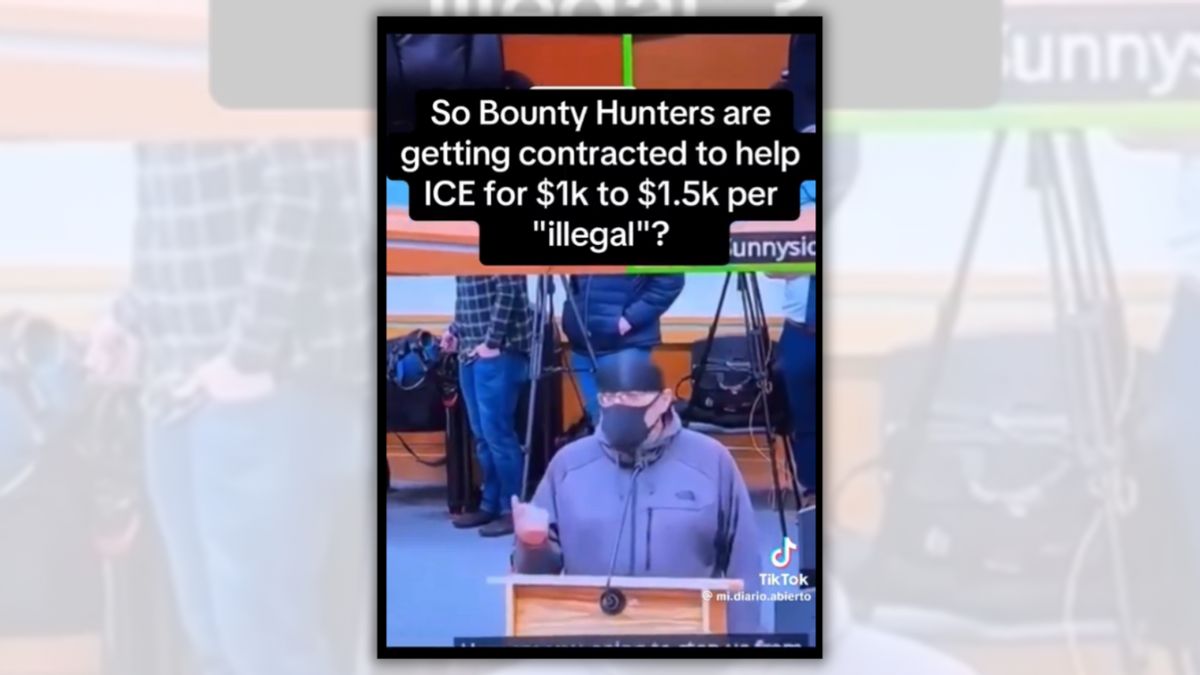
In June 2025, a claim (archived) circulated online that U.S. Immigration and Customs Enforcement (ICE)

(X user @charise_lee)
One X user wrote: "Bounty Hunters Deputized By ICE!! $1000.00 to $1500.00 PER UNDOCUMENTED IMMIGRANT Anyone walking around with their face covered is not working legally!!"
The claim circulated widely across Facebook (archived), Threads (archived), Instagram (archived), Reddit (archived), Bluesky (archived) and TikTok (archived).
But our investigation found no evidence of a formal plan for ICE to use bounty hunters to track down and detain people they believed were subject to removal from the U.S. in the way the claim described. White House spokeswoman Abigail Jackson said, "This is fake news and anyone caught impersonating a federal law enforcement official will be prosecuted to the fullest extent of the law."
Chuck Jordan,
We reached out to ICE to ask whether it had deputized bounty hunters or planned to do so in the future. We also reached out to a number of associations for bounty hunters or bail bond/fugitive recovery agents to ask if they could confirm this claim. We await replies to our queries.
The claim originally circulated in January 2025 after a man who identified himself as Martin Alvarado spoke during a news conference in Sunnyside, Washington. Alvarado said:
My name is Martin Alvarado, I'm a bounty hunter by trade. I've been introduced by my agency — I'm from Seattle — Tacoma called me and told me that as the waves go through, this is the first wave, the second and third is when they're going to hire us. ICE is going to hire us bounty hunters and they're going to be giving $1,500 to $1,000 per illegal. How are you going to stop us from coming through because we don't have to worry about warrants, we don't really have to follow too many of the laws, and if we're going to be deputized by ICE, we can pretty much do anything we want. They're already going over there and creating the squads as we speak, now, that's why they called me. So, as soon as I get back with my squad in Tacoma, we will be coming down the state. $1,000 per illegal is a pretty good price just to do things that you kind of enjoy. How are — what are you guys going to do to stop that? Are you going to pay us more? Are you going to pay us $2,000 to just leave them alone?
After another person in the room, who did not appear to be a city official, accused Alvarado of "creating panic." Sunnyside City Manager Mike Gonzalez asked security officials to remove Alvarado from the room.
Gonzalez told the Tri-State Herald at the time, "There are no bounty hunters with ICE. That guy was a bit out of his mind and I think was trying to stir the pot." We reached out to Gonzalez for any further developments with regards to Alvarado's statements since January.
We could not find Alvarado online to ask him to detail his claims, nor did he appear to have made them to any reputable media sources.
In June 2025, a Tacoma Police Department spokesperson said via email it had "no information" that would support claims that ICE was recruiting bounty hunters. Alvarado claimed "Tacoma" had called him to discuss hiring bounty hunters.
The scope of a bounty hunter
When asked about Alvarado's claim, Jordan said:
At this time and for the past several decades, bounty hunters (bail bond fugitive recovery agents) that work within the context of the commercial bail bond industry are permitted to apprehend illegal aliens that have been released from ICE custody after posting a bail bond underwritten by a bail bondsman (Surety) provided they have been contracted to do so by said bondsman.
Essentially, as we'll discuss in greater detail below, bounty hunters can already arrest people without lawful status in the U.S. — but only if they have a bail bond and work at the behest of a bond agent, not a government body.
We also found no evidence of a history of involvement between bounty hunters and ICE, though officials
The Federal Register listing for the program said, "DHS/ICE will collect all bonds and retain the funds, as appropriate, in the instance that a bond is breached." The listing did not mention the use of bounty hunters.
How bounty hunting works
A bounty hunter — also known as a bail enforcement agent or a fugitive recovery agent — is a person who tracks down defendants who skip bail, meaning they fail to show up for arranged court dates.
The entity that pays the bounty hunter is not the government but rather the bond agent who entered into a contract with the bounty hunter to track down the bail skipper at a rate of up to 25% of full bail, according to Jordan, depending on the case.
In the U.S., when defendants appear for an arraignment (typically the first court appearance after arrest) a judge will set an amount for bail if they don't regard the defendant as a flight risk and the defendant is not accused of a violent crime.
If a defendant cannot pay this amount the person must remain in jail and wait for the charges to be resolved.
However, as bail amounts can be higher than the average person can readily pay, defendants can also enter agreements with bail bond agents, or bail bondsmen, to post bail. Under these agreements, defendants pay a smaller amount of the bail (usually 10%) to the bail bond agent, who acts as a third-party guarantor, promising to cover the full amount if the defendant fails to appear at scheduled court appearances.
According to the 1872 Supreme Court ruling in Taylor v. Taintor, bondsmen or their agents may use "reasonable and necessary force" to return defendants who skip bail, meaning they fail to appear in court or otherwise breach bail conditions, invoking full payment of the bail amount.
Bounty hunters do not need warrants or reasonable cause to detain bail skippers. The late bounty hunter Bob Burton, who founded a bounty hunters' group that merged with NAFRA, explained in a 2005 HowStuffWorks article, "When the defendant signs the bail bond contract, they do something very important. They waive their constitutional rights."
"They agree that they can be arrested by the bail bond agent. And they waive extradition, allowing bondsmen to take them to any state," Burton added.
Hence, bounty hunters need no additional authority or "deputization" to find and arrest people without lawful status in the U.S. — but they can only make arrests if those people have skipped bail. The government agencies that bounty hunters hand defendants to typically do not pay bounty hunters directly — rather, the latter's cut comes from the bond agents whom defendants pay to post their bond.
In sum, the model Alvarado suggested — where ICE directly paid bounty hunters to bring in any people without lawful status in the U.S. — would require significant changes to the current authority of bounty hunters. Jordan said he was not aware that any such changes were underway.
The Trump administration previously ran a pilot program that made posting bond part of the visa process for access to the U.S. There was no evidence at the time of this writing that talks about this program were in progress again or that a revived version would include bounty hunters.
Snopes previously reported on a since-failed bill in the Mississippi House of Representatives that would pay bounty hunters $1,000 each time they helped successfully deport immigrants in the country illegally.