
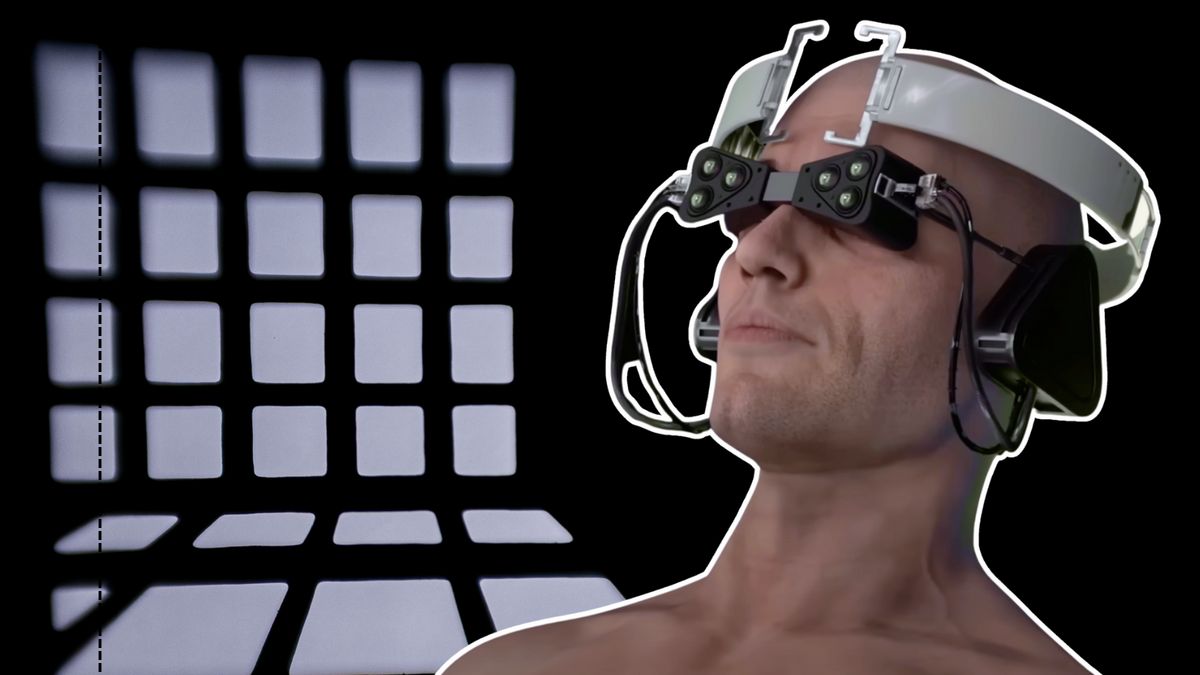
In late June 2025, a Snopes reader inquired about a supposed new technology known as "Cognify" that is changing how criminals are incarcerated.
"Is there really a program giving prisoners a choice to either serve their sentences or allow their memory to be wiped out with a process called Cognify?" the reader asked.
As it happened, a different reader had asked us a similar question a year earlier, in June 2024: "Are AI chips being developed to insert into prisoners brains to give them the feeling that they have served a 10-year prison sentence in 10 minutes?"
This supposed new method of incarceration has also been the subject of social media chatter. For example, one June 2025 X post (archived) that received 1.5 million views read: "The end of prison cells? New tech simulates decades of time in just minutes. A new concept called Cognify could let criminals serve 20+ year sentences in just 7 minutes — all through an AI-powered brain implant. This is beyond Black Mirror"

(X user @ProjectConstitu)
The X post above included a video that was a remake of a TikTok video originally posted (archived) on March 2, 2025. That original video had received 2.3 million views as of this writing. The TikTok user, whose bio identifies her as a content creator, described a system where criminals would "have a choice to spend tens of years behind bars, or they can make the choice to get the artificial memory and plant it into their brain." The video claimed the process "only takes about seven minutes, but to the patient, it seemed like it had been years."
But while Cognify is the name of an actual concept proposing the use of AI to drastically change the nature of incarceration and rehabilitation, no such technology currently exists. Here's what we know:
Cognify: Concept origin
The Cognify concept was created by Hashem Al-Ghaili, who is best known for publishing Facebook infographics (archived) about scientific findings and concepts.
Al-Ghaili posted (archived) the Cognify concept video on YouTube on June 24, 2024.
Soon after its release, news station KTTV in Los Angeles discussed it in a segment (archived) titled "Is this the 'prison of the future?'" and Fox Business covered it in a clip (archived) titled "Prison of the future? 'Cognify' proposes rehabilitation through artificial memories."
The Cognify concept video describes a system where prisoners would receive brain implants that create artificial memories of their crimes from victims' perspectives. The concept suggests this could compress years of rehabilitation into minutes.
In a follow-up video (archived) responding to a comment of the Cognify concept, Al-Ghaili stated:
This was in response to my new video concept Cognify, where you implant false memories into the prisoner's brains to help them rehabilitate faster. It's nothing wrong with it. It's a fantastic technology. It will help create a society free of crimes, and it could also help us treat conditions like memory loss, traumatic experiences, PTSD. We should all endorse it. You might think that this is still in the realms of science fiction, but in reality, it's already been done on animal models. Scientists have been implanting false memories into animals brains since 2013. So you can imagine how much we have progressed so far.
Al-Ghaili also claimed that "all we need is to generate specific videos customized to that memory that we want to implant, and then use the method that researchers used on animals and test them on humans," adding that "this technology is coming in, society won't be able to stop it."
Snopes reached out to team members of Tonegawa Lab at Massachusetts Institute of Technology, who conducted the 2013 research on implanting false memories in mice, for comment on the scientific feasibility of the claims.
Al-Ghaili has previously created concept videos that some people mistook for real, existing technology. In 2022, his artificial womb facility concept called EctoLife was shared as if it was an actual facility, leading to misinformation that Reuters fact-checked (archived).
Memory research background
The concept draws from scientific research into memory manipulation. Former MIT researchers Steve Ramirez and Xu Liu implanted false memories in mice in 2013 using optogenetics — a technique that uses light to control brain cells. In their experiments, mice displayed fear responses to environments where they had never experienced trauma.
"Memories can be unreliable. We created a false memory in mice by optogenetically manipulating memory engram–bearing cells in the hippocampus," the researchers wrote in the peer-reviewed journal Science. The mice reacted with fear to artificial memories.
Researchers have since demonstrated they can convert (archived) negative memories into positive ones in mice and transfer (archived) simple memories between marine snails. However, memory manipulation has so far been limited to basic emotional associations in laboratory animals.