
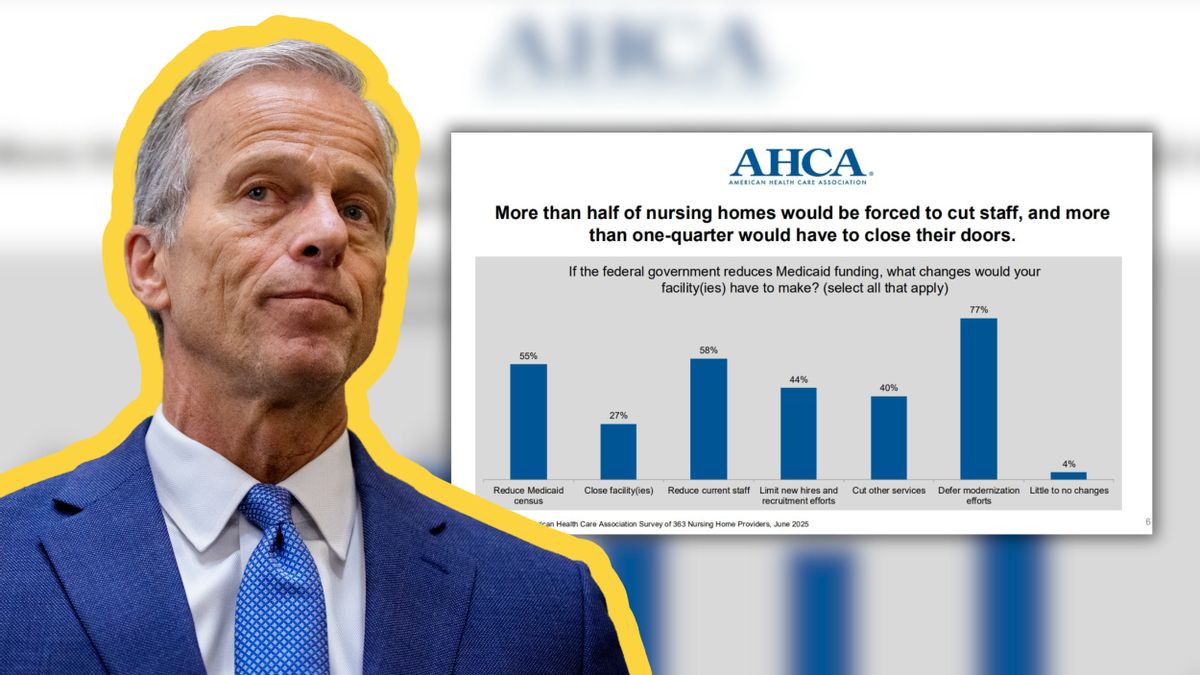
As budget legislation moved through (archived) the U.S. Congress in June 2025, social media posts warned that nursing homes nationwide faced closure if Medicaid spending cuts became reality. On July 4, 2025, those cuts became law when U.S. President Donald Trump signed (archived) the One Big Beautiful Bill Act.
For example, on June 28, U.S. Sen. Elizabeth Warren, D‑Mass., wrote (archived) on Facebook: " BREAKING: 1 in 4 nursing homes say they will be forced to close if Republicans pass Trump's Big Beautiful Bill. No grandma should be kicked out of her nursing home so that Mark Zuckerberg can buy another Hawaiian island."

(Sen. Elizabath Warren/Facebook)
The post had received more than 140,000 reactions and 8,200 shares as of this writing.
Similar claims appeared on Facebook (archived) from Social Security Works, an American political advocacy group that calls for expansion of Social Security, as well as on X (archived) from Jesse Ferguson, former deputy press secretary for Hillary Clinton's 2016 campaign.
The posts referenced survey data from the American Health Care Association (AHCA), a nursing home industry trade group. According to the organization's June 2025 "Provider Insights: Medicaid" survey of 363 nursing home providers, 27% indicated they would "close facility(ies)" if the federal government reduced Medicaid funding under the bill.
The survey asked: "If the federal government reduces Medicaid funding, what changes would your facility(ies) have to make?" Respondents could select multiple options. Beyond the 27% who said they would close facilities, 55% said they would reduce their Medicaid
Background on nursing home finances
The AHCA survey provides context for why nursing home operators have expressed concern about potential Medicaid cuts. According to the survey, 80% of nursing homes were operating at a loss or with narrow profit margins of 3% or less. Specifically, 30% reported operating at a loss, while 50% reported operating with total margins between 0-3%.
Medicaid serves as the primary revenue source for nursing homes, accounting for 59% of their income on average, according to the survey. However, 62% of providers report that Medicaid reimburses less than 80% of their actual costs of care, with 24% saying Medicaid covers less than 60% of costs.
The survey found that 79% of nursing home providers were "extremely concerned" about potential Medicaid reductions, with an additional 13% "moderately concerned."
Independent research examines closure risks
Meanwhile, a June 2025 analysis by Brown University School of Public Health researchers Vincent Mor and Fangli Geng commissioned by Senate Democrats identified 579 nursing homes nationwide at high risk for closure. According to the study, these facilities represent approximately 4% of all U.S. nursing homes and met three criteria: over 85% of patients on Medicaid, occupancy rates below 80%, and quality ratings of 1-2 stars on the Centers for Medicare & Medicaid Services (CMS) Five-Star Quality Rating System. The facilities were distributed across 45 states, with Illinois having 93 high-risk facilities, Texas 66, Ohio 41, Missouri 39, and Georgia 37.
Regarding potential impacts of Medicaid cuts, the researchers wrote:
It is difficult to say for sure, but a payment freeze lasting more than a year could nearly double the closure rate. People tend to enter nursing homes that are close to their homes or near where their families live, so closures often result in greater travel for residents and their families. In many communities, nursing homes are a major employer of low-skilled workers, particularly in rural and exurban areas. When they close, those in the community have to look further afield for employment, and in rural areas, discharged workers may need to relocate.
The Brown analysis focused on facilities currently meeting specific risk indicators, while the AHCA survey asked nursing home operators about their anticipated responses to hypothetical funding reductions. The researchers noted that facilities with high Medicaid populations would be "differentially adversely affected" by payment freezes since they have limited non-Medicaid revenue sources.
What the legislation would do
According to the Congressional Budget Office, baseline federal Medicaid outlays were projected to total $8.2 trillion over the next 10 years. Independent analyses, including those by the Kaiser Family Foundation (archived) and State Health and Value Strategies, estimated that the law will reduce Medicaid spending by approximately $880 billion over that period, based on the House-passed version.
House Republicans initially passed their version of the bill on May 22, 2025, but the Senate approved deeper cuts of around $930 billion before the final legislation was signed into law.