
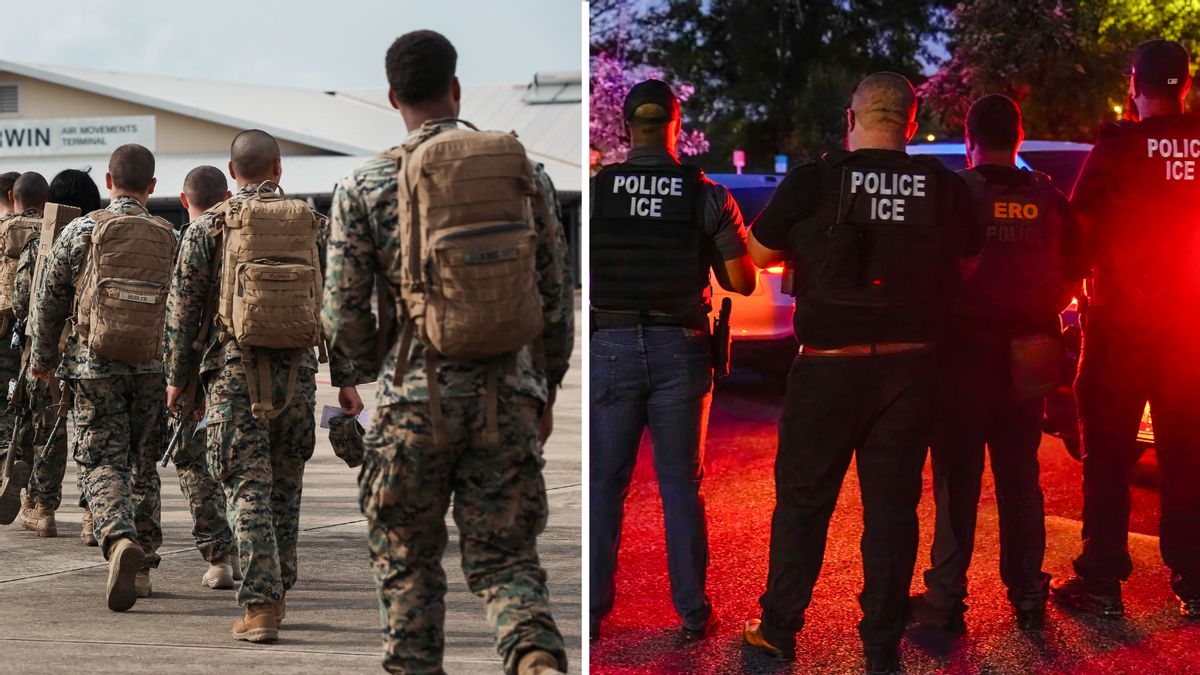
In the summer of 2025, a claim spread online that lawmakers approved a $160 billion budget for U.S. Immigration and Customs Enforcement — allegedly more than the country spends on the U.S. Marine Corps.
The rumor spread on platforms like X and Facebook. Some claims specified that the alleged money came from the "BBB," presumably meaning Trump's tax and budget megabill — commonly known as the One Big Beautiful Bill Act (OBBB).
Trump signed his bill into law on July 4, 2025.
However, total spending allocated to ICE did not amount to $160 billion. That number likely represented estimates for potential total immigration enforcement spending in the Big Beautiful Bill, not ICE as a specific agency. ICE and the U.S. Marines presented their proposed budgets differently, making it difficult to provide an apples-to-apples comparison.
Still, it is accurate to say the OBBB allocated $75 billion to ICE as a lump sum available through Sept. 30, 2029, more than the entire budget proposed for the Marines in the upcoming fiscal year. The Marine Corps' budget was $57.26 billion, according to available documents.
Snopes reached out to ICE and the U.S. Department of the Navy, which oversees the U.S. Marines, for more detailed breakdowns of their budgets in order to provide more direct comparisons and await a response.
Breaking down the total ICE budget
Two major budget allocations
The total proposed base budget for ICE in fiscal year 2026 was $11.29 billion, according to the agency's budget request document — an increase from $10.4 billion in fiscal year 2025 (see Page 5). According to the agency, the bulk of that amount, $10.88 billion, would need Congressional approval; the rest would come from fees, such as those imposed on travelers.
In addition to this base budget, ICE will receive another approximately $75 billion to remain available up until Sept. 30, 2029, through the OBBB, as we previously reported.
There were two major provisions in the GOP bill allocating funds to ICE: the first provision, on Page 825, Section 90003, "Detention Capacity," sent $45 billion to ICE specifically for immigration detention centers (emphasis ours):
SEC. 90003. DETENTION CAPACITY.
In addition to any amounts otherwise appropriated, there is appropriated to U.S. Immigration and Customs Enforcement for fiscal year 2025, out of any money in the Treasury not otherwise appropriated, to remain available until September 30, 2029, $45,000,000,000, for single adult alien detention capacity and family residential center capacity.
The second provision, starting on Page 904, appropriated $29.85 billion to ICE for the purposes of hiring, training, recruiting and retaining officers, facility upgrades, "promoting family unity" by keeping detained immigrants with their children, attorneys and legal staff, funding an office supporting victims of immigration crimes and "fleet modernization" — presumably a reference to updating ICE aircraft and vehicles.
SEC. 100052. APPROPRIATION FOR U.S. IMMIGRATION AND CUSTOMS ENFORCEMENT. In addition to amounts otherwise available, there is appropriated to the Secretary of Homeland Security for U.S. Immigration and Customs Enforcement for fiscal year 2025, out of any money in the Treasury not otherwise appropriated, $29,850,000,000, to remain available through September 30, 2029.
Add the two provisions together to arrive at $74.85 billion on top of the annual base budget, proposed at $11.29 billion for fiscal year 2026. The OBBB also imposed additional fees on people facing various immigration enforcement actions, a portion of which would go to ICE's coffers (see pages 896 and 898 of the Senate's bill).
Comparing ICE budget to Marine Corps spending
According to Page 30 of the Department of the Navy's
ICE's budget documents, in contrast, did not include how much the agency planned to budget from the OBBB's allocations for fiscal year 2026. As such, it was not possible to determine ICE's exact total annual budget, as the bill stipulated a single large infusion of money — the $75 billion — to remain available to the agency for multiple years, through Sept. 30, 2029.
It was also difficult to determine how much in total the U.S. Marines would receive from the Big Beautiful Bill, as the act included numerous provisions providing funding for all military members, not just the Marine Corps — for example, Page 101 provided $2.9 billion "to supplement the basic allowance for housing payable to members of the Army, Air Force, Navy, Marine Corps, and Space Force."
However, adding together every single provision that mentioned the Marine Corps in the Big Beautiful Bill — including provisions that directed funding to other military forces, not just the Marine Corps — produced a total of $
Thus, it would be accurate to say the OBBB allocated much more funding directly to ICE than it did to the Marines, but it was unclear whether ICE's total annual budget — including both Big Beautiful Bill funding and the base budget — would outmatch that of the Marines.
So ... where did the $160 billion number come from?
Clearly, the government did not grant ICE a $160 billion budget, given that $74.85 billion (available over four years) plus $11.29 billion (over one budget year) makes a total of $86.14 billion. Additionally, the $11.29 billion
However, the $160 billion amount did appear to be based in some truth, as reputable groups and news outlets like Bloomberg estimated that the total amount spent on overall immigration enforcement in the OBBB amounted to about $150 billion. Add that number to ICE's base budget in fiscal year 2025 — $10.4 billion, according to Page 5 of the agency's budget request — to get about $160 billion. (Snopes has not independently verified this number.)
The $75 billion for ICE did not include, for example, U.S. Customs and Border Enforcement provisions. Some of those major allocations included $46.55 billion for the border wall on Page 824 and $4.1 billion to hire Border Patrol personnel.
It is worth noting, however, that this $160 billion estimate did not appear to encompass total amounts of spending on immigration enforcement. For instance, aside from the amount in the OBBB, the U.S. Department of Homeland Security requested $23 billion for U.S. Customs and Border Patrol's base budget (see Page 4).
To summarize: Comparisons between ICE's and the U.S. Marines' actual and proposed budgets are difficult, given that the two organizations broke down their funding differently in the available documentation. However, it is accurate to say that the One Big Beautiful Bill Act allocated $75 billion to ICE through Sept. 30, 2029, in addition to another potential $11.29 billion the president proposed for the agency's base budget. In contrast, the Marine Corps requested $54.96 billion for its base budget in fiscal year 2026, with an additional $2.3 billion to come from the One Big Beautiful Bill Act for that specific year.