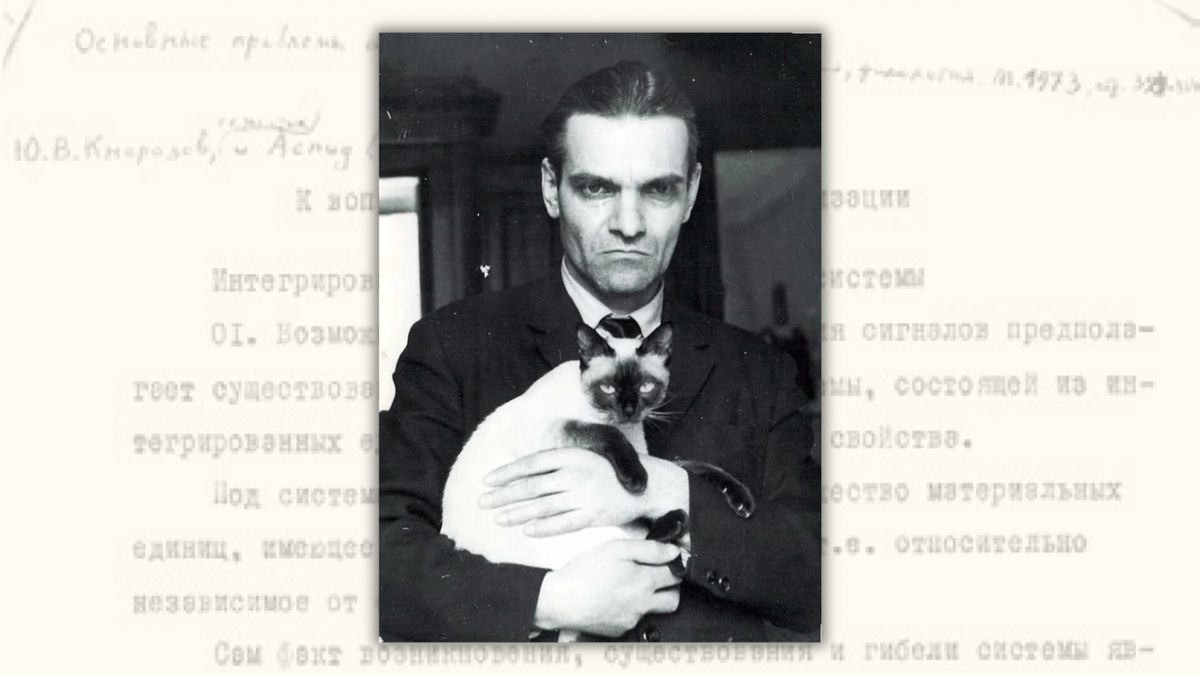
For years, internet users have delighted over a story about Soviet scholar Yuri Knorozov's close relationship to his cat, Asya.
Posts on TikTok, Facebook and Reddit claimed Knorozov, best known for deciphering the ancient script of the Maya civilization in Mesoamerica, often cited Asya as a co-author in his work — but the editors "always removed her." Someposts also claimed Knorozov offered a photo of him accompanying Asya as his standard author photo, but editors would crop out his beloved cat.
Even Knorozov's Wikipedia page, as of this writing, listed the two rumors about Knorozov and Asya as true.
However, those online may have exaggerated Knorozov's proclivity for adding Asya's name to his work. According to two academics who spoke to Snopes via email, Knorozov did appear to list his cat as a co-author at least once, but he did not make it a regular practice. It was also unclear whether Knorozov seriously wanted to give Asya co-authorship, or if he was merely making a joke.
Only one such manuscript in which Knorozov seemingly gave Asya authorship has survived, said Harri Kettunen, adjunct professor of Latin American studies at the University of Helsinki and president of the European Association of Mayanists.
That manuscript, from the 1970s, was titled "On the issue of signaling classification" according to both Kettunen and Alexandre Tokovinine, an associate professor of anthropology with a specialty in Maya epigraphy at the University of Alabama. (In the field of linguistics, scholars study signals — like a grunt to express agreement or a wave to say "hi" — as a way to help define what language is and isn't.)
Here's the full citation for the published version of the article in Russian, per Tokovinine:
Кнорозов Ю. В. К вопросу о классификации сигнализации / Ю. В. Кнорозов // Основные проблемы африканистики : Этнография. История. Филология: К 70-летию чл.-кор. АН СССР Д.А. Ольдерогге : [Сборник статей] / АН СССР. Ин-т этнографии им. Н.Н. Миклухо-Маклая. Всесоюз. геогр. о-во. ; ред. коллегия: Ю.В. Бромлей (отв. ред.), Ю. В. Кнорозов [и др.] ; - Москва : Наука, 1973. – С. 324-334.
According to two Snopes reporters familiar with Russian's Cyrillic alphabet, "Asya" would most likely be spelled "Ася," and "Ася" did not appear in the text above — nor did "Анастасия," for Anastasia, which Asya can be a diminutive of, indicating that the cat did not appear as co-author in the final, published form of the article.
However, Kuttenen provided a scanned PDF of Knorozov's typewritten manuscript of the article — including what appeared to be a handwritten citation with Asya's name — from a book on Knorozov called "Yu. V. Knorozov - SELECTED WORKS," published by the Russian Academy of Sciences and Kunstkamera, a Russian science museum. The book captioned the manuscript "Рукопись статьи, соавтором которой стала кошка Ася," which according to Google Translate, meant "The manuscript of the article, co-authored by the cat Asya" in English (see Page 21).
Per Google Translate's rough interpretation, the book said Knorozov "got along well with small children and adored animals, especially cats." It also noted that Asya "once even became a 'co-author'" of Knorozov's article, but did not mention any other articles in which Knorozov cited Asya (translated from Page 22).