
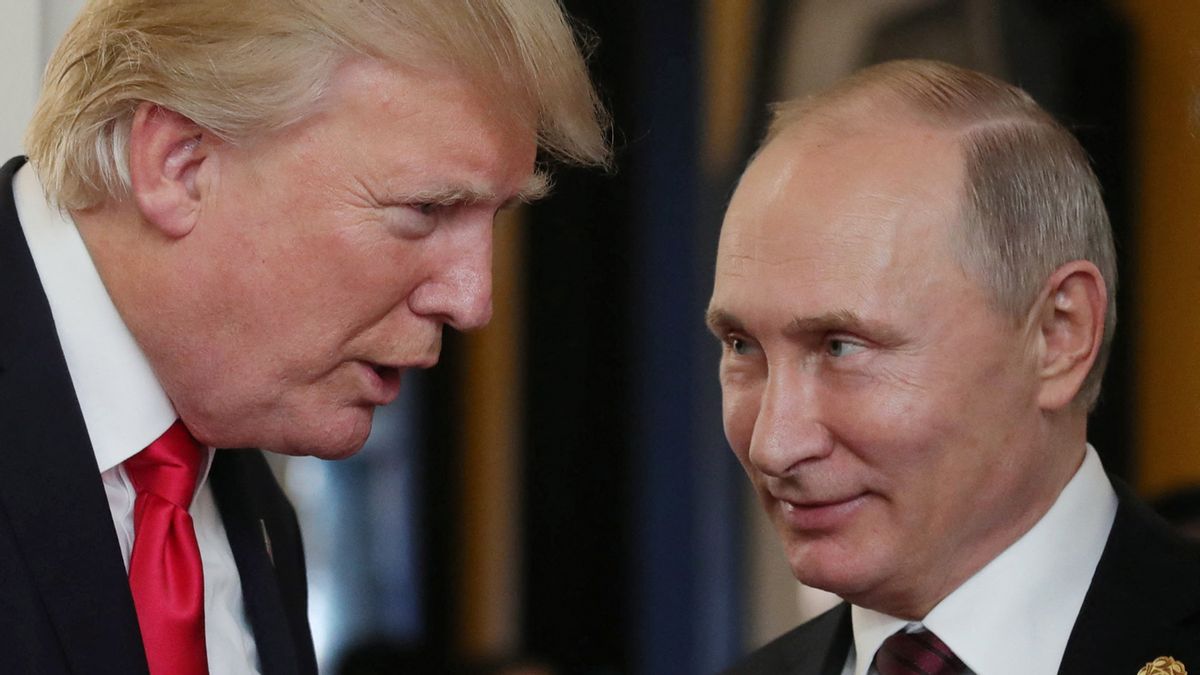
In August 2025, as U.S. President Donald Trump and Russian President Vladimir Putin prepared to meet in Alaska to discuss the war in Ukraine, speculation swirled online about whether Trump could or should arrest the Russian president at the meeting on a warrant from the International Criminal Court that accused Putin of carrying out war crimes.
One X user claimed (archived) that arresting and extraditing Putin would be the "only right outcome" of the planned summit.
Posts on Facebook (archived), Instagram (archived), Threads (archived) and Reddit (archived) also called for Putin's arrest at the summit.
However, though it was impossible to know at the time of this writing exactly what would happen at the Aug. 15 summit, Trump was under no legal obligation to arrest Putin over the ICC's warrant. The U.S. has never ratified the Rome Statute, the document that gave the ICC its jurisdiction to prosecute certain crimes, and withdrew from it before its enactment in 2002. During his previous and current administrations, Trump has sanctioned ICC officials and otherwise dismissed the court's authority. Russia also did not recognize the court at the time of this writing.
ICC relies on international partners for enforcement
The ICC is an international court based in The Hague, Netherlands. The Rome Statute gave the court authority to try four types of crimes: genocide, war crimes, crimes against humanity and the crime of aggression.
The United Nations also can refer cases to the ICC if they fall outside those four types of crimes, giving the court the power to try them.
However, unlike — for example — a court in the U.S. that relies on domestic police forces and prosecutors to arrest and charge defendants, the ICC relies on national systems from member states to arrest and transfer defendants to the court as well as uphold sentences the court imposes.
In March 2023, the ICC issued an arrest warrant for Putin and Maria Alekseyevna Lvova-Belova, the Russian commissioner for children's rights. According to the warrant, the pair were allegedly responsible for "the war crime of unlawful deportation of population (children) and that of unlawful transfer of population (children) from occupied areas of Ukraine to the Russian Federation," starting in February 2022 when Russia invaded Ukraine.
That warrant meant that the national systems of any Rome Statute signatories had the authority to arrest Putin and Lvova-Belova should they enter those countries.
US historically offered cold shoulder to ICC
As mentioned above, the U.S. is not a Rome Statute signatory and has no commitments to the court or its warrant for Putin.
The U.S. signed the Rome Statute under former President Bill Clinton in December 2000 but never ratified it, meaning it was never legally binding. The U.S. withdrew from the Rome Statute in 2002, during George W. Bush's first term as president.
Trump imposed potential sanctions on ICC officials, employees, agents and their family members during his first administration. The Biden administration revoked those sanctions before Trump reimposed sanctions on the ICC early in his second presidency.
Though the U.S. has previously handed over people with ICC warrants to national systems that in turn handed them over to the ICC, arresting and directly handing over Putin to the ICC would be an unheard-of measure.
Even member states have previously opted not to arrest people with ICC warrants despite hosting them in their countries, an issue that the ICC has struggled to curb or discipline. In 2024, the ICC's Pre-Trial Chamber found that Mongolia, which ratified the Rome Statute in 2002, failed to arrest Putin when he visited the country in late August 2023, five months after the ICC issued a warrant for his arrest.
However, Mongolia seemingly did not face consequences for its lack of cooperation with the ICC. The Assembly of Parties, the court's management oversight and legislative body, noted (Page 6) the incident in a resolution adopted by the ICC in December 2024. That resolution did not include any consequences for Mongolia's failure to arrest Putin.
Trump teases 'land swapping'
While on the campaign trail in 2024, Trump repeatedly said he could end the war in Ukraine in a single day if he were elected. Aug. 15, 2025, will be the administration's 208th day.
Ahead of the summit, Trump told (at 1:56:55) reporters during a news conference on Aug. 11 that he would meet Putin and "probably in the first two minutes I'll know exactly whether or not a deal can be made."
Trump also teased (at 1:51:05) discussions about "land swapping" between Russia and Ukraine. Russian media, reporting on Trump's news conference, wrote that "Moscow has repeatedly emphasized that the issue of territorial affiliation of Crimea, Donbas and Novorossiya is closed, and the results of the referendums are already reflected in the Russian constitution."
Russia occupied and annexed the Crimean Peninsula in 2014. It has pushed further into the Donbas regions of Luhansk and Donetsk since invading Ukraine in February 2022. Novorossiya was a region in imperial Russia, since part of southeastern Ukraine, that Russian forces have also moved to control as part of the 2022 invasion.
Volodymyr Zelenskyy, the president of Ukraine, criticized the decision to hold a summit without Ukraine in a video message (archived) on Aug. 9.
Zelenskyy also dismissed the idea of "land swapping," writing on X (archived): "The answer to the Ukrainian territorial question already is in the Constitution of Ukraine. No one will deviate from this—and no one will be able to. Ukrainians will not gift their land to the occupier."
On Aug. 12, three days before the summit, European leaders said in a joint statement that "a just and lasting peace that brings stability and security must respect international law, including the principles of independence, sovereignty, territorial integrity and that international borders must not be changed by force."
The statement echoed Zelenskyy's, adding "The path to peace in Ukraine cannot be decided without Ukraine."
According to reporting in German media, German Chancellor Friedrich Merz arranged a call for European leaders with Trump and Zelenskyy on Aug. 13, two days before the planned summit. The call would focus on "pressure options against Russia, questions about Ukrainian territories seized by Russia, security guarantees for Kyiv and the sequencing of potential peace talks," according to a Politico report citing a German government spokesperson.
In sum, there was no indication at the time of this writing that Trump and Putin's Alaska summit would end in the Russian president's arrest. Though Putin was wanted on a warrant from the ICC that accused him of carrying out war crimes, neither the U.S. nor Russia recognize or cooperate with the court. Whether Trump would be able to secure a peace deal in the war in Ukraine at a summit without Ukraine present remained to be seen.