
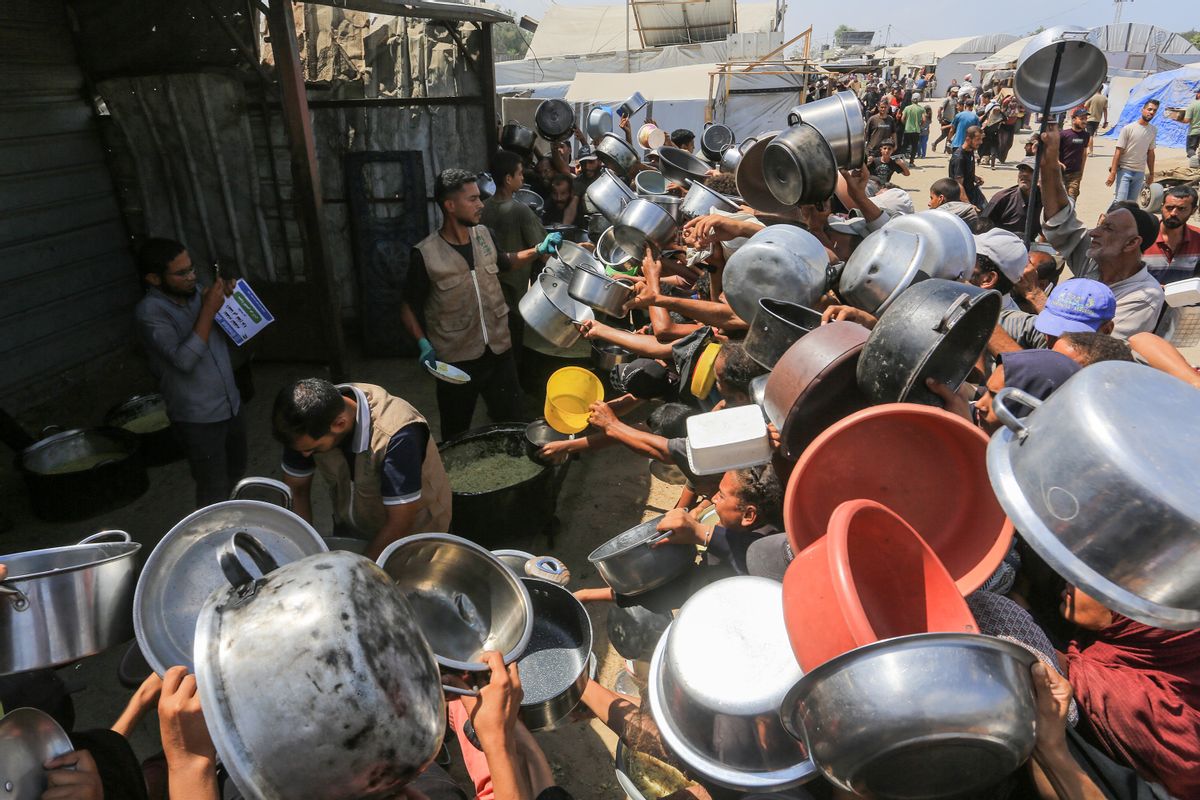
On Aug. 22, 2025, the Integrated Food Security Phase Classification (IPC), the foremost authority on global food security confirmed a famine was ongoing in Gaza. The United Nations-backed group found that more than half a million people in the Gaza Governorate in northern Gaza (which includes Gaza City) were experiencing starvation, and that famine conditions were expected to spread to Deir Al Balah and Khan Younis governorates by the end of September.
This follows our previous reporting from early August, in which the IPC determined the "worst-case scenario" of famine was unfolding in Gaza but did not officially declare a famine due to the lack of available data. At the time, the IPC noted it was issuing an "alert" and not a formal famine classification.
In the 22 months since militant group Hamas' Oct. 7, 2023, attack on Israel and capture of Israeli hostages, more than 60,000 Palestinians have been killed in Israel's ensuing offensive, 90% of Gaza's population has been displaced and vast swathes of the enclave has been destroyed by Israel's bombardment, according to The Associated Press.
U.N. agencies and independent aid groups accused Israel of not allowing enough aid into Gaza and warned of impending famine. The U.N.-convened independent Famine Review Committee — the primary international body to oversee the analysis of food scarcity — noted in its review of IPC's Aug. 22 report:
As this Famine is entirely man-made, it can be halted and reversed. The time for debate and hesitation has passed, starvation is present and is rapidly spreading. There should be no doubt in anyone's mind that an immediate, at-scale response is needed. Any further delay—even by days—will result in a totally unacceptable escalation of Famine-related mortality.
If a ceasefire is not implemented to allow humanitarian aid to reach everyone in the Gaza Strip, and if essential food supplies, and basic health, nutrition, and WASH (Water, sanitation and hygiene) services are not restored immediately, avoidable deaths will increase exponentially.
As we researched how such a catastrophe emerged in Gaza, we found that experts and international aid groups designated it an "entirely preventable" crisis caused by Israel's control of the flow of food into the region — not just since the current Israel-Hamas war began, but over decades.
An international war of words raged over the famine in Gaza. In July Israeli Prime Minister Benjamin Netanyahu claimed in July 2025 there was "no starvation" and "no policy of starvation" in Gaza as U.S. President Donald Trump disagreed, citing photographs of starving Gazans and saying, "Those children look very hungry." In response to the Aug. 22 IPC report, Israel's foreign ministry denied such a famine was taking place, writing on X, "There is no famine in Gaza":
Below, we look at the process for declaring a famine, the authority behind it and what it means to formally declare a famine:
What does it take to declare a famine?
As Snopes has previously reported, the U.N. uses the IPC's standardized scale to inform governments and policymakers about the severity of famine risk in certain regions. The U.N. convenes the Famine Review Committee — which works with expert panels it recruits, or with nongovernmental organizations and other international agencies — to make sure published analyses of food security risk accurately follow a standardized methodology.
The IPC has a five-phase scale, with the most extreme being a "catastrophe/famine."

(United Nations)
In order for a food security emergency to be formally declared a famine, the following very high thresholds must be met:
The Integrated Food Security Phase Classification (IPC) defines Famine as a situation in which at least one in five households has an extreme lack of food and face starvation and destitution, resulting in extremely critical levels of acute malnutrition and death.
A Famine classification (IPC Phase 5) is the highest phase of the IPC Acute Food Insecurity scale, and is attributed when an area has at least 20% of households facing an extreme lack of food, at least 30% of children suffering from acute malnutrition, and two people for every 10,000 dying each day due to outright starvation or to the interaction of malnutrition and disease.
The FRC's role, as we reported before, is akin to that of peer reviewers of academic papers. Ultimately, the committee makes the final call on endorsing or rejecting the findings of the expert panels. NGOs and panels cannot use the IPC framework without the FRC approving their work. As the central body protecting the IPC framework, the FRC must, by regulation, technically examine any Phase 5 finding made by other groups or experts before publication, given the severity of the claim.
Alex de Waal, an anthropologist and the author of "Mass Starvation: The History and Future of Famine" described the FRC as "all volunteers, drawn from academia and international agencies, and it has met just over twenty times over the last decade, including four times on Gaza."
The U.N. and governments are usually expected to declare famines, not the IPC. In this instance, the IPC has made a formal classification of famine, which the U.N. has backed. While a number of independent U.N. experts declared in July 2024 that famine had spread throughout Gaza Strip, the U.N. itself had not made such a declaration. However, as reported by The Associated Press, the IPC says that usually by the time a famine gets declared, it is too late.
Why did it take so long to declare a famine?
Simply put, until Aug. 15, 2025, the IPC did not yet have the requisite data to state whether a famine was taking place, and Israel, as of this writing, has severely limited access to the territory, making it difficult (and sometimes impossible) to gather data. Although the IPC normally relies on humanitarian partners on the ground to collect this data, it is not easy to come by in Gaza's case.
Before officially declaring famine in northern Gaza, the IPC said famine thresholds had been reached for food consumption in most of Gaza, and for acute malnutrition in Gaza City, meeting two out of three conditions for it to be declared an official famine. By Aug. 15, the IPC confirmed, with "reasonable evidence," that famine (IPC Phase 5) existed in Gaza Governorate.
In its analysis of the Aug. 22 IPC report, the FRC noted that while it had made the determination of famine in the Gaza Governorate region, they could not make the same determination in North Gaza Governorate because of a lack of data:
The FRC finds the severity of conditions in North Gaza similar or worse than in Gaza Governorate. However, due to limited evidence on the population in this area the FRC recommends not to classify North Gaza Governorate. Urgent steps should be taken to allow for a full humanitarian assessment in this governorate.
There are several factors that contributed to it taking so long to declare a famine. Death rates, the third piece of data used to calculate a famine, according to de Waal, are generally harder to calculate the more disruption exists in a community. The FRC, de Waal noted, is also "scrupulously cautious" and "resistant to alarmist calls." In an email to Snopes, he wrote:
The reason why they couldn't determine famine was that there was no new data (hence it's an "alert" not a report) and it had no mortality data. Having made a projection of famine in May based on a "reasonable worst case scenario", when that scenario unfolded they concluded that famine was unfolding. It's the closest that they can come without having data.
Determining deaths caused solely by hunger and starvation is increasingly difficult in conflict zones. De Waal wrote in the London Review of Books:
In the famine I studied in Sudan in the 1980s, malnutrition was rarely identified as the cause of death. More common culprits by far were measles, malaria and diseases causing diarrhoea, which were spread by people moving around in search of food, overcrowding in unsanitary camps, the collapse of vaccination against childhood diseases – and were more lethal because so many children were underfed. Mass starvation isn't simply individual starvation aggregated, but the collapse of human health in a collapsing society: first displacement and the disruption of water, sanitation and shelter, attended by a drop in consumption of essential foods; then child malnutrition; and in the absence of remedial health and nutrition efforts, the prospect of mass deaths.
Israeli bombardment has decimated Gaza's health care systems and overwhelmed the remaining hospitals with war casualties. Screening people for malnutrition has become difficult, as has determining causes of death from either starvation or other causes. Hundreds of Gazans killed in Israeli strikes while seeking food aid are being described as victims of famine by Palestinians, even though a number of them may not be technically counted among the "malnourished."
What does the data say right now?
The U.N. said nearly 1,400 people were killed and 4,000 injured trying to obtain food in recent weeks (as of Aug. 5, 2025). At least 859 of the deaths occurred in the vicinity of the U.S.- and Israeli-run private aid organization Gaza Humanitarian Foundation, which "bypassed regular humanitarian operations," according to the U.N. According to an August investigation by Israeli outlet +972 Magazine, The Guardian, and Hebrew-language outlet Local Call, classified Israeli intelligence showed at least 83% of people killed in Gaza were civilians.
The FRC review of the IPC report from Aug. 22, 2025, noted 30% of households in Gaza Protectorate were in the "Catastrophe" classification, while 50% were classified as being in "Emergency" status:
Bombardment from air, land and sea continued across much of the Gaza Strip, resulting in further deaths, injuries, displacements, and the destruction of buildings and other infrastructure. Critical infrastructure essential to provide and sustain life-saving services, such as health, water, sanitation and hygiene facilities are largely damaged, destroyed or otherwise inoperable or inaccessible. The food system has collapsed as assets required for food production, such as croplands, greenhouses, and fishing assets have been dismantled, while logistical infrastructure, including roads and warehouses are heavily damaged.
The IPC's July alert noted that more than 20,000 children were admitted for treatment for acute malnutrition between April and mid-July. More than 3,000 children were severely malnourished.
Israel's own data confirmed less food was going into Gaza as of July 29 than at any other time since Hamas' attack in October 2023. However, the GHF claimed it delivered more than a million boxes of aid to Gazans at its distribution sites as of Aug. 1.
News reports from Gaza detail the deaths of dozens of children and adults from malnutrition in July alone, based on data from the Gaza Health Ministry. The World Health Organization documented that 21 children younger than 5 died of causes related to malnutrition in 2025. The World Food Program said around 100,000 women and children need urgent treatment for malnutrition.
On Aug. 2, the Gaza Health Ministry reported that 85 children had died of malnutrition-related causes thus far in the war, with a total of 127 people dying of malnutrition-related causes. The adult deaths were counted over the last few weeks of July alone, according to The Associated Press. A malnutrition clinic in Gaza reported receiving an average of 40 cases weekly, while Nasser Hospital's pediatric department with eight beds was dealing with around 60 cases.
Infant formula also was limited in Gaza as a result of the Israeli-imposed blockade in summer 2025, according to reports from doctors and mothers in the region. In late June 2025, COGAT, the Israeli agency in charge of aid coordination in Gaza, said at least 1,000 tons of baby food was distributed in Gaza through international agencies. However, that claim were disputed by Gaza's health officials, who said not enough of that aid had critical medical equipment, formula and medicine. On Aug. 4, Save the Children reported 43% of examined pregnant and breastfeeding women were malnourished — three times the number screened in March 2025.
What is Israel's role in the starvation crisis?
Instead of starvation caused by natural disaster or geographic inaccessibility, the IPC report from Aug. 22 listed destruction of infrastructure, import limitations and population displacement as the three main factors contributing to famine. Israel has systematically destroyed Gaza's infrastructure for decades, has restricted the flow of goods across Gaza's borders and has caused widespread displacement through destroying residential homes and issuing evacuation orders. The report read:
The current catastrophic shortage of food availability inside the Gaza Strip comes as a result of three compounding factors. Namely, the destruction of domestic food production systems, import limitations, and displacement of populations away from available food sources or production systems. Food deliveries from land and recent airdrops are insufficient to meet current extreme food consumption gaps.
On July 9, a group of U.N. experts stated, "We declare that Israel's intentional and targeted starvation campaign against the Palestinian people is a form of genocidal violence and has resulted in famine across all of Gaza."
Israel has denied these accusations, and following the IPC's official declaration of famine, Netanyahu's office said the report was an "outright lie." The statement continued: "Like all previous IPC reports, this one ignores Israel's humanitarian efforts and Hamas's systematic theft. Hamas steals aid to finance its war machine."
Other politicians and commentators have similarly shifted blame from Israel and onto Hamas, Gaza's governing militant group. Gazan writer Ahmed Fouad Alkhatib claimed in The Atlantic:
Hamas actually wants a famine in Gaza. Producing mass death from hunger is the group's final play, its last hope for ending the war in a way that advances its goals. Hamas has benefited from Israel's decision to use food as a lever against the terror group, because the catastrophic conditions for civilians have generated an international outcry, which is worsening Israel's global standing and forcing it to reverse course.
Regardless of Hamas' purported actions, Israeli officials have already publicly endorsed aid cutoffs. The claim that Hamas steals humanitarian aid and benefits from Israel's "levering" of food against the Gazan population, if true, doesn't negate the fact that international law explicitly prohibits starvation as a tactic of war.
Furthermore, some Israeli government officials have themselves denied the claim that Hamas steals aid. Israeli Finance Minister Bezalel Smotrich said in May 2025 that "no aid is going to Hamas, period." In a July 2025 New York Times report, two Israeli military officials (speaking on condition of anonymity) asserted that although Hamas allegedly "did steal from some of the smaller organizations," there is no proof Hamas routinely stole U.N. aid.
A July 2025 review by the U.S. Agency for International Development found "no evidence of systematic theft" by Hamas of U.S.-funded humanitarian supplies, which has served as the primary rationale for backing the GHF. On Aug. 5, U.N. experts called for an immediate dismantling of the Israeli-backed U.S. militarized aid distribution operation.
Although the GHF has reportedly raised more than $100 million between its founding in February 2025 and early June, the group has not revealed its funding sources. Later in June, the U.S. State Department publicly transferred $30 million to the foundation.
The GHF's four distribution sites have largely replaced the former U.N. aid distribution system that previously had hundreds of active distribution sites since its founding in February 2025; Israel, as of this writing, continues to uphold its March 2, 2025, blockade on all humanitarian aid from The United Nations Relief and Works Agency for Palestine Refugees in the Near East — historically, Gaza's primary source of aid.
As desperation for food has grown in Gaza and hundreds flock to the GHF distribution sites, the number of those killed by Israeli munitions while trying to source food rises.
"The GHF … is an utterly disturbing example of how humanitarian relief can be exploited for covert military and geopolitical agendas in serious breach of international law," U.N. experts wrote at the beginning of August. "The entanglement of Israeli intelligence, US contractors and ambiguous non-governmental entities underlines the urgent need for robust international oversight and action under UN auspices."
As the occupying power in Gaza (per the United Nations), Israel stands responsible in the eyes of international law for the needs of the local population, according to Article 43 of the Hague Regulations and Article 64 of the Fourth Geneva Convention.
"This crisis is entirely preventable," the WHO said in a news release. The Israeli news outlet Haaretz posited in July 2025: "The situation in Gaza is likely the most extreme example of politically–driven starvation in the 21st century." Statements by the U.N. and other human rights agencies have echoed this claim of a "targeted starvation campaign," which Israel has denied.
Israel maintains control over two of the three main border crossings into the Gaza enclave — meaning that Israel (along with Egypt) regulates the passage of all food, medical supplies, fuel and movement of people in and out of Gaza.
Israel's control over food permitted to enter Gaza has affected the population for more than a decade. Documents released in 2012 indicated Israel historically used a "calorie count" to limit food into Gaza. Even before Israel began tightening its grip on the Gaza border following Hamas' election as the ruling party in 2007, Gazans suffered under Israeli cutoffs that disrupted the flow of goods into Gaza as well as destruction of agricultural infrastructure. For example, Israeli bulldozers systematically razed fields of crops and targeted fishers and confiscated fishing boats, resulting in a dwindling independent supply sector in Gaza.
For decades, Gaza has struggled under the weight of both Israeli occupation and the influx of Palestinian refugees following the mass expulsion of people from their homes during the Nakba, or "catastrophe" — the event between 1947 and 1949 in which armed Zionist militias forcibly claimed the homes, land, and possessions of approximately 750,000 Palestinians. While Israel has upheld this tight border control on Gaza for nearly 20 years, it intensified the existing blockade following Hamas' attack on Israel in October 2023.
"We are imposing a complete siege on Gaza. There will be no electricity, no food, no water, no fuel. Everything will be closed," Israeli Defense Minister Yoav Gallant said after the attack.
Aside from destroying housing, schools and other architecture, the heavy bombardment of Gaza that followed Oct. 7, 2023, destroyed vast swaths of agricultural land. According to a May 2025 analysis by the Food and Agriculture Association of the United Nations, more than 95% of Gaza's agricultural infrastructure — including cropland, greenhouses and agricultural wells — is unusable. Additionally, Israel restricted the delivery of necessary tools and supplies such as fuel, which according to the U.N. has prevented Gazans from receiving life-saving health services and preparing their food.
Other sources of food, including many bakeries and Gaza's once-autonomous fishing industry have either been wiped out as a result of Israel's artillery or shuttered as a result of aid blockades.
Israel's grip on Gaza's borders eased during the January 2025 ceasefire, during which the number of aid trucks allowed in skyrocketed before plummeting on March 2 when Israel announced a cut-off of all aid into Gaza. The following chart by The Associated Press illustrates the amount of aid entering Gaza from October 2023 through May 2025 compared with the average amount of aid that entered Gaza before October 2023:

As of this writing, this blockade continues, although Israel has allowed a trickle of aid from surrounding nations via air drops as well as limited aid truck entry. According to the U.N., these air drops are a last-resort measure and carry risks for people on the ground — for example, when the approximately 2,000-pound packages land on tents, crushing those inside. The number of aid trucks entering Gaza also remains insufficient according to the U.N., as of this writing.
The evidence we have shown points toward the starvation of Gazans being a direct result of Israeli policies. As experts from the bipartisan think tank Center for Strategic and International Studies' Global Health Policy Center asserted, "The resumption of food aid alone is insufficient to address the health disaster in Gaza," which is the result of decades of restriction and destruction and for which rehabilitation would necessitate a permanent ceasefire.
How does the debate over 'famine' label affect Gazans?
For many international aid experts and scholars, the confirmation of an official famine in Gaza was beside the point. As evidenced above, the region was in crisis and in need of urgent aid and international intervention before the official classification.
Oxfam America's director of peace and security, Scott Paul, told the media in July 2025 that action must be taken before a famine is declared and aid organizations need more than just food to address the crisis. Fixing the water and sanitation crisis to prevent disease from spreading is also crucial, he said.
Experts at CSIS noted in late July that governments or international agencies could not wait to act. They wrote:
World leaders cannot wait for a declaration to act while Gazans, including children, are dying each day of starvation. Starvation will continue to kill Gazans until there is a sustained ceasefire and an unencumbered influx of humanitarian assistance, including food, clean water, medical and sanitation supplies, and malnutrition treatments. And even if such assistance were allowed, Gazans will continue to require long-term support following the provision of such aid, as today's starvation will burden children with lifelong physical and cognitive deficits.
De Waal wrote that a famine declaration has more "moral force" than legal consequence. While international humanitarian law has no legal definition of famine, starvation is explicitly prohibited as a weapon of war. Declaring a famine thus has few legal ramifications for perpetrators in man-made catastrophes, though their actions can be prosecuted as war crimes. However, the crime of starvation has never been considered in a court of international law.
Regardless of Gaza's food-insecurity risk designation, it is clear based on the available data and reporting coming out of the region, as well as overwhelming calls from international agencies to increase aid, that aside from the long-term humanitarian aid and holistic support needed to prevent the catastrophe in Gaza from getting even worse, the onus lies on Israel to lift the severe restrictions on food currently creating faminelike conditions in Gaza.
"Any further delay—even by days—will result in a totally unacceptable escalation of Famine-related mortality," the FRC analysis of the IPC's August 2025 findings said.