
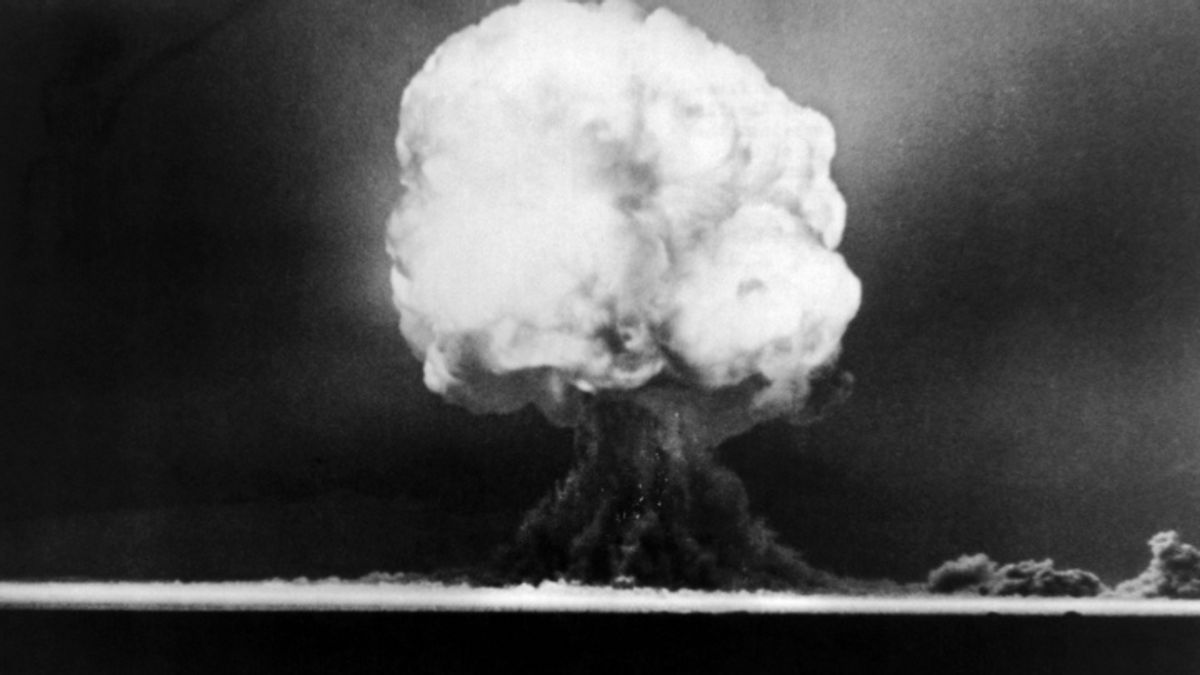
A number of social media posts in August 2025 shared a story about the civilian aftermath of America's rush to create the atomic bomb in 1945. According to the posts, a group of 13-year-old girls was camping in Ruidoso, New Mexico, at the time of the Manhattan Project's Trinity test in 1945, the world's first test of a nuclear bomb.
The girls, not knowing what nuclear fallout was at the time, jumped into a nearby river and played in what they thought was snow dropped by the detonation's cloud. All of the girls developed cancer and all but one died before the age of 30, according to the posts.
One such post (archived) began:
Various Facebook accounts (archived) and pages (archived) shared the story between June (archived) and August. The story also spread to Instagram (archived) and X (archived).
Many of the comments under these posts doubted the authenticity of the story. One Snopes reader sent an email asking if the story was true.

(Facebook page Sustainable Human)
The story shared in the posts is a real account that one of the girls at the camp, Barbara Kent, has shared with multiple credible outlets. However, we were unable to find concrete details about the other 11 women, including their names and ages at death. We've reached out to Kent's family to ask for more information and will update this story if and when we hear back.
Kent's story
The information in the posts largely came from a 2021 National Geographic article, which included quotes from Kent and the blurry photo of the girl, Kent herself, playing in the river, crediting the image to Kent. The quotes come directly from a pair of paragraphs early in the story:
"We were all just shocked … and then, all of a sudden, there was this big cloud overhead, and lights in the sky," Kent recalls. "It even hurt our eyes when we looked up. The whole sky turned strange. It was as if the sun came out tremendous."
A few hours later, she says, white flakes began to fall from above. Excited, the girls put on their bathing suits and, amid the flurries, began playing in the river. "We were grabbing all of this white, which we thought was snow, and we were putting it all over our faces," Kent says. "But the strange thing, instead of being cold like snow, it was hot. And we all thought, 'Well, the reason it's hot is because it's summer.' We were just 13 years old."
Later in the National Geographic story, Kent said she was the only survivor of all the girls from the camp by the time she turned 30. However, while Kent was consistent in her recounting of the day of the test itself, she recalled the part about being the only survivor a little differently in a 2015 interview she gave to the Santa Fe New Mexican. That article wrote:
Of the 12 girls at the camp, Kent said, only
two lived to be 40 . She herself survived skin cancer and several other cancers. Her mother, who was staying in the nearby Noisy Water Lodge 70 years ago, died of a brain tumor. The dance teacher's daughter, also present that day, died of cancer, Kent said, and the teacher died about five years later.
The Santa Fe New Mexican reported that Kent was 83 at the time that story was published, 70 years after the date of the Trinity test. By the time National Geographic interviewed her six years later, she would have been 89 or 90.
Aside from variation in the exact
Both of those articles, along with the Nuclear Threat Initiative story and a story mentioning Kent by the Bulletin of Atomic Scientists, shared the story in the context of the fight by many survivors of radiation exposure from the Trinity test to receive compensation from the government akin to that granted to other survivors of radiation exposure from government programs.
The Manhattan Project's Trinity test was the world's first test of a nuclear bomb. The researchers selected the New Mexico location for its isolation, although more than 13,000 people lived within 50 miles of the test site and more than 450,000 lived within 150 miles of the test site, according to the Bulletin of Atomic Scientists.
At the time of a July 2024 Congressional Research Service report, Trinity test survivors were still not eligible to receive compensation through the Radiation Exposure Compensation Act (RECA), which offers eligible people a one-time payment as compensation for the effects of the radiation exposure. However, an amendment made to RECA in the July 2025 One Big Beautiful Bill Act temporarily expanded the program to include those impacted by the Trinity test.
AI image included in some social media posts
Some of the posts about the story that circulated in summer 2025 used Kent's reportedly real photograph from that morning, while others attached an image that showed clear hallmarks of artificial intelligence (AI) generation.
The AI-generated image showed a group of 11 girls in a river lined up for a picture in front of a mushroom cloud. Not only were the girls not in the river at the time of the test according to any of the accounts Kent gave, but the image was also far too clear for the quality of cameras available at the time of the Trinity test. Sightengine, a tool for detecting AI-generated images, determined the likelihood it was AI-generated to be 99%.
By contrast, the other image used in some of the posts sharing the story, a blurrier black-and-white image of one of the girls posing at the center of the frame, was a real photo Kent and her family shared with National Geographic and other media publications, according to credit information in those articles. The girl at the center of the frame was Kent herself.
Snopes has previously fact-checked claims surrounding past nuclear weapons tests.