
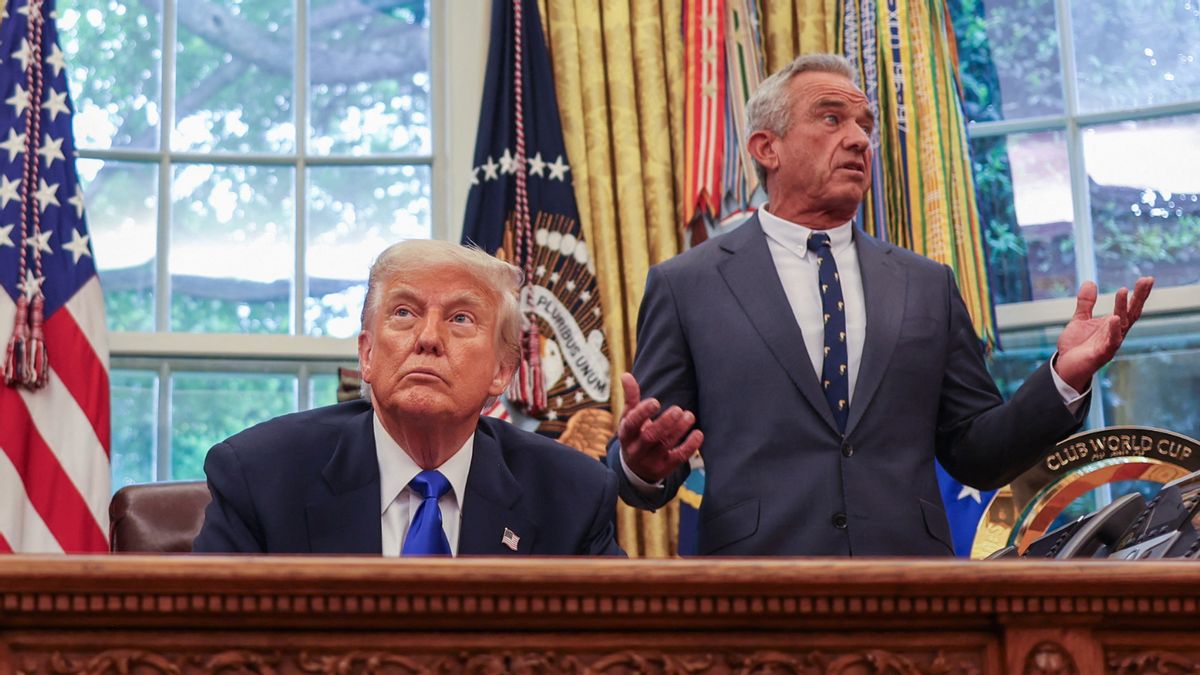
In late August 2025, social media posts claimed U.S. President Donald Trump and Health and Human Services Secretary Robert F. Kennedy Jr. planned to ban the COVID-19 vaccine "within months."
Many of the posts sharing the claim cited the news outlet Newsweek.
"BREAKING: President Trump and HHS Sec. Robert F. Kennedy Jr. are allegedly planning to ban the COVID vaccine 'within months,' according to an associate of Kennedy's, per Newsweek," one Aug. 25 X post (archived) read.
Multiple X users shared the same claim (archived here, here and here). Snopes readers also emailed us and searched our website to verify whether Trump and Kennedy were really planning to ban the COVID-19 vaccine.
The claim stemmed from a report (archived) published by The Daily Beast on Aug. 25 that cited Dr. Aseem Malhotra, a British cardiologist and close associate of Kennedy. Newsweek published its own article (archived) on the same day, citing The Daily Beast's reporting.
A spokesperson for the Department of Health and Human Services told Snopes the agency cannot comment on potential policy decisions. The White House did not respond to our request for comment by the time of publication. We will update this report should we receive more information.
What the Daily Beast report says
The Daily Beast quoted Malhotra as saying the Trump administration would move to pull the COVID-19 vaccine off the U.S. market "within months." The report did not provide a specific timeline for the alleged move.
Malhotra serves as the chief medical adviser for Make American Healthy Again (MAHA) Action, a
According to The Daily Beast, Malhotra reportedly said "influential" members of Trump's family share Kennedy's stance, seemingly referring to efforts to remove the COVID-19 vaccine from the market. Malhotra also reportedly told The Daily Beast that many people close to Kennedy have told him they "cannot understand" why the vaccine continues to be prescribed.
On the process of potentially pulling the vaccine from the market, The Daily Beast quoted Malhotra as saying:
It could [happen] in a number of stages, including learning more about the data. But given the increased talk of vaccine injuries in the past few weeks among the administration, it could also come with one clean decision.
However, Snopes was unable to independently verify the details in The Daily Beast's article.
We reached out to Malhotra to ask whether he could provide any documentation or evidence confirming that discussions about pulling the COVID-19 vaccine off the market had taken place, and whether Trump or any members of his team have communicated with him about such plans. We did not receive a response by the time of publication.
We sent similar questions to MAHA Action and await a response.
Kush Desai, a White House spokesperson, provided the following statement to The Daily Beast:
The Administration is relying on Gold Standard Science and is committed to radical transparency to make decisions that affect all Americans. Unless announced by the Administration, however, any discussion about HHS policy should be dismissed as baseless speculation.
Could Trump unilaterally 'ban' a vaccine?
It's unclear exactly what would happen if the Trump administration does move to pull COVID-19 vaccines from the market. However, some public health experts say such a move would likely face significant legal hurdles.
According to The New York Times, the president does not have the authority to unilaterally ban certain vaccines. Public health authority lies primarily with the states, not the federal government, and vaccines themselves are licensed and regulated by the U.S. Food and Drug Administration (FDA), as the newspaper noted.
Lawrence O. Gostin, an expert in public health law at Georgetown University, told the Times that a president's attempt to unilaterally remove a lawful product from the market would likely trigger a legal fight.
Experts with KFF, a nonprofit health policy organization, shared (archived) a similar sentiment about potential legal issues. They explained that the FDA can remove vaccines from the market in the event of serious safety concerns or other issues, and that the agency follows a formal process for doing so.
Removing an approved vaccine without compelling new evidence of harm or other concerns would likely lead to legal challenges, the KFF experts said.
New federal guidance on COVID shots
On Aug. 27, 2025, the FDA approved updated COVID-19 vaccines but restricted their use to a more-limited group of people, as The Associated Press reported.
According to the AP, the new vaccines from Pfizer, Moderna and Novavax are approved for all seniors. But federal regulators narrowed their use for younger adults and children to people with at least one high-risk health condition, such as asthma or obesity.
Previously, the U.S. had recommended yearly COVID-19 vaccines for everyone 6 months old and older.
Wind-down of mRNA vaccine development
The Daily Beast's report was published after HHS announced (archived) in early August 2025 that it would wind down its mRNA vaccine development efforts under the Biomedical Advanced Research and Development Authority.
The move included ending 22 mRNA vaccine development projects worth nearly $500 million, according to the agency.
Kennedy said the decision was based on data that shows the vaccines fail to effectively protect against respiratory infections like COVID-19, a claim health experts have disputed.
Some final-stage mRNA contracts will continue in order to "preserve prior taxpayer investment," but "no new mRNA-based projects will be initiated," HHS said. Other uses of mRNA technology within the department were not affected by the announcement, the agency said.
Public health experts have openly criticized the agency's decision, warning it will undermine preparedness for future emerging diseases and the next pandemic.