
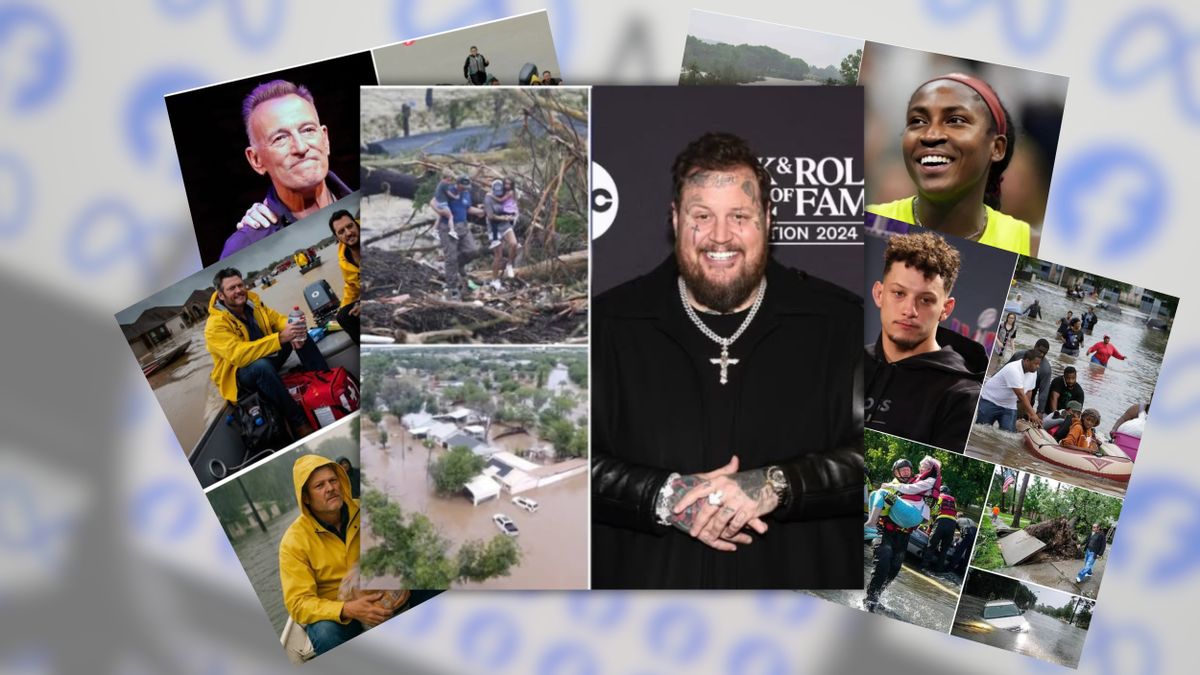
The Facebook posts claimed celebrities were donating money or taking part in rescue efforts, ranging from fictional stories about tech billionaire Elon Musk donating $7 million to Led Zeppelin singer Robert Plant visiting the flood site, for example.
Some posts included photos generated by artificial-intelligence (AI) software, and, based on their comments and popularity, many readers mistook the anecdotes as real.
Snopes analyzed 15 such stories, all of which were the subject of individual fact checks in the past. By looking at Facebook data and other evidence, we traced the majority of them to Facebook pages and websites based outside of the U.S.
With links in their captions or comments, the posts intended to drive people to websites outside of Facebook, where site administrators sold advertising space for profit. Those websites contained blog articles with more details about the alleged charitable acts by celebrities.
To learn about who profits from the misinformation, we reached out to two ad tech firms — Adhub.media in Singapore and Netlink Online Corporation in Vietnam — that host advertisements on several such websites. The former did not respond to our inquiry and the latter company said it provides advertising to thousands of publishers without always knowing what the sites show.
Meanwhile, we reached out to Meta, Facebook's parent company, to answer for the posts. For years, the company has faced heavy scrutiny for its role in amplifying misinformation for profit. In January 2025, Meta announced an end to its fact-checking program designed to help users identify misleading posts.
Asked about those accounts and the false stories that they had posted, a Meta spokesperson said, "We removed the groups and restricted the accounts behind them for violating our account integrity policies," in reference to a set of rules governing the platform's content. According to Meta's community standards, users are prohibited from posting "content that is designed to deceive, mislead, or overwhelm users in order to artificially increase viewership."
It was true that, as of this writing, all 15 Facebook posts had been removed. However, some pages, such as Forward Vision (which falsely claimed U.S. Rep. Jasmine Crockett donated $25 million to victims of the Texas floods) and Clapton's Guitar Legends (which falsely claimed musician Eric Clapton paid funeral expenses for those who had died), remained active.
In short, while the sensational Facebook posts exploited an American tragedy and the likeness of various celebrities for views and clicks, there were many unknowns about the forces behind them
FB posts used a repeated formula
Each of the 15 posts we examined followed a nearly identical template: images that seemed to show specific celebrities donating money or providing aid to flood victims, paired with emotionally charged captions designed to encourage engagement.
Many of these posts featured images generated using AI, as evidenced by their unnaturally smooth textures and impossible physical details. For example, a post about MSNBC host Rachel Maddow's alleged contributions included an image with a child appearing to run on the surface of floodwaters covering a street.

Among the posts were claims that musician Bruce Springsteen paid for funerals of flood victims and that Kansas City Chiefs quarterback Patrick Mahomes donated $1.5 million to help survivors and rented apartments for homeless families.
Snopes separately debunked each of the 15 posts, as displayed below. (In some cases, multiple rumors about the same celebrities circulated via multiple Facebook posts, and, for this investigation, we examined the first post mentioned in the fact checks.)
Toddler girl lost in Texas floods rescued by 'guardian angel' dog? - 3 missing girls found alive in hollow tree 10 days after Texas floods?
- Texas floods: Myriad of misleading claims besiege Tom Brady in aftermath
- Musk donated $7M to help Texas flood victims?
- Led Zeppelin singer Robert Plant visited Texas to build shelters for flood victims?
- Did Jelly Roll donate $50 million or travel to Texas to help flood victims?
- Caitlin Clark offered to pay Texas flood victims' funeral expenses?
- Slew of misleading claims surrounds Rachel Maddow in Texas floods aftermath
- Checking claim Bruce Springsteen paid for funerals of Texas flood victims
- Did Coco Gauff donate $3M to support Texas flood search efforts?
- Don't be fooled by claims Blake Shelton, Luke Bryan or Gwen Stefani went to Texas to help flood relief efforts
- Did Patrick Mahomes donate $1.5M to Texas flood victims?
- Story of Eric Clapton paying funeral expenses of Texas flood victims doesn't hold water
- Did Jasmine Crockett donate $25M to Texas flooding victims and aid efforts?
- Investigating claim George Strait donated $3.5M to Texas flooding victims
The pages that published the posts used names resembling sanctioned fan accounts — such as The Music Fandom (archived) and NFL Legend.
Despite being false, the posts drew massive engagement. Collectively, users reacted more than 1.22 million times, left over 133,000 comments — many thanking the celebrities for their supposed generosity — and shared the posts more than 167,000 times. In total, the 15 Facebook posts had a combined reach of almost 3 million users.
The fake stories about celebrities helping victims of the Texas floods are just a small sample of a misinformation trend sometimes referred to as "AI slop."
In recent years, Snopes has seen a wave of Facebook pages posting similar fake stories about celebrities supposedly making donations or performing acts of kindness, oftentimes with AI-generated elements. Some stories incorporate elements from real news events — like natural disasters or tragedies — while others are entirely fabricated scenarios.
About the FB pages, websites spreading the misinfo
According to Facebook data, the majority of administrators behind the accounts that published the 15 posts were based in Vietnam and other countries in Southeast Asia.
A look at Facebook's "Page transparency" feature revealed a mixture of locations for the users managing the pages. Nine of the 15 pages listed Vietnam as their primary base, while six listed the United States, often in combination with Vietnam. Other countries included Pakistan, the Philippines, Myanmar, Germany, Russia, India and Spain.

(Dusty Roads Radio/Facebook)
Under the Facebook post's captions, authors pinned comments linking to the external websites. These websites, which lacked credible author information, company details and legal disclosures, hosted blog articles that claimed to tell the alleged "full story."

(Vibe Station/Facebook)
The domains included:
- Autulu.com
- Celebrity.Cafex.biz
- Celebys.com
- Insightflowmedia.com
- LiveXTop.com (four stories)
- NewsNgay.com
- Pollywebart.com
- TopNewsSource.com
- TodayCNews.com
- Updatenhanh.com (two stories)
- Xemgihomnay247.com
When Snopes attempted to see who was running the sites via WHOIS records, many domains displayed the name "Withheld for Privacy" as the registrars with the address
According to The New York Times, "
Other domains that the Facebook posts linked to used a similar identity shielding service,
Ad tech firms in Southeast Asia seem to be profiting
Using Google AdSense publisher IDs, which are unique identifiers that reveal who makes money from a website's ads, Snopes found that ads on several websites linked in the Facebook posts were connected to Southeast Asian ad tech firms.
Specifically, the companies Adhub.media, based in Singapore, and Netlink Online Corporation, based in Vietnam, hosted advertisement space on several such sites, according to the Google AdSense data.
According to records hosted by well-known.dev, a research tool that uses specific files standard to the digital advertising industry to track relationships between ad companies and websites, Adhub.media controlled two advertising accounts associated with several domains promoting the fabricated stories about celebrities and the Texas floods.
Adhub.media manages the Google AdSense ID 7472198107183412 under the corporate name ADHUB MEDIA PTE. LTD., as well as 2388584177550957 — an ID registered to an individual with a Vietnamese name. Combined, the owners used these two accounts across nearly 600 websites, with some listings possibly being duplicates.

(Adhub.Media/LinkedIn)
According to LinkedIn, Adhub.media employs a majority of employees in Vietnam, despite showing the incorporation country as Singapore. Ten employees listed Vietnam as their location, with seven specifically displaying Ho Chi Minh City.
Adhub.media did not reply to Snopes' emailed requests for an interview.
Well-known.dev also provided a link between two in-question websites (NewsNgay.com and Updatenhanh.com) and the Vietnamese ad tech company Netlink Online Corporation. Those blogs displayed the Netlink Google AdSense ID as 9378724246417115. Well-known.dev's records showed the advertising account appeared across more than 17,000 websites.
Netlink Chief Commercial Officer Tony Trinh said via email the company serves thousands of different customers as nothing more than an advertising provider. "We are just a partner of Google supporting Google to place ads for publishers, we do not interfere with the content of publishers' websites, we have thousands of publishers."
He requested more information about the websites displaying the fake stories and offered to investigate Netlink's alleged connection. We fulfilled that request, but he stopped responding to Snopes after that.
We will update this story if we receive more information from either company.
How we linked the ad firms to the sites
To identify Netlink and Adhub.media as possible profiters from websites sharing the fake stories, we examined the source code behind the websites' domains.
We found some shared the same Google AdSense publisher ID — suggesting ad revenue was being funneled to, or through, the same operators. In practice, when sites share the same publisher ID, this number works like a shared bank account for ad revenue.
For example, both Updatenhanh.com and NewsNgay.com displayed the AdSense ID 9378724246417115. (Readers can confirm that this publisher ID appears on these websites in a desktop web browser: select "View," "Developer" and then "View Source." Once the source code appears, a simple "find" command to search for the ID number will locate it.)
In another example, four posts by Facebook pages
Other domains used different IDs, pointing to multiple operators being involved.
To identify the ad companies associated with the AdSense IDs, we used well-known.dev — a research tool that tracks advertising relationships across millions of domains. The tool works by scanning two industry transparency files — ads.txt and sellers.json — which are designed to stop fraud and make clear who is authorized to sell ad space.
In practice, ads.txt is where ad publishers list companies allowed to sell
However, there can be a disconnect. Shailley Singh, chief operating officer and executive vice president of product at the Interactive Advertising Bureau Tech Lab, told Snopes the system only works if buyers actually check the files. "The rules aren't broken — the enforcement is," Singh said. "Ads.txt and sellers.json only work if buyers check them. If they don't, bad sites can still make money."
Drawing on the information in these files, well-known.dev reported that the AdSense ID shared by Updatenhanh.com and NewsNgay.com was owned by Netlink Online Corporation, the Vietnam-based ad tech company mentioned above. Similarly, the files from the LiveXTop.com domain listed that site's "owner domain" as Adhub.media, the ad tech company in Singapore.
In sum ...
While we found no evidence of the ad firms in Southeast Asia having a role in what the websites showed, the evidence above creates a link between them, suggesting they profited from the misinformation.
It's unclear how much ad revenue the fictional stories about the Texas floods generated in total.
Senior Reporter Jordan Liles contributed to this story.