
As
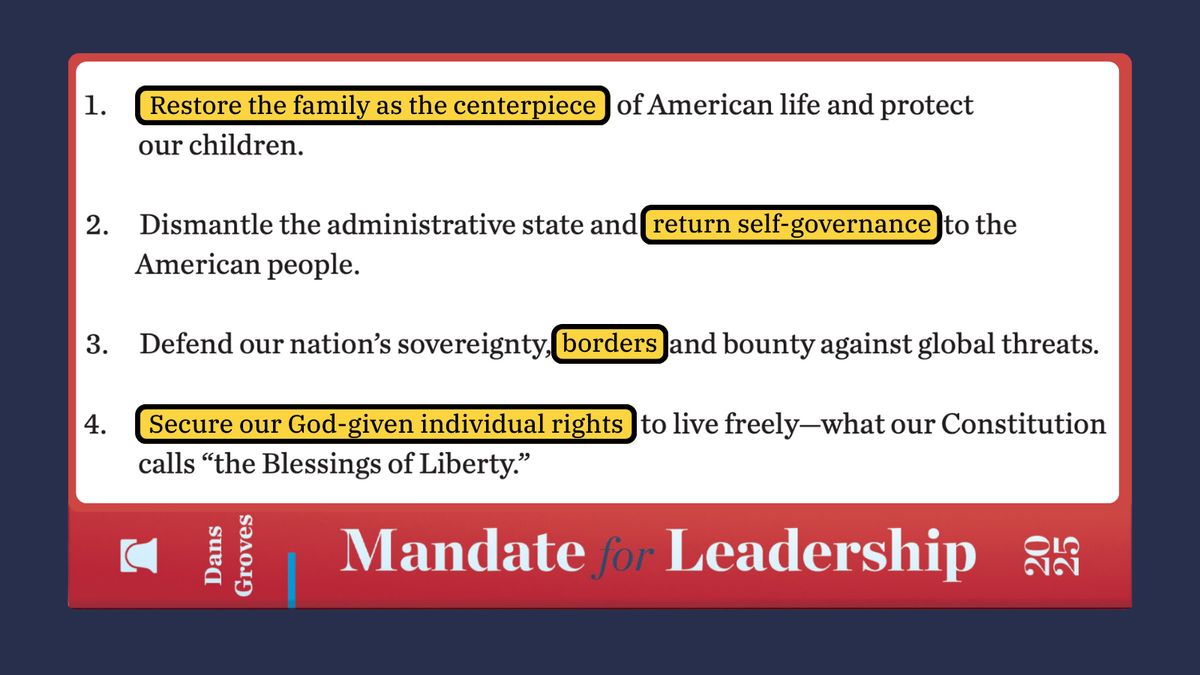
Below, we highlight several proposals in a roughly 1,000-page document at the center of Project 2025 and actions by the Trump administration that align with them, as of December 2025.
- Severing industry ties with
China - Decreasing access to abortions
- Revamping the FBI
- Defunding the Justice Department
- Removing protections against housing discrimination
- Penalizing so-called "sanctuary cities"
- Deprioritizing DACA recipients, temporary work visas
- Cracking down on illegal immigration, crime
- Cutting federal funding for public media
- Halting efforts to monitor online disinformation
- Revamping K-12 education
- Increasing reliance on fossil fuels
- Pulling back on efforts to curb climate change
- Banning trans people in the military
- Changing protections for LGBTQ+ people
- Restructuring the federal workforce
The effort centered on a document of proposals, published in 2023, including recommendations to reclassify federal jobs to give more power to the executive branch and reverse policies issued by former President Joe Biden on immigration, climate, civil rights and more.
Based on news reports by reputable sources, federal records and the Project 2025 document, this report analyzes just a sample of Project 2025 proposals. Snopes selected these issues, in particular, to follow up on Project 2025 reporting during Trump's 2024 presidential campaign and because evidence exists to confirm the presidential administration's work on them, as of December 2025.
Also, some Trump-sponsored measures that mirror Project 2025 recommendations haven't been fully implemented because they face legal challenges or require legislative action.
We reached out to the Trump administration to respond to our findings about how its agenda aligns with Project 2025. We will update this report if we receive a response.
In mid-December 2025, the Heritage Foundation sent an email to members that said it was planning to "work with the Trump administration" to enact its latest set of proposals.
Restructuring the federal workforce
Project 2025 proposed turning up to 50,000 nonpartisan,
To do that, Project 2025 recommended reinstating Schedule F, an executive order to change federal workers' job titles that Trump issued during his first presidential term and Biden later rescinded.
Per the Project 2025 document, the Schedule F order would recategorize career civil servants as at-will employees, giving high-level workers the ability to terminate subordinates' employment for any reason without warning and fill those jobs with new people.
From the beginning of his second presidential term, Trump implemented changes to the federal workforce that mirrored these recommendations by Project 2025.
On Jan. 20, 2025, Trump's first day in the White House, he issued an executive order reinstating Schedule F.
Months later, in April 2025, the White House announced that the
Following in line with Project 2025's goal of shifting power to the executive branch, the Trump administration has also eliminated thousands of jobs by closing or restructuring departments.
In an August 2025 interview with
During
A number of unions sued the Trump administration over those layoff notices and sought to block White House budget director Russ Vought —
Changing protections for LGBTQ+ people
Project 2025 made several recommendations related to gender policies and federal protections for LGBTQ+ people. The Trump administration has followed through with some of them.
For example, Project 2025 called for abolishing a federal department that Biden established to supposedly "advance equity in government policy," dubbed the Gender Policy Council. On the first day of Trump's second presidential term, Trump issued an executive order rescinding the council.
Project 2025 also recommended removing terms such as "sexual orientation" and "gender identity" from records and policies, as well as rescinding policies that prohibit discrimination on the basis of "sexual orientation, gender identity, transgender status, and sex characteristics."
The president carried out those objectives with another executive order on his first day, titled, "Defending women from gender ideology extremism and restoring biological truth to the federal government."
According to that order, all federal departments and policies must refer to sex as an individual's "immutable biological classification as either male or female" and should not consider gender identity a "meaningful basis for identification," nor be "recognized as a replacement for sex."
Banning trans people in the military
Project 2025 called for reinstating a
Pulling back on efforts to curb climate change
Project 2025 called for withdrawing from international efforts attempting to reduce climate change, such as the Paris Agreement, as well as reversing Biden-era policies that aimed to curb the country's carbon emissions.
The Trump administration's actions have aligned with those recommendations. In January 2025,
Trump also ordered to terminate the American Climate Corps, a Biden initiative that attempted to encourage young people to go into jobs that aim to reduce carbon emissions and protect communities against weather disasters.
Increasing reliance on fossil fuels
Also aligning with Project 2025's proposals to increase U.S. production of fossil fuels, Trump declared a "national energy emergency" and ordered federal agencies to facilitate energy production on federal lands.
For example, Trump signed executive orders opening Alaskan federal lands to oil and gas production, thus permitting drilling and mining on a region that federal law
According to court documents, m
Per an analysis by
Revamping K-12 education
Project 2025 proposed that "federal education policy should be limited and, ultimately, the federal Department of Education should be eliminated." Trump's efforts have aligned with that goal.
On March 20, 2025, Trump signed an executive order that intended to shut down the Education Department. A couple of days later, a judge temporarily blocked the order. In July 2025, the Supreme Court ruled that the Trump administration could
Project 2025 also called for bans on so-called "critical race theory" (CRT) and "gender ideology" lessons in public schools, asking for legislation that would require educators who share such material to register as sex offenders and be imprisoned.
The Trump administration has taken steps in line with those objectives around curriculum and has called for legal action against teachers who it claims have inappropriately discussed "gender ideology" in lessons.
A January 2025 executive order called for eliminating federal funding for what it described as "illegal and discriminatory treatment and indoctrination in K-12 schools, including based on gender ideology and discriminatory equity ideology."
Weeks later, in February 2025, the Education Department said it cut $600 million in grant funds to teacher training programs. Per the Education Department, these programs "included inappropriate and unnecessary topics such as Critical Race Theory; Diversity, Equity, and Inclusion (DEI); social justice activism;
Project 2025 also asked the federal government to prioritize "education freedom" and "school choice," the notions that families should be able to select education programs for their children from a range of private, faith-based or charter schools, not just public schools.
In line with that Project 2025 proposal, Trump issued a January 2025 executive order requiring the Education Department to make "education freedom" a priority when deciding how to issue federally funded grants.
Halting efforts to monitor online disinformation
Project 2025 recommended the Cybersecurity and Infrastructure Security Agency (CISA) stop efforts to curtail online propaganda campaigns, arguing the federal government should not make judgment calls on what's true and what isn't. Trump has taken steps in line with that Project 2025 proposal.
Soon after taking office, he signed an
The Trump administration put numerous CISA employees on administrative leave, including employees of the division responsible for securing elections, and nearly one-third of the agency's employees had resigned by April 2025.
Also in April 2025, the administration shut down the State Department's office for monitoring foreign disinformation campaigns known as the Counter Foreign Information Manipulation and Interference hub. The office focused on propaganda by countries such as Russia, China and Iran.
Cutting federal funding for public media
The Project 2025 document accuses the agencies of promoting what it describes as "anti-U.S. talking points" and recommends the USAGM to be "defunded and disestablished."
Trump has targeted the same
For example, in March 2025, he ordered the federal government to cut funding toward USAGM, prompting the VOA to halt broadcasting for the first time in 83
In July 2025, he signed a bill eliminating $9 billion in public broadcasting funding and foreign aid, an action that stopped funding for the Corporation for Public Broadcasting. These actions triggered lawsuits by journalists and press-freedom groups seeking to block the Trump administration's efforts
Cracking down on illegal immigration, crime
Project 2025 urged the federal government to crack down on illegal immigration, and the Trump administration has issued numerous policy changes in line with that goal.
For example, within his first few weeks in office, Trump signed an executive order that expands efforts by federal immigration authorities to detain and remove people living in the U.S. without legal status.
Project 2025 also proposed mobilizing law enforcement to crack down on immigrants with criminal records.
That is happening under the Trump administration. Immigration and Customs Enforcement (ICE) agents have accelerated efforts to detain immigrants with alleged criminal histories, and Trump has signed the Laken Riley Act that expands mandatory detention for immigrants accused of certain crimes.
Deprioritizing DACA recipients, temporary work visas
Project 2025 proposed deprioritizing DACA (Deferred Action for Childhood Arrivals), the federal program that protects undocumented immigrants who were brought to the U.S. as children from deportation.
As of this writing, DACA recipients can renew and keep their status. And while first-time applicants can file requests, the Trump administration is not approving any of those applications. In a court-ordered brief, the administration said it planned to restart adjudicating at least some new DACA applications in the future, per the Los Angeles Times and The Associated Press.
Project 2025 also recommended phasing out temporary work-visa programs that allow immigrants to legally work in the U.S. without full citizenship.
The Trump administration has taken steps to reduce people's access to those types of visas. In September 2025, Trump signed an executive order targeting the H-1B visa program that allows U.S. employers to hire foreign workers in specialized professions by imposing a $100,000 fee on employers seeking such visas for workers who live outside the U.S.
Penalizing so-called 'sanctuary cities'
Officials in those cities say they limit cooperation with federal immigration authorities so residents are not fearful about reporting crimes, or contacting local law enforcement, regardless of their immigration status.
In April 2025, Trump signed an executive order that directed federal agencies to put pressure on these jurisdictions, arguing that they undermine public safety by not cooperating with federal immigration enforcement. A follow-up executive order directed federal agencies to suspend or terminate funding for the cities, among other penalties.
By October 2025, more than two dozen cities
Removing protections against housing discrimination
Specifically, it called for repealing the Biden-era "Affirmatively Furthering Fair Housing" (AFFH) rule, which required some Housing and Urban Development (HUD) funding recipients to identify and address patterns of discrimination.
In January 2025, in anticipation of Trump assuming the presidency, the HUD withdrew that rule, federal records show. Weeks later, in March 2025, the department issued
The Trump administration has also terminated grants for organizations that investigate, or litigate, housing discrimination complaints, according to March 2025 reporting by The Associated Press.
Defunding the Justice Department
Project 2025 called for a "top-to-bottom overhaul" of the Department of Justice (DOJ), arguing the agency has become overly politicized.
The Trump administration has echoed that sentiment and taken steps to restructure the department.
For example, it has reshaped the DOJ's internal structure, reportedly
In January 2025, the department's Civil Rights Division was ordered to
Also, Reuters reported in October 2025 the DOJ
Revamping the FBI
Project 2025 called for revamping the FBI and stopping investigations that are supposedly "unlawful or contrary to the national interest."
Citing FBI data, The Washington Post reported in October 2025 a quarter of FBI agents were assigned to immigration enforcement,
Decreasing access to abortions
Project 2025 advocated for restricting people's access to abortions and for the Centers for Disease Control and Prevention (CDC) to stop promoting abortion procedures as health care.
It also recommended the Food and Drug Administration (FDA) end its approval and promotion of pills that end pregnancies. The document stated "alternative options to abortion, especially adoption, should receive federal and state support."
Soon after taking office, Trump turned several of those recommendations into policy. In January 2025, he signed an executive order to end federal funding for
That same month, Trump issued a
In March 2025, Politico reported the Trump a
By June 2025, the administration rescinded federal guidance that aimed to protect people seeking emergency abortions.
Severing industry ties with China
Project 2025 framed China as an existential adversary and urged "strategic
In January 2025, Trump
The Trump administration also adopted a series of trade measures against China, mirroring Project 2025 proposals.
Between April and August 2025, Trump issued a series of
Project 2025 also recommended outlawing Confucius Institutes, Chinese government-funded language and cultural centers, and urged penalties for universities that take money from the Chinese Communist Party, including loss of accreditation and federal funding eligibility.
Congress under Trump has considered similar proposals. As of this writing, the House of Representatives has passed the "DHS Restrictions on Confucius Institutes and Chinese Entities of Concern Act," a bill that would restrict funding to schools that have relationships with the in-question entities. The legislation pends action in the Senate.