
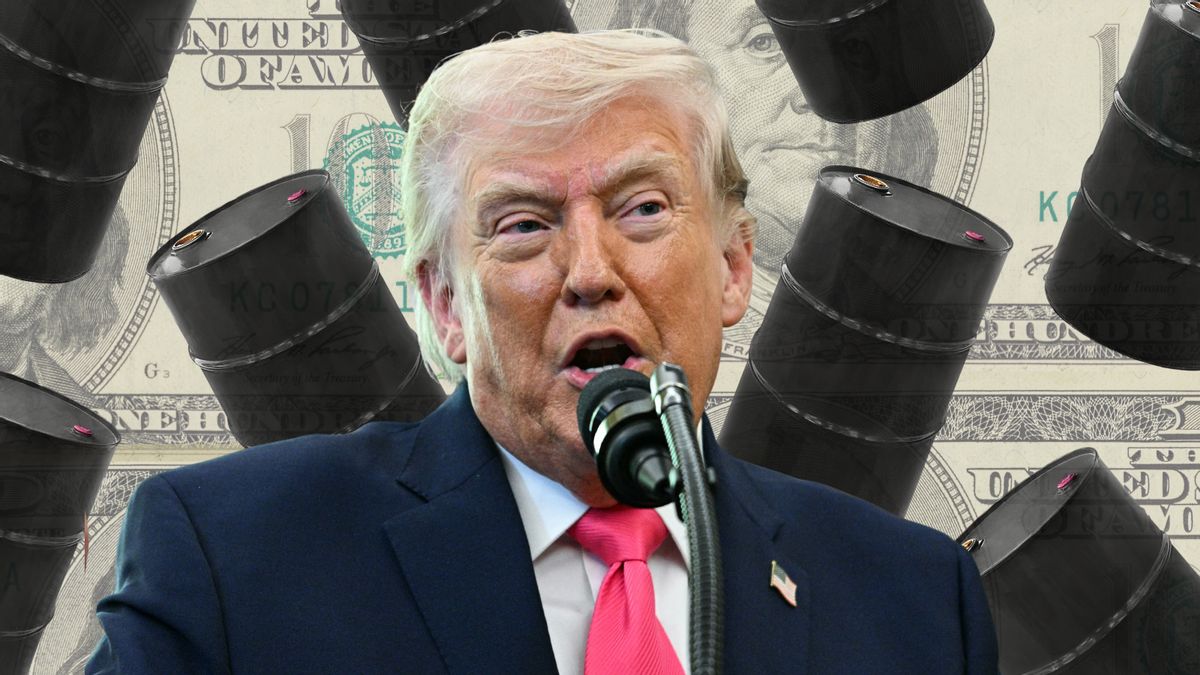
In March 2026, a rumor circulated online that U.S. President Donald Trump would give Iran a $14 billion "handout" for the country's oil.
For example, one X user who shared the claim wrote (archived), "Donald Trump just gave Iran $14 billion for their oil, while fighting a war against them. Defend that MAGA."
Donald Trump just gave Iran $14 billion for their oil, while fighting a war against them.
Defend that MAGA.— Travis Akers 🇺🇸 (@travisakers) March 21, 2026
The rumor also circulated on Instagram (archived), Threads (archived) and Bluesky (archived), while a Facebook page (archived) and a Reddit user (archived) referred to the payment as a "handout."
It is true that, at the time of this writing in late March 2026, the U.S. Treasury has issued a license to temporarily permit the purchase and import of Iranian oil that Secretary of the Treasury Scott Bessent described (archived) on X as "stranded at sea." The value of this estimated amount of oil was more than $15 billion on March 20, when Bessent lifted the sanctions.
It is unclear whether the U.S. would buy any Iranian oil after lifting sanctions on the country's floating reserve, thus directly funding Iran's continued war efforts. Bessent wrote on X that "Iran will have difficulty accessing any revenue generated" from oil sales under the Treasury's license but did not provide additional details on what safeguards the department would put in place to achieve that.
Given the uncertainty about the effects of the Treasury's license and whether the U.S. would directly purchase any of Iran's reserves, we have left this claim unrated.
Snopes contacted the Treasury to ask how it would ensure Iran would have "difficulty" accessing revenue from the sale of its oil reserves. We will update this report if we get a response.
Concerns Treasury license funding Iran war efforts
The Treasury's license temporarily lifted, with some restrictions, long-standing U.S. sanctions on the purchase of Iranian oil. It only applied to Iranian oil that was "loaded on vessels" as of 12:01 a.m. ET on March 20, 2026, and would last through 12:01 a.m. ET on April 19, 2026.
The Brent crude oil price benchmark topped at $112 per barrel on March 20, meaning that if Iran sold 140 million barrels — an estimated figure Bessent provided on X — at that price on that date it would have earned more than $15 billion.
Though the license allowed for direct imports of Iranian oil into the United States, U.S. Ambassador to the United Nations Mike Waltz suggested on March 20 during a CNN Town Hall that it could be the United States' allies in Asia, rather than the U.S. itself, that would buy the floating reserves.
It is unclear how the U.S. would keep Iran's regime from profiting from oil sales to a third country. Snopes has previously reported on how escrow accounts — where a third party opens an account to hold money on behalf of two or more other contracting parties — have previously allowed Iran to make money off energy sales that it can only access for set purposes or under set conditions.
Critics of the Treasury license have argued that the risk of allowing Iran to continue to fund its war efforts outweighs the benefit of accessing the 140 million barrels Bessent estimated were in its floating reserves. An approximation from the U.S. Energy Information Administration, a government agency that provides official energy data and analysis, suggests that 140 million barrels account for slightly less than 1 1/2 days of global consumption.
The Foundation for Defense of Democracies — which Influence Watch, a database founded by conservative think tank Capital Research Center, said usually supported a "confrontational policy" against countries like Iran — wrote on March 21 that the U.S. government must add escrow "safeguards" and reporting requirements to the Treasury license.
United Against Nuclear Iran, a policy organization that campaigns to suppress Iranian nuclear power, wrote on March 21 that previous sanctions waivers for Iran included strict "ringfencing" of money the Islamic Republic made as a result. The organization said the March 2026 waiver "should be understood as operating within the same framework" and be "subject to the same strict principles." Snopes contacted the organization for comment on whether it has further knowledge on the waiver. We await a reply.
Uncertainty over how many barrels Treasury license releases
Bessent estimated on March 20 that the Treasury's license would release 140 million barrels to the world markets. Multiple news media outlets reported a slightly lower figure of 105 million barrels based on investment bank Goldman Sachs' estimation.
Meanwhile, the Iran-based, government-aligned WANA news agency reported that Saman Ghodousi, a spokesperson for the country's Ministry of Oil, wrote on X (archived) that Iran had "essentially no" floating oil reserves.
Before U.S. and Israeli strikes initiated the war in Iran in late February 2026, Reuters, citing shipping data providers Kpler and Vortexa, reported that Iran had up to 170 million barrels in transit (meaning sold to a buyer) or in floating storage (meaning loaded onto a vessel but not in transit towards a buyer.)
At that time, Reuters reported that Iran had increased the number of barrels in its floating reserves due, in part, to concerns about safeguarding its stockpiles from U.S. strikes.
In sum...
At the time of this writing, uncertainty reigns over how much oil the Treasury's license would release onto global markets and what effect this would have on both oil prices and Iran's ability to continue strikes on U.S. and Israeli allies in the Middle East and beyond.
It is unclear whether the U.S. would directly purchase oil from Iran. One United States official suggested that U.S. allies might purchase the oil instead. It is unclear how the United States might ring-fence or safeguard the money Iran might make or to keep it from being used to fund continued warfare.
On March 23, Trump wrote on Truth Social that he instructed the Department of Defense to postpone strikes on Iran for a five-day period while talks between the U.S. and the Islamic Republic continued.
Two days earlier, on March 21, Trump threatened increased strikes on Iranian infrastructure if it did not fully open the Strait of Hormuz, a key shipping lane in the Middle East, within 48 hours. No such strikes appeared imminent despite the strait, through which roughly 25% of the world's seaborne oil transit normally flows, remaining effectively closed to U.S. allies on March 23.