
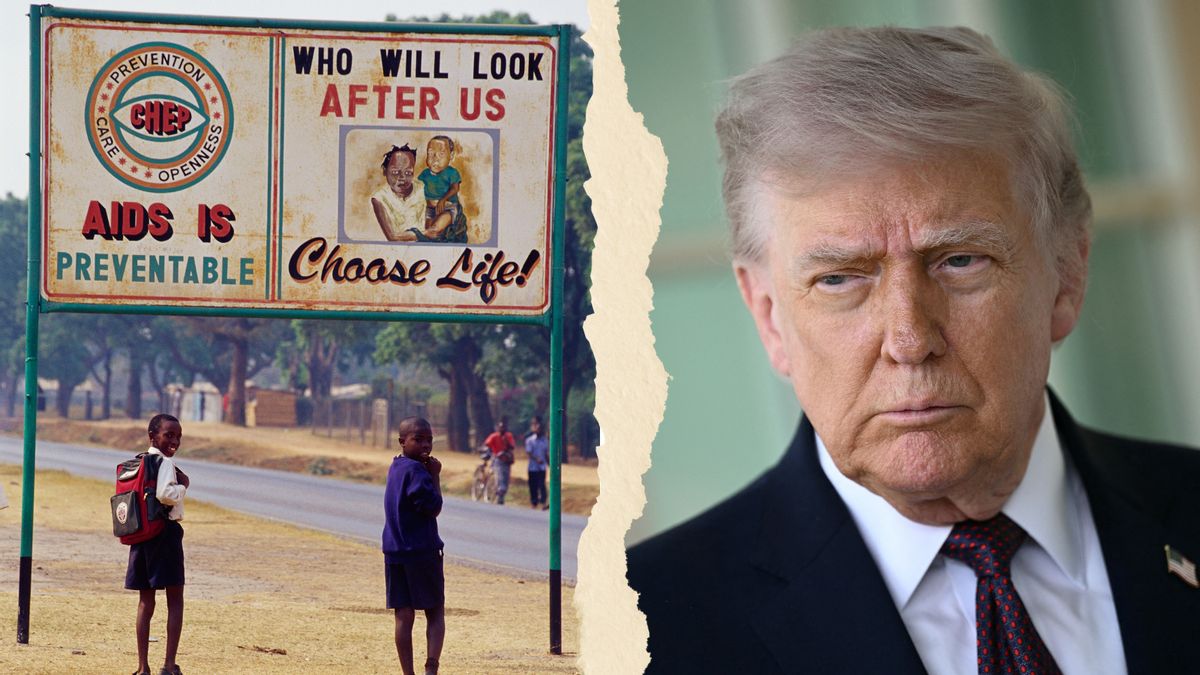
In early 2026, social media users claimed U.S. President Donald Trump's administration issued the African country of Zambia an ultimatum to hand over its mineral rights by April 30 or lose access to HIV and AIDS medications from the United States.
The claim spread on X, Threads and Reddit.
The rumor originated from New York Times reports, which alleged that the U.S. State Department had "tied support for the H.I.V. program" to U.S. access to Zambia's minerals. Per an April 25 New York Times story, the United States gave Zambia until April 30 to sign a deal or lose all U.S. support to their
The Times, Zambia's health department and the State Department did not return inquiries for more information to verify the Times' reporting. (The New York Times has previously told Snopes that it does not share source material).
Given that Snopes requires independent verification of evidence to support our conclusions, we have left the claim unrated.
There's no evidence disproving the Times' report. The Trump administration has a documented history of attempting to block or limit funding to United States' lifesaving global HIV/AIDS program, claiming that the program is rife with waste (see Page 8 of this State Department report). Snopes previously took apart budget director Russell Vought's claim that U.S. HIV/AIDS spending went to cooking and dance events for Haitian male sex workers.
The U.S. HIV/AIDS program's official name is the President's Emergency Plan for AIDS Relief, or PEPFAR. It is a broadly bipartisan program created in 2003 under former President George W. Bush and is credited by the U.S. State Department with saving 26 million lives, primarily in low-income African countries.
NYT reporting
On March 16, 2026, the Times published a story titled, "U.S. Considers Withholding H.I.V. Aid Unless Zambia Expands Minerals Access." The Times said it based its story on a draft State Department memo it obtained, but did not share the draft or where it obtained the memo from.
Here's how the report on Zambia began:
The State Department is considering withholding lifesaving assistance to people with H.I.V. in Zambia as a negotiating tactic to force the government of the southern African country to sign a deal giving the United States more access to its critical minerals.
"We will only secure our priorities by demonstrating willingness to publicly take support away from Zambia on a massive scale," a draft of a memo prepared for Secretary of State Marco Rubio by the department's Africa Bureau staff says. A copy of the memo was obtained by The New York Times.
Some 1.3 million people in Zambia rely on daily H.I.V. treatment that is provided through the decades-old U.S. President's Emergency Plan for AIDS Relief (known as PEPFAR) and on tuberculosis and malaria medications that save tens of thousands of Zambian lives each year. The Trump administration is considering whether to "significantly cut assistance" as soon as May, to increase pressure on Zambia, the memo says.
In a follow-up story published on April 25, the Times provided an in-depth look into the impact of cutting back on HIV/
"The department has warned Zambia that if no agreement is signed by April 30, all U.S. support will end," the story said.
According to the Times, the State Department memo proposed $1 billion of U.S. support to health funding over five years — less than half the amount of U.S. health assistance Zambia received before Trump took office in 2025. In return, Zambia would commit to $340 million of new health spending.
The second part of the proposal reportedly involves giving American businesses more access to "Zambia's vast mineral deposits" to end, by extension, "what the United States sees as China's preferential access to Zambian mines."
The story does not explicitly say which kinds of minerals, but it notes that Zambia is "one of the world's major copper producers, and also has huge reserves of minerals like lithium and cobalt, all of which are key in the green energy transition."
The third part of the proposal is a renegotiation of a contract with the federal Millennium Challenge Corporation, an American foreign assistance agency, to add "regulatory changes in mining and other industries," the Times said.
All three Times stories mentioned above were written by Stephanie Nolen, a global health reporter at the Times who reported both stories from Zambia and has covered the country's
HIV funding abroad under Trump
The Trump administration has a long history of disrupting PEPFAR funding. In January 2025, Snopes confirmed that an executive order signed by Trump
However, amid the Trump administration's dismantling of USAID, which once administered the program, credible reports indicated that PEPFAR funding and services had stalled despite the waiver.
In February 2025, Republican Sen. Bill Cassidy of Louisiana, a doctor, expressed concern that "drugs are still being withheld at clinics in Africa." The United Nations AIDS office found a "seismic impact" of "widespread service gaps" due to PEPFAR cuts and the executive order pause, including "thousands of health workers being retrenched, programs halted, reduced access to HIV prevention" and more.
Nolen and the Times also reported in August 2025 that the Office of Management and Budget, in defiance of a Congressional directive, was refusing to fully fund PEPFAR.
The Times said the administration released $2.9 billion of $6 billion set aside by Congress — equivalent to the Trump administration's initial request for PEPFAR spending in budget year 2026. (In an emailed statement, the budget office's communications director, Rachel Cauley, called the story "riddled with falsehoods.")