
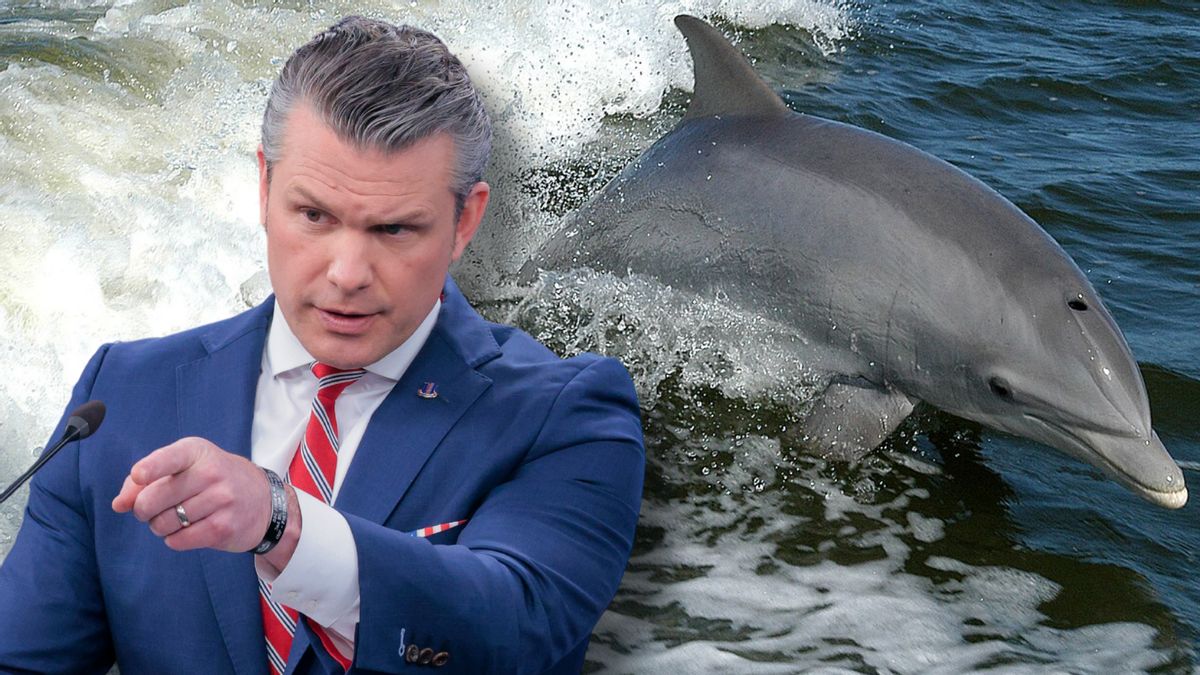
During a news conference in May 2026, a reporter asked Defense Secretary Pete Hegseth and Chairman of the Joint Chiefs of Staff Gen. Dan Caine to confirm reports of the U.S. military using "kamikaze dolphins" during marine combat operations against Iran.
"Kamikaze" refers to the Japanese pilots in World War II who made planned suicidal crashes into enemy targets, particularly ships. Social media users and Snopes readers speculated that the United States was training dolphins to act as kamikazes to attack Iranian ships with explosives. For example, one reader asked us:
Pete Hegsbreath referenced yesterday in a press briefing that the U.S. may be using "exploding dolphins" in this war. Is it true that we have trained dolphins we can control and use against the enemy via explosives? Are we using them in the war?
Hegseth and Caine downplayed the claim in their responses and did not confirm whether the military is using such dolphins in the war. The U.S. Navy does, however, train marine mammals for mine detection, recovery and other purposes through the Naval Information Warfare Center Pacific's Marine Mammal Program.
We contacted the U.S. Navy and the NIWC to learn more about how marine mammals are used in naval operations and whether "kamikaze dolphins" are real. We will update this post accordingly if we learn more. Until seeing evidence that such animals are being used against Iran, it is not possible to rate this claim.
Hegseth asked about 'kamikaze dolphins'
On May 5, a reporter asked Hegseth: "Are there still concerns about mines in the Strait [of Hormuz] and can you kind of clarify these reports of kamikaze dolphins that we've heard about?"
Initially, Caine said: "I haven't heard the kamikaze dolphin thing. It's like sharks with laser beams right?" He then answered a separate question the reporter asked.
Once Kaine finished speaking, Hegseth told reporters: "I can't confirm or deny whether we have kamikaze dolphins. But I can confirm they don't, ultimately [referring to Iran]."
Dolphins and sea lions have been used by Navy
While it has not been possible to confirm the existence of "kamikaze dolphins" in the U.S. Navy, the maritime service branch of the United States Armed Forces does have a research and training facility for marine mammals and uses them for other tasks. Since 1959, the NIWC's Marine Mammal Program has trained bottlenose dolphins and California sea lions to "detect, locate, mark and recover objects in harbors, coastal areas, and at depth in the open sea." According to the NIWC:
Dolphins naturally possess the most sophisticated sonar known to science. Mines and other potentially dangerous objects on the ocean floor that are difficult to detect with electronic sonar, especially in coastal shallows or cluttered harbors, are easily found by the dolphins. Both dolphins and sea lions have excellent low light vision and underwater directional hearing that allow them to detect and track undersea targets, even in dark or murky waters. They can also dive hundreds of feet below the surface, without risk of decompression sickness or "the bends" like human divers. Someday it may be possible to complete these missions with underwater drones, but for now technology is no match for the animals.
Recovering objects in harbors, coastal areas, and at depth in the open sea, sea lions locate and attach recovery lines to Navy equipment on the ocean floor. Dolphins are trained to search for and mark the location of undersea mines that could threaten the safety of those on board military or civilian ships. Both dolphins and sea lions also assist security personnel in detecting and apprehending unauthorized swimmers and divers that might attempt to harm the Navy's people, vessels, or harbor facilities.
Over short distances, they are trained to either swim alongside a small boat or ride in the boat itself. For longer trips, animals can be transported by sea on naval vessels or by air in planes or helicopters.
The U.S. Navy has pushed back on reports that it has trained dolphins to kill enemy divers with nose-mounted guns and explosives. In 1990, former Navy trainers reportedly told The New York Times that at least a dozen dolphins had been killed or injured in training for such combat. The newspaper wrote that a spokesperson for the Naval Ocean Systems Center said, "We use dolphins only for underwater surveillance, object detection, location, marking and recovery. The Navy has said very pointedly that we don't train animals to kill people." The report revealed the Navy had suspended plans to use bottlenose dolphins to guard a nuclear submarine base.
On Sept. 12, 2020, science documentary YouTube account Real Science published a video about dolphins trained by the U.S. Navy.
According to PBS and the U.S. Naval Undersea Museum, bottlenose dolphins and sea lions were trained to do underwater surveillance and guard boats and submarines during the Vietnam War. Additionally, from 1986 to 1988, the U.S. Navy sent dolphins to the Persian Gulf where they reportedly escorted Kuwaiti oil ships through dangerous waters.
For further reading, Snopes has dived into many rumors about dolphins over the years.