
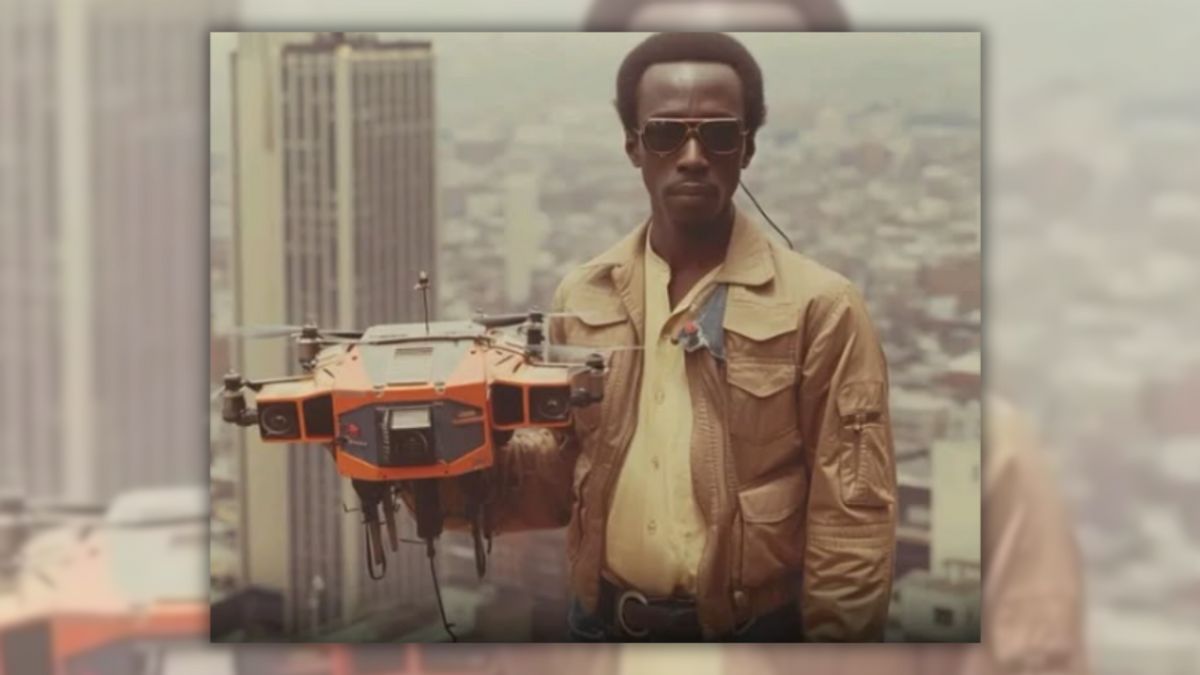
A popular claim circulating on the internet alleges a forgotten Black inventor named Willie "Tech-Man" Jenkins was largely responsible for the creation of modern drone technology.
An Instagram post (archived), for instance, shared the claim along with an image of a man holding what is implied to be a prototype of his "Sky Watcher" drone.
The post read in part, "The city of Los Angeles stands as a testament to the resilience and perseverance of individuals like Willie 'Tech-Man' Jenkins, whose contributions transcended the limitations imposed by society. The city honored Jenkins' legacy not only as a visionary inventor but also as a symbol of hope and inspiration for future generations."
The claim spread widely across social media on platforms such as Threads (archived), Facebook (archived), and LinkedIn (archived), with commenters chiming in equally to celebrate or question the alleged story.
One video, posted to YouTube and Instagram (archived) on Jan. 26, 2025, purported to tell the full story of Jenkins using narration and images, along with a post that read:
In the 1970s, Willie Jenkins grew up in Los Angeles, a young genius captivated by the mechanics of flight. With a humble rooftop workshop as his laboratory, Willie used salvaged parts to build intricate inventions, guided by his dream to create an unmanned flying machine that could change the world.
By the early 1980s, Willie's vision became reality with the Sky Watcher, a groundbreaking drone prototype. Fueled by innovation, he crafted the device with precision — assembling the frame, installing motors and sensors, and perfecting its flight capabilities. Yet, when Willie presented his invention to potential investors, he faced systemic barriers. His designs were dismissed, only to be stolen and mass-produced without acknowledgment [sic]. Willie was left in the shadows, watching the world profit from his ideas.
Decades later, journalist Maya Harris stumbled upon Willie's story. Her investigative work uncovered not only his forgotten legacy but also the profound impact drones now have across industries. From precise assembly lines to quality testing fields, the drones of today are built on the foundation Willie envisioned. Maya's revelations sparked a global conversation, leading to the recognition Willie deserved.
A statue of Willie Jenkins now stands tall in Los Angeles, honoring his resilience and brilliance. Children visit the monument, inspired to explore STEM fields and follow in his footsteps. As drones revolutionize emergency services, filmmaking, and agriculture, Willie's legacy soars — a reminder of the power of innovation and the importance of reclaiming erased histories.
However, Snopes found no evidence of any truth to this claim.
First, the video purporting this claim was constructed by generative artificial intelligence (AI). The video begins and ends with the logo of Visla, an AI video creation tool.
Second, the image purporting to show Jenkins holding a prototype drone is also at least partially AI-generated, with Hive Moderation, an AI detection tool, indicating an 86.2% chance that it contains imagery generated by AI.

(Hive Moderation)
A reverse-image search only revealed more iterations of the same claims beginning in late January 2025.
Further, a simple search revealed that no reputable outlets have ever reported on "Willie Jenkins" or the "Sky Watcher," and the only mentions of the name or his contributions to drone technology were variations on the same AI-generated claim.
A search of newspaper archives in the Los Angeles area from 1977 to the present also yielded no relevant results, nor any mention of a Willie Jenkins being celebrated by the city of Los Angeles or having a statue erected in his honor.
Finally, the journalist referenced in the posts accompanying the AI-generated video appeared to refer to former Vice President Kamala Harris' sister, Maya Harris. The latter is a former senior policy adviser to Hillary Rodham Clinton, a criminal justice reform advocate and an author. Snopes reached out to her for comment on this claim and will update this article should we receive a response.
The history of drones, also known as unmanned aerial vehicles (UAVs), goes back much further than the 1980s. An article in the Fall 2024 issue of Smithsonian's Air & Space Quarterly by aviation journalist Mark Piesing traced their history to the dawn of the 20th century.
He wrote:
In 1898, newspapers heralded the dawn of a new age with the invention of a device that would "render fleets and guns useless." Physical distance was said to "have no effect on its magic results," which could be controlled "with the touch of a switchboard key." On top of that, the device didn't cost much.
The invention that had inspired such glowing reviews was a four-foot-long model of a torpedo boat unveiled by Nikola Tesla — considered by some to be the world's greatest inventor — at a press conference in New York City. When Tesla turned a switch on a small box at the other end of the laboratory he had set up, the boat's propeller began to move, and when he gave the switch another turn, it sent the helm of the boat "sharp over" to starboard.
In truth, other engineers had already been working on the promising concept, pondering the potential battlefield applications of Guglielmo Marconi's 1895 invention of the radio transmitter and receiver. Just one year prior to Tesla's press conference, guns had been remotely fired at an electrical exhibition at Madison Square Garden in Manhattan. One journalist noted the gun firing, mocking Tesla's "extravagant promises and meager performances."
"Despite his reputation as a genius, there was nothing particularly novel about what Tesla was saying," says Iwan Rhys Morus, author of the 2019 book Nikola Tesla and the Electrical Future. "He may have been surfing the wave of the zeitgeist. But he was a very, very good surfer."
While these beginnings were a far cry from UAVs as we know them today, familiar applications for the technology began to emerge after World War I.
According to Piesing:
In the 1930s, British military leaders realized that naval anti-aircraft gunners were having a tough time hitting fast-turning aircraft from a warship that was also maneuvering. The solution was the de Havilland Queen Bee drone. "It's this requirement for anti-aircraft training that really drives the drone industry and establishes it as a viable aerospace niche during the '30s," says Connor …
"Projects like the Queen Bee should get the credit for being the first viable application of drones, which up to that point had been more or less laboratory work," says Connor. Drones had begun to develop the reputation — repeated as a mantra throughout the 20th century — as the workhorses for missions that were too dull, dirty, and dangerous for piloted aircraft.
In sum, while we found no evidence of the Willie Jenkins claim being truthful, Snopes recently investigated claims of a forgotten Black aviator who contributed to aviation history by patenting an airship before the Wright Brothers took their famous first flight.