
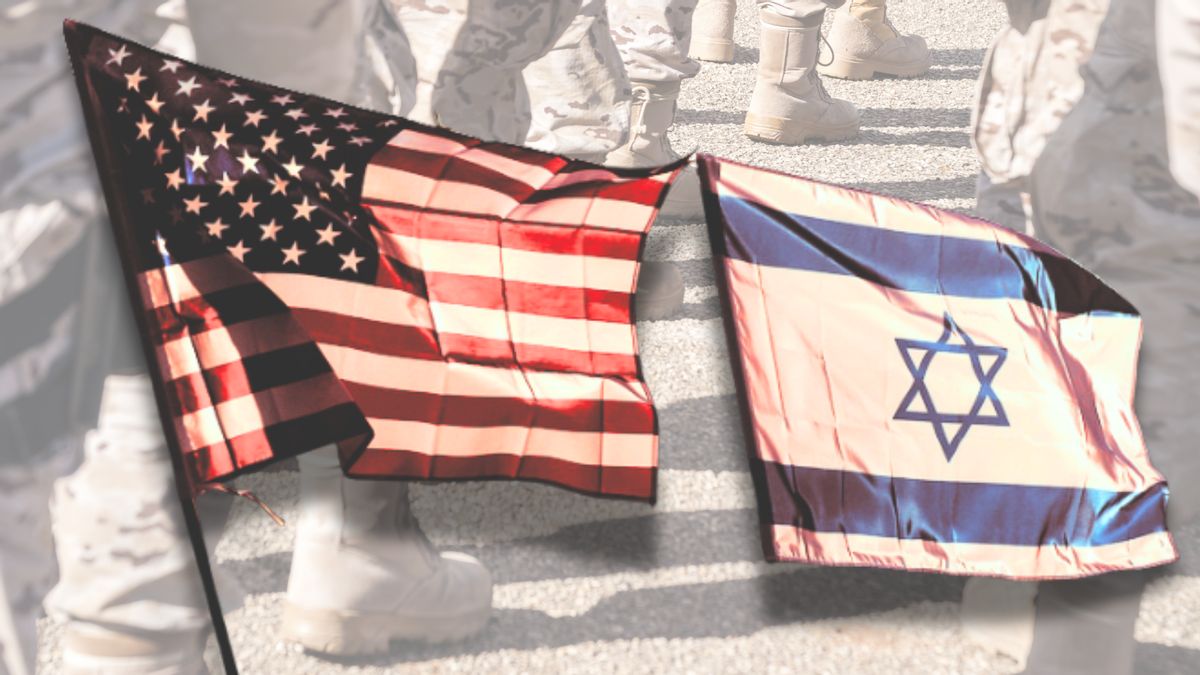
In early June 2026, a claim circulated online that the U.S. Congress was preparing to
The claim stemmed from online foreign policy magazine Responsible Statecraft after it published anwould "all but fuse the two countries' armed forces together."
. He said that if Section 224 "makes it out of committee" he would "offer an amendment to strip it from the bill on the floor" of the House Committee on Armed Services.
Alabama Republican Rep. Mike Rogers and Washington Democratic Rep. Adam Smith introduced the bill on May 13, 2026. As of this writing, it has yet to receive a hearing.
Some posts said the U.S. and Israeli militaries were "integrating," while others said Congress proposed "linking" the two militaries. Although there is no evidence the two militaries would fully merge, Section 224 of the NDAA
On June 4, 2026, Democratic Rep. Ro Khanna of California introduced an amendment to strike Section 224 from the bill, which the committee voted down.
In response, Rogers, chairman of the House Armed Services Committee, said (at 4:39:26): "Section 224 doesn't create any new programs within the Department of Defense; it simply designates a single, senior official to coordinate existing initiatives. Section 224 actually improves oversight and accountability of these programs by designating a single official responsible for them."
The executive agent's responsibilities would include identifying Israeli technology that could be integrated into U.S. systems, promoting joint-training exercises and information-sharing mechanisms and more (PDF pages 43-44).
While this specific executive agent role was not included in previous NDAAs, cooperation with Israel for defense technology development has been. Although the majority of U.S. NDAA content on Israel has involved development of the Iron Dome, Israel's missile defense system, the two governments have coordinated development in other areas.
For example, the 2016 NDAA said the U.S. government would "carry out research, development, test, and evaluation, on a joint basis with Israel, to establish anti-tunnel capabilities to detect, map, and neutralize underground tunnels that threaten the United States or Israel" (PDF Page 355).
Section 224 of the 2026 NDAA, titled, "United States-Israel Defense Technology Cooperation Initiative," begins (PDF Page 9, emphasis ours):
Sec. 224—United States-Israel Defense Technology Cooperation Initiative
This section would require the Secretary of Defense to designate an executive agent responsible for synchronizing cooperative efforts between the United States and Israel, including bilateral defense technology research, development, testing, evaluation, integration, and industrial cooperation.
The cooperative efforts the appointed executive agent would be responsible for then reads as follows (PDF pages 44-45):
(1) Counter-Unmanned Systems including aerial, maritime, and ground platforms.
(2) Anti-tunneling and subterranean threats.
(3) Missile and air defense technologies.
(4) Artificial intelligence, quantum, machine learning, and autonomous systems.
(5) Directed energy and advanced sensing.
(6) Cyber defense, electronic warfare, and digital resilience.
(7) Biotechnology, biomanufacturing, and medical defense.
(8) Network integration, data fusion, and contested logistics.
(9) Defense industrial base cooperation, manufacturing, and co-production.
(10) Other emerging technologies as jointly agreed by the United States and Israel.
The section then outlines coordination with other federal departments, how progress will be updated and how the public will stay informed. The full text of Section 224 reads as follows:
U.S.-Israeli collaboration in air defense technology, combatting tunneling threats, directed energy development (2017 NDAA, PDF Page 541) and more has long been established. There is evidence of U.S.-Israeli collaboration in other areas identified, such as artificial intelligence; for example, joint-government foundation BIRD has funded collaborative research for homeland security purposes since 1977.
Alongside historic, unparalleled U.S. support for Israel, cooperation between the two militaries is not new. American and Israeli soldiers have long trained together, troops have swapped military equipment and technology and the U.S. has spent more than $300 billion on Israel (adjusted for inflation) in bilateral assistance and missile defense funding since Israel's inception in 1948.
.jpg)
While introducing his amendment to strike Section 224 on June 4, Khanna said the section's addition was a strategic request by Israeli Prime Minister Benjamin Netanyahu to a member of Congress given the lack of popular support for aid to Israel.
Khanna pointed to an authentic letter Netanyahu sent to Republican Rep. Marlin Stutzman of Indiana, who introduced a House Resolution a week after they met in Israel that would transition the U.S.-Israel relationship "away from one of traditional foreign assistance towards a new era of mutual cooperation, joint investment, and shared development."
Netanyahu's letter to Stutzman read in full:
While the Israeli and the U.S. militaries have collaborated for decades, Section 224 would formalize and expand these collaborative efforts into a wide array of areas, some of which are vaguely identified, such as "network integration" and "data fusion." As the 2027 NDAA moves out of committee, these items may be more openly debated.
Massie said on May 30 he would move to block Section 224 once it arrives on the House floor.
Snopes has previously reported on Responsible Statecraft, the online magazine that published the headline, "